


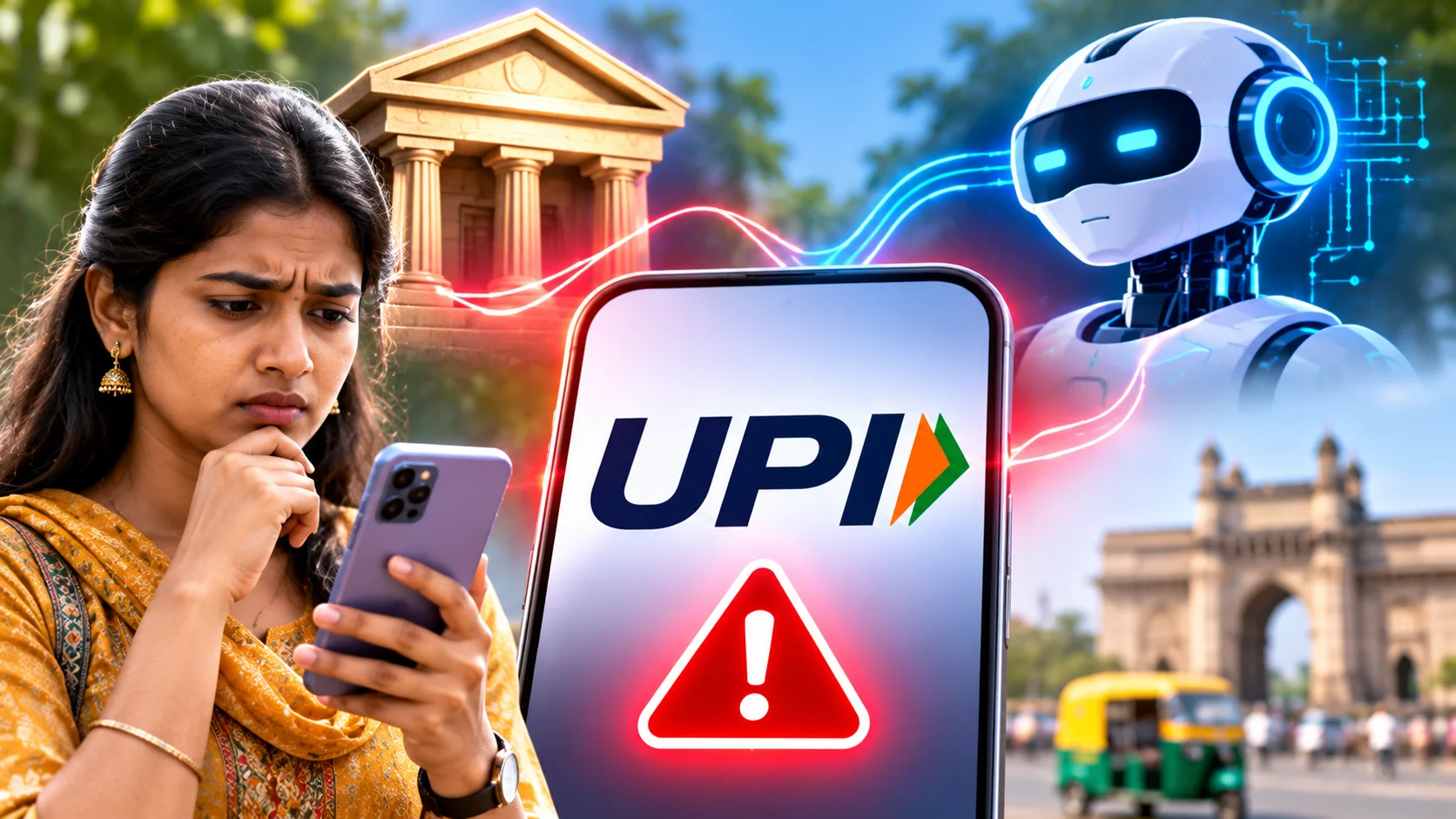
When bank AI goes off-script, Tamil Nadu customers feel it first as a frozen UPI, a silent loan rejection, or a chatbot inventing a rule that never existed. This article covers what The Ken reported on HDFC Bank and Kotak Mahindra Bank, the three real layers of bank AI, and why you should treat the bot like a junior staffer: screenshot, demand a ticket, and get a human.
- Business magazine The Ken put HDFC Bank and Kotak Mahindra Bank on a sharp headline: what happens when bank AI goes rogue.
- TamilTech has not seen internal bank files. We are not inventing war-room scenes, loss figures, or fake spokesperson lines.
- Rogue here is not a movie robot. It is a chatbot, fraud Model, or credit engine that is confidently wrong.
- You feel it as a frozen UPI, a silent loan no, or a bot that invents a rule.
- Treat the bot like a junior staffer. Screenshot. Ask for a ticket number. Get a human.
What just happened?
You know that 11 pm panic. A UPI to the kirana bounced. Salary is still processing. The branch opened five hours ago in another life. So you tap the chat bubble inside the bank app.
The bot is fast. It says your name. It sounds like it has read every circular ever written.
Then it tells you something that does not match your SMS, your passbook, or the charge you saw last month.
That gap — a machine that sounds sure, a ledger that disagrees — is the real story under a lot of Indian banking right now.
Business magazine The Ken recently hung that problem on two large private-sector names: HDFC Bank and Kotak Mahindra Bank. According to that report's framing, these banks are finding out what happens when AI goes rogue.
Look, we are not going to fake a closed-door meeting in BKC. TamilTech has not independently verified internal tickets, vendor contracts, or any exact rupee impact. If a number is not in our notes, it will not appear here as fact.
What is not a secret: big Indian banks have spent years pushing AI into chat, fraud flags, KYC reading, and credit yes/no. When that stack misfires, it does not trend like a Phone launch. It trends like a dead debit card on a Sunday.
Banks will not use the word rogue in a press note. They will say Model update, false positive, learning phase. Your grocery payment does not care about the vocabulary.
How does this actually work?
Forget the sci-fi poster. There is no Server growing a moustache and walking into the vault.
Inside a typical large bank, AI sits in three boring layers. Marketing will mash them into one AI-powered banner. Your app does not.
First, the talker. In-app chat, WhatsApp banking, the voice bot that answers when you call. Newer ones use generative AI — the same broad family as ChatGPT — so they reply in full, polite sentences. Older ones were just flowcharts with a smiley.
The new ones sound human. That is the trap. They can hallucinate. That means they invent a fee waiver, a foreclosure figure, a line that it will reverse tonight, because the Model is trained to finish a sentence, not to open your core banking record.
Second, the judge. Credit underwriting, pre-approved card limits, which overdue account gets a call first, sometimes even who gets a human instead of a bot. This is usually older machine learning, not a chat Model. It chews bureau data, salary credits, how you use UPI.
When it fails, there is no poetry. There is a silent no. Or a limit that shrinks overnight with a bland SMS.
Third, the back-office helper. Reading Aadhaar and PAN images for KYC, sorting fraud queues, drafting mails. This is how staff close more tickets before lunch. It is also how a shortcut — pasting a customer file into a public ChatGPT-style tab — becomes a compliance headache.
We are not accusing HDFC or Kotak of that specific act. We are saying every bank compliance team in the country already loses sleep over it.
Rogue, in engineering, is usually one of four dull failures.
Hallucination: the bot states a rule that is not on the circular.
False positive: the fraud Model treats your standing GPay to the society maintenance account like a mule run.
Drift: how India pays in 2026 does not look like the older training set, so scores go strange.
Human shortcut: someone trusts the Model more than the policy PDF.
You do not need a hacker for any of this. A rushed vendor go-live is enough.
Keep this picture in your head. The AI is not the bank. Your rupees still sit in the old ledger. The Model is a talkative receptionist with a key to the side door.
What changes for people in India?
If you live on UPI — GPay, PhonePe, Paytm, or the UPI tab inside HDFC and Kotak apps — you have already met this stack. Fraud engines are twitchy for a reason. Mule accounts and fake-job, fake-investment calls are not a myth.
That twitch still lands on innocent people. A declined scan at the supermarket. A card that dies mid-cab. An SMS that says the payment was blocked for your safety while you were paying for milk.
HDFC and Kotak customers are not a separate species. Other large banks and the fintech apps sit in the same squeeze. The Ken story, as framed by its headline, just turned the spotlight on two names a lot of us already keep on the home screen.
Credit and cards cut differently. Instant sanction is often an AI score with a human stamp, or sometimes not even the stamp. If the Model does not like a cash-heavy, gig-heavy, joint-family money life, the app will not write you an essay. It will show a colourless decline.
You can still ask for the reason and a human review. Most people just close the screen.
Customer care is the third cut. A human minute costs the bank real INR. The bot is cheaper. Fine, until it loops, or quotes a foreclosure charge that is not in your agreement. Believe the bot blindly, and you have gifted them the argument later.
One more desi detail. Shared phones. OTPs forwarded in the family WhatsApp. A son running a parent's account from his handset. A confused AI plus a shared Phone is how a small mismatch becomes three trips to the branch.
What should you do now?
Do not fling the app into the sea. Do not treat a magazine headline as a buy or sell signal on bank stocks either. This is information, not investment advice.
Use the bot the way you use a junior staffer at the counter. Helpful. Not the manager.
If chat promises a reversal, a waiver, or that money will reflect in two hours, screenshot the full thread. Then ask for a service request or complaint number. No number, no promise.
If a UPI or card freeze hits, do not search random helplines. Open the official app. Use the number printed on the card. Scam callers wait for exactly this moment — a scared person whose card just died.
Never paste an OTP, CVV, PIN, full card number, or net-banking password into a chat window, even if the bot says it needs it to verify. Real bank flows do not work like that.
Read SMS and email alerts the same day, not on salary weekend. AI mistakes unwind faster when they are hours old, not 40 days old.
If the bot and the human both stonewall, the RBI Ombudsman complaint through the CMS portal is still the adult road. Automated or not, the bank owns the outcome. You do not have to win a debate with a Model. You take it up with the institution that switched the Model on.
If you work in a bank or a fintech, do not drop customer KYC into a public ChatGPT tab to write the mail faster. That is how rogue starts as a shortcut, not as a villain.
The simple bit, then. AI is already inside the chat bubble you will open tonight. The banks in that The Ken headline are the names under the light. The homework is the same for anyone with a UPI ID. Trust the ledger. Distrust the confident paragraph. Keep a paper trail.




Comments (0)
Be the first to comment!