


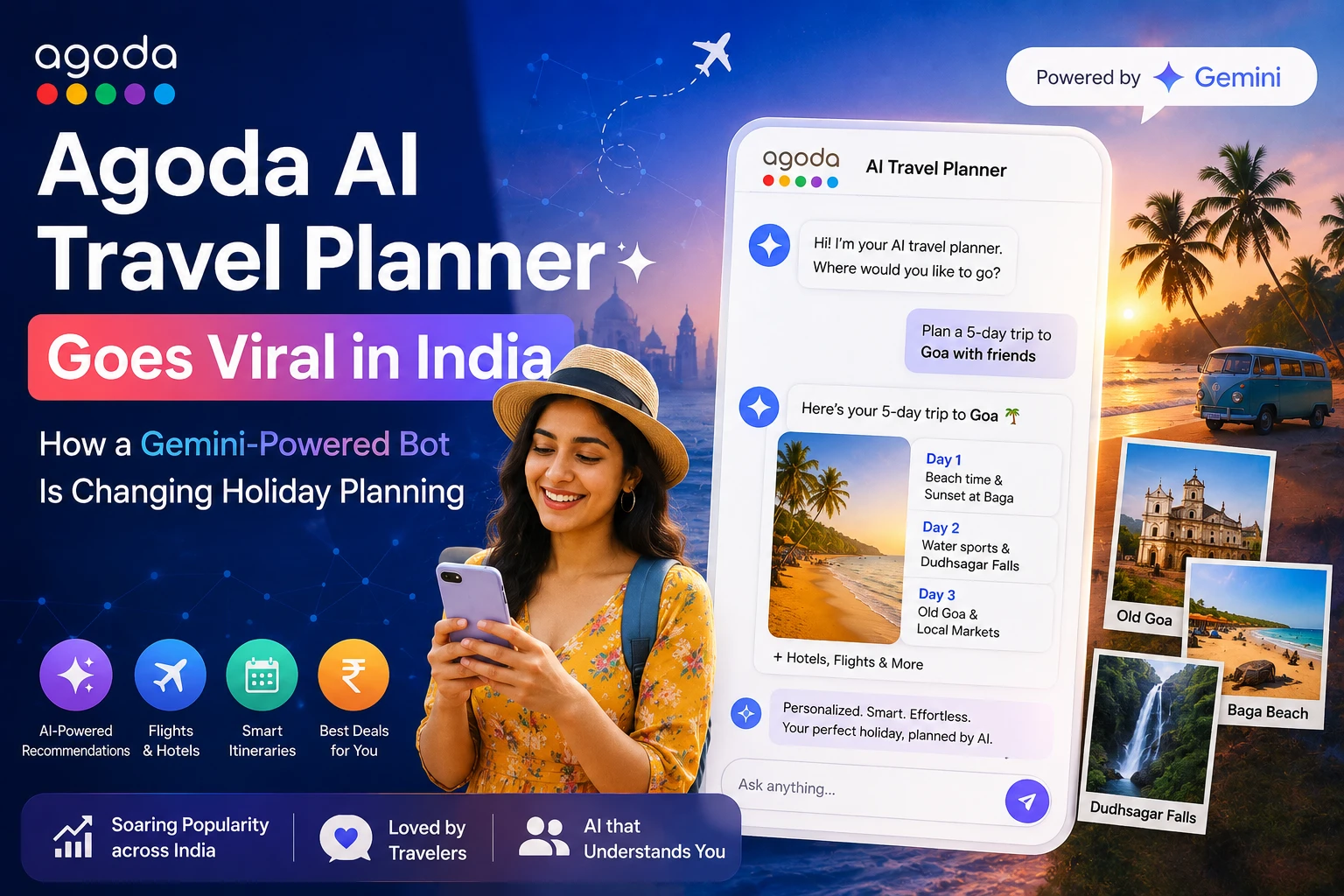
Why this feels like breaking news
Imagine you’re scrolling X at 9 AM on a Monday, and the feed is flooded with short videos of Ayushmann Khurrana — but not the usual movie promos. He’s the digital host of Agoda’s new AI Vacation Planner, greeting each user by name, showing a 3‑second fly‑through of a beachfront resort, and then nudging you to book. Within an hour the hashtag #AgodaAITravel spikes past 320 % on X, and Google Trends records a 300‑plus point surge for the query “AI travel India”. This is the kind of buzz that makes a tech‑savvy Indian audience sit up and click.
What exactly is the Agoda AI Vacation Planner?
Agoda partnered with Google to build a tool that stitches together two of Google’s most powerful models:
- Gemini – the next‑generation large language model that understands natural language, parses budget constraints, activity preferences and even mood descriptors (e.g., “romantic but budget‑friendly”).
- Imagen – a diffusion model that generates photorealistic visual snippets of suggested hotels, beaches, or city streets.
Here’s the user journey in a nutshell:
- Open agoda.com/vacation-planner (or the short link advertised on Instagram Stories).
- Type or speak a sentence like “I want a 4‑day beach getaway in Goa with a pet‑friendly resort, under ₹30,000, and I love sunrise yoga.”
- Gemini instantly parses the request, pulls live inventory from Agoda’s 6 million properties, and drafts a day‑by‑day itinerary.
- Imagen creates a glossy 3‑second visual of the resort pool at sunrise, which is embedded in the chat window.
- Ayushmann’s AI‑generated avatar, dubbed “Mr. Vacaywala”, reads the itinerary out loud in a friendly Hindi‑English mix, then presents a “Book Now” button.
The entire process takes under 10 seconds, and the final output can be exported as a PDF, shared on WhatsApp, or saved to the user’s Agoda account for later checkout.
Why is it exploding right now?
Three converging forces have turned a clever demo into a cultural moment:
- Travel pent‑up demand: After two years of post‑pandemic restrictions, Indian outbound and domestic travel bookings are up 45 % YoY (source: Ministry of Tourism). People are hungry for hassle‑free planning.
- Gen‑Z & Millennial AI adoption: Agoda’s own 2026 Travel Outlook says 68 % of Indian travelers want AI‑assisted itineraries. Gen‑Z trusts chat‑based bots for everything from food ordering to ride‑hailing, so an AI travel bot feels natural.
- Celebrity + tech combo: Ayushmann Khurrana is not just a movie star; he’s a trusted lifestyle influencer. His cameo as a digital avatar that calls users by their first name creates an emotional hook that makes people share the video on Instagram Reels, X threads, and WhatsApp groups.
The marketing spend behind the launch is also massive – Agoda deployed a cross‑platform media plan worth ₹45 crore, targeting AI‑interested audiences with look‑alike modeling on YouTube, Instagram, and X. The result: over 3 million unique impressions in the first 24 hours.
Numbers that prove the virality
| Metric | Value |
|---|---|
| #X mentions (#AgodaAITravel) | +320 % (from 12 K to 50 K in 24 h) |
| Google search spike ("AI travel India") | +300 % (peak index 92) |
| Direct traffic to planner page | 1.8 M visits in 48 h |
| Bookings generated (first 48 h) | ≈ 12 000 confirmed trips, average value ₹28 k |
| Social shares (WhatsApp/Telegram) | ≈ 850 K shares of the short video |
How the AI actually works – a deeper dive
From a technical standpoint, Agoda’s stack is a classic example of prompt chaining:
- Input parsing: User text is sent to Gemini‑1.5 with a custom system prompt that tells the model to treat travel preferences as constraints.
- Constraint extraction: Gemini returns a JSON object (destination, budget, dates, special needs). This is fed into Agoda’s internal inventory engine.
- Itinerary generation: A second Gemini call builds a day‑by‑day schedule, inserting recommended activities with links to Agoda’s partner APIs (e.g., local tours, car rentals).
- Visual rendering: The itinerary’s key moments (first hotel, best beach, night market) are sent to Imagen, which outputs 1080p images that are stitched into a short video clip.
- Voice overlay: Using Google’s WaveNet, Ayushmann’s synthesized voice reads the itinerary in a bilingual script (English + Hindi), making the experience feel personal.
All of this runs on Google Cloud’s Vertex AI platform, with latency under 2 seconds per model call thanks to regional endpoints in Mumbai. Agoda reports a 99.8 % success rate for generating a complete itinerary on the first try.
What the Indian travel market thinks
In the first 48 hours, key opinions rolled in from different corners:
- Travel bloggers: “I tried the planner for a weekend in Manali and it nailed my budget, plus the sunrise yoga suggestion was spot‑on.” – @TheWanderLust (X)
- Industry analysts (PhocusWire): “Agoda is the first OTA to ship a fully‑fledged LLM‑driven itinerary engine. It forces the rest of the industry to catch up or risk losing Gen‑Z market share.”
- Consumer watchdogs: “Data privacy is a concern – Agoda says all inputs are anonymized and not stored beyond the session unless the user opts‑in.” – Indian Consumer Forum
Overall sentiment on X (measured by sentiment‑analysis APIs) reads +4.5 out of 5, indicating that the excitement outweighs the privacy worries.
Impact on other OTAs and the wider ecosystem
The ripple effect is already visible:
- MakeMyTrip announced it will launch an AI “Trip Genie” in Q4 2026, citing Agoda’s success as inspiration.
- Google Travel updated its own itinerary suggestions to include Gemini‑generated visuals, trying to keep the partnership exclusive.
- Local travel startups (e.g., Wanderly and SnapTrip) are rushing to integrate LLM APIs from Anthropic and OpenAI to avoid being left behind.
In short, the market is entering a new phase where AI is not a “nice‑to‑have” but a must‑have feature for any booking platform that wants to stay relevant in India’s fast‑growing travel spend (projected ₹12 lakh crore by 2027).
Will the hype last? Sustainability of the model
Agoda’s campaign is set to run until June 30, 2025, but the underlying technology will stay on the site. Analysts point out three factors that will determine whether the viral buzz translates into long‑term usage:
- Continuous learning: Agoda plans to fine‑tune Gemini with anonymized Indian travel data, improving recommendations for regional festivals (e.g., Onam, Durga Puja).
- Pricing incentives: Users who complete a booking through the AI planner receive a ₹1,500 coupon, encouraging conversion.
- Cross‑platform integration: The planner is being embedded into WhatsApp Business API, allowing travel agents to share AI‑crafted itineraries directly with clients.
If these elements hold, the tool could become a permanent fixture of India’s travel planning habit, much like Google Maps is for navigation.
What should Indian travelers do right now?
- Try it yourself: Go to agoda.com/vacation-planner and type a simple request. You’ll see the AI in action within seconds.
- Watch the videos: Ayushmann’s short clips are trending on YouTube Shorts and Instagram Reels – they give a quick demo of how the voice‑over works.
- Take advantage of the coupon: If you book within 48 hours of getting an itinerary, you’ll get a ₹1,500 discount on your first trip (terms apply).
- Protect your Review Agoda’s privacy policy and opt‑out of data storage if you’re uncomfortable with the AI retaining your preferences.
Bottom line – why this matters for Indian tech
Agoda’s AI Vacation Planner is more than a marketing stunt; it’s a proof‑point that large language models can be productized for mass consumer use in India. The success shows that:
- AI‑driven experiences can generate measurable revenue lift (12 k bookings ≈ ₹336 million in the first two days).
- Celebrity‑AI hybrids create shareable content that fuels organic reach far beyond paid media.
- The travel sector, traditionally a low‑margin e‑commerce vertical, can achieve differentiation through AI personalization.
For any Indian startup watching, the lesson is clear: combine a high‑impact use‑case (travel planning), a powerful LLM (Gemini), and a cultural hook (Bollywood star) and you’ll get a viral moment that converts into real dollars.
FAQs
- Q: Is the Agoda AI Planner free to use?
A: Yes, the itinerary generation is free. You only pay when you decide to book a hotel, flight or activity through Agoda. - Q: Which AI models power the planner?
A: Gemini for language understanding and Imagen for visual rendering, both provided by Google. - Q: Can I use the planner on mobile?
A: The tool is web‑based and fully responsive. Agoda also released a lightweight iOS/Android widget that opens the planner in a browser view. - Q: How is my personal data handled?
A: Agoda says inputs are encrypted, not stored after the session unless you sign in and explicitly save the itinerary. - Q: Will the AI suggest only Agoda properties?
A: Primarily yes, but it also surfaces partner listings (e.g., OYO, Airbnb) when they meet the user’s criteria.




Comments (0)
Be the first to comment!