


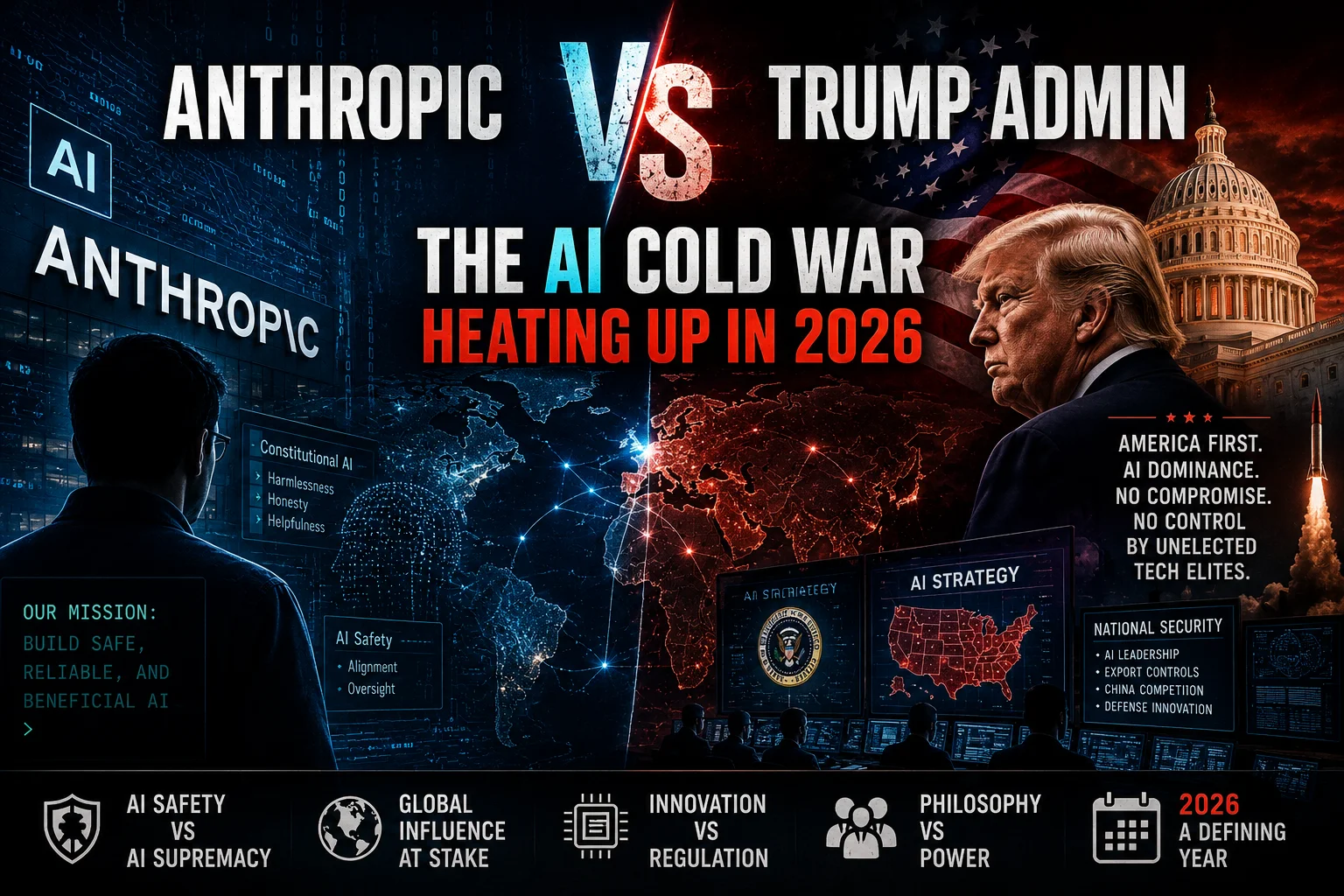
Key Takeaways
- Anthropic is reportedly in a standoff with the Trump administration over non-compliance with a 2026 Cyber Executive Order (EO).
- A high-ranking official stated the company 'screwed us' by failing to share critical vulnerability data as per the national security mandate.
- The friction stems from Anthropic's 'Safety-First' internal policies clashing with the government's 'America First' speed-focused AI agenda.
- Indian startups relying on Claude APIs may face service volatility if federal investigations or sanctions are imposed on Anthropic.
- The core of the dispute involves the refusal to provide 'backdoor' or 'priority access' to AI weights for government red-teaming.
The 2026 AI Political Crisis: What's Happening?
It’s June 2026, and the honeymoon period between Silicon Valley’s AI darlings and Washington D.C. is officially over. For months, we’ve heard whispers about tension behind closed doors, but things just took a turn for the worse. Anthropic, the company we all know for its safety-focused Claude models, is currently at loggerheads with the Trump administration. This isn't just a minor disagreement over taxes or office space; we are talking about a fundamental breakdown in communication that has left government officials fuming. One official went as far as saying Anthropic 'screwed' the administration after failing to honor a specific Cyber Executive Order (EO) that was supposed to bridge the gap between private AI development and national security.
If you've been following the AI space this year, you know that the current administration has been pushing for what they call 'AI Dominance.' They want American companies to move fast, break things, and stay ahead of global rivals at any cost. Anthropic, which was founded on the principles of 'Constitutional AI' and extreme caution, has always been the odd one out in this race. While OpenAI and Google have found ways to play ball with the new federal mandates, Anthropic seems to be digging its heels in. This clash was inevitable, but the scale of the fallout is much bigger than anyone anticipated. It's a classic case of tech idealism meeting the cold, hard reality of 2026 geopolitics.
The Cyber Executive Order That Started It All
To understand why the government is so angry, we have to look at the Cyber EO issued earlier this year. This wasn't just a piece of paper; it was a mandate requiring top-tier AI labs to provide the government with detailed reports on 'model vulnerabilities' and, more controversially, a pathway for federal agencies to conduct independent 'red-teaming' on unreleased models. The administration argues that since AI is now a matter of national defense, the government shouldn't be kept in the dark about what these models can actually do—especially when it comes to cyber-warfare capabilities.
Sources suggest that Anthropic initially agreed to the terms but later backed out or provided 'insufficient data,' citing their commitment to user privacy and corporate autonomy. The 'screwed us' comment from the official likely refers to a specific project where the government expected Anthropic’s help to secure federal networks using Claude's advanced reasoning, only to be met with a 'no' or a heavily redacted version of the tech. In the eyes of the administration, Anthropic took the benefits of being an American company but refused to fulfill its 'patriotic duty' when the chips were down. This has created a massive trust deficit that might take years to repair, if it ever does.
Why Anthropic is Playing Hardball
Now, let’s look at this from Anthropic’s perspective. Since its inception, the company has marketed itself as the 'safe' alternative to the move-fast-and-break-things culture. Their internal structure is literally built to prevent the commercial or political side of the business from overriding safety concerns. If they give the government a 'backdoor' or even 'priority access' to their model weights, they risk compromising the very safety guardrails they spent billions to build. In 2026, the fear isn't just about a rogue AI; it's about a rogue government using AI for surveillance or offensive cyber ops that the creators never intended.
Anthropic's leadership likely feels that if they give in now, they set a precedent that turns every AI lab into a de facto arm of the military. We’ve seen this movie before with encryption in the early 2000s, but with AI, the stakes are exponentially higher. By 'failing to honor' the Cyber EO, Anthropic is essentially saying that their corporate mission of AI alignment is more important than the immediate demands of the current administration. It’s a bold move, maybe even a suicidal one, considering how much power the federal government has over compute resources and regulatory approvals in today's landscape.
The India Impact: Why Should We Care?
You might be wondering, 'This is a US political drama, why does it matter to me in Chennai or Bangalore?' Well, it matters a lot. A huge chunk of Indian SaaS startups and developers have migrated to Claude 3.5 and Claude 4 (released earlier this year) because of their superior coding and reasoning capabilities. If the Trump administration decides to play hardball back—say, by restricting Anthropic’s access to the massive Nvidia H200 clusters they need, or by tying them up in endless litigation—the stability of the Claude API becomes a huge question mark.
In India, we are already seeing a shift where companies are looking for 'sovereign AI' alternatives or moving towards open-source models like Llama 4 to avoid being caught in the crossfire of US internal politics. If Anthropic is labeled as 'uncooperative' by the US government, it could lead to export restrictions or even pressure on allied nations (like India) to reconsider how they integrate these models into public infrastructure. We’ve seen how the US handled TikTok; don't think for a second they won't use similar tactics against an AI company they feel has betrayed them. For Indian developers, the lesson is clear: don't put all your eggs in one proprietary AI basket.
TamilTech’s Honest Take: Is Anthropic Right?
Here is what we think at TamilTech. On one hand, you have to admire Anthropic for standing by their principles. In an era where everyone is chasing government contracts and massive valuations, they are choosing the hard path of safety and independence. But on the other hand, you can't ignore the reality that AI is the new nuclear weapon. No government is going to sit idly by while a private company develops technology that could potentially bring down a power grid or automate a massive cyberattack. The 'screwed us' comment shows just how personal this has become for the officials involved.
We believe we are heading toward a future where AI companies will be forced to pick a side. There will be 'Government-Aligned AI' that gets all the funding and compute, and 'Independent AI' that has to fight for survival. Anthropic is trying to be the latter, but in the 2026 political climate, that might be an impossible dream. If you are a business owner in India using Claude, our advice is to start testing your workflows on Gemini or Llama as a backup. The 'AI Cold War' isn't just between countries anymore; it's between the people who build the tech and the people who want to control it. Buckle up, because the next few months are going to be wild.





Comments (0)
Be the first to comment!