


Key Takeaways
- Apple executives held a high-level emergency meeting in early 2025 to admit that their AI strategy was lagging years behind competitors like OpenAI and Google.
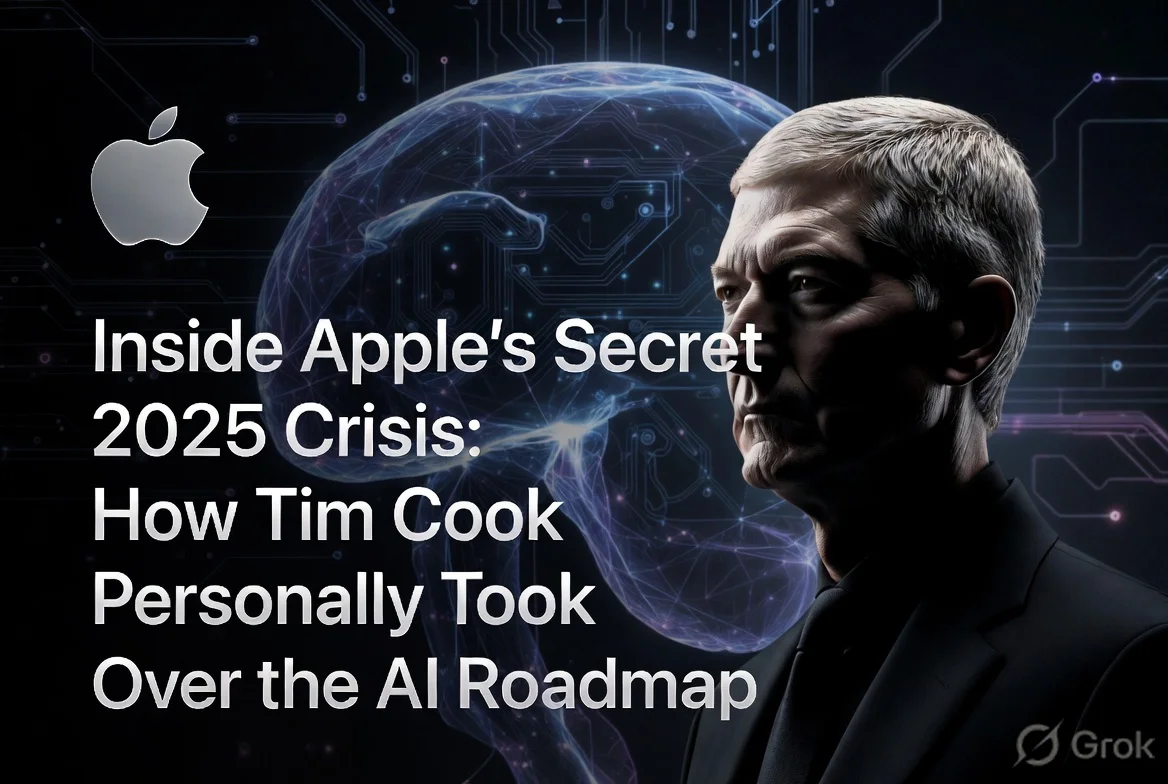
- Tim Cook transitioned from a high-level overseer to a hands-on manager of the AI roadmap, personally reviewing weekly progress on Large Language Models (LLMs).
- The shift led to the 'Apple Intelligence' ecosystem we see today in 2026, prioritizing on-device processing over cloud-heavy alternatives.
- For Indian users, this pivot resulted in significantly better Siri support for regional languages and local context starting with the iPhone 17 series.
- The current 2026 roadmap focuses on 'Private Cloud Compute' to ensure user data never leaves Apple's encrypted servers even for complex AI tasks.
The Moment Apple Realized It Was Behind
It is now mid-2026, and we are finally seeing the full fruits of a massive internal shift that happened at Apple about eighteen months ago. In early 2025, behind the closed doors of Apple Park, a senior executive meeting took place that changed the trajectory of the iPhone forever. For years, Apple had been cautious, almost silent, while ChatGPT and Google Gemini were taking over the world. But during that 2025 meeting, the truth came out: Apple’s leadership admitted that Siri was fundamentally broken compared to the new wave of generative AI. They realized that their 'privacy-first' stance, while noble, had become a technical bottleneck that prevented them from building competitive AI models.
We at TamilTech have been tracking these developments closely. The internal atmosphere at Apple during that time was described as 'controlled panic.' While the public saw a calm Apple, internally, the engineering teams were being pushed to consolidate years of research into months. The admission of failure wasn't just about a voice assistant; it was about the fear that the iPhone would become a 'dumb' device in a world of 'AI-first' hardware. This realization was the catalyst for the aggressive AI features we are currently using in iOS 19 and the latest iPhone models in 2026.
Tim Cook’s Radical Pivot
Perhaps the most surprising detail to emerge from that 2025 period was the change in Tim Cook’s leadership style. Usually known for his operational expertise and supply chain management, Cook took a surprisingly 'intimate' role in the AI roadmap. He began attending technical reviews that were previously handled by VPs. He wasn't just looking at the business side; he was asking deep questions about model latency, token costs, and how Apple’s neural engine could handle on-device LLMs without killing the battery life. This was a massive shift for a CEO who typically delegates technical architecture to his lieutenants.
Cook’s direct involvement meant that AI was no longer just a 'feature'—it became the core of the company. He pushed for the integration of AI into every single app, from Notes to Final Cut Pro. This is why, in 2026, we see such a seamless experience where your iPhone can summarize a 30-minute meeting or edit a video based on a simple text prompt. The 'Cook-led' roadmap prioritized what we now call 'Hybrid AI'—doing as much as possible on the phone and only using the cloud for the heaviest tasks. This was a strategic masterstroke that allowed Apple to maintain its privacy reputation while catching up on performance.
The Technical Debt: Why Siri Stalled
To understand why that 2025 meeting was so critical, you have to look at the mess Siri was in. Siri was built on an old-school architecture of 'intent recognizers' and pre-written scripts. Every time you asked a question, Siri was looking for a specific keyword to trigger a specific response. Meanwhile, ChatGPT was actually 'understanding' the context. Apple’s engineers admitted in 2025 that they couldn't just 'patch' Siri anymore; they had to burn it down and rebuild it using a transformer-based architecture, similar to what powers the modern LLMs we use today.
This transition was incredibly difficult because Apple refused to compromise on user privacy. While Google and Microsoft were happy to process your data on their massive server farms, Apple spent the better part of 2025 developing 'Private Cloud Compute.' This technology, which is now the industry standard in 2026, uses Apple’s own silicon in the cloud to process data in a way that even Apple employees cannot see. It was a massive engineering gamble that cost billions, but it’s the reason why privacy-conscious users in India and around the world still stick with the iPhone despite heavy competition from the Android ecosystem.
India Impact: Localization and Regional AI
For us in India, that 2025 pivot was a game-changer. Before this shift, Siri’s support for Indian languages was mediocre at best. It struggled with accents and had zero understanding of local context like UPI payments or Hinglish/Tamlish phrases. However, because Tim Cook pushed for a more 'integrated' AI roadmap, the localized data teams were given more resources. By the time the iPhone 17 launched late last year, we saw a Siri that could actually understand complex commands in Tamil and Hindi, and even help navigate local apps like Swiggy or Zomato via App Intents.
In 2026, we are seeing the real-world benefits. The AI on your iPhone now understands that when you say 'Gpay pannu,' you are talking about a specific transaction flow. This level of local integration didn't happen by accident; it was a direct result of that 2025 meeting where Apple decided to stop being a 'global generic' brand and start being a 'locally intelligent' companion. For the Indian market, where AI-driven smartphones from brands like Samsung and Xiaomi are very aggressive, this was a necessary survival move for Apple.
TamilTech’s Verdict: Was the Pivot Successful?
Looking at the landscape today in June 2026, we think Apple’s 'panic' in 2025 was the best thing that could have happened to them. They were getting complacent, and the sudden rise of generative AI forced them to innovate at a speed we haven't seen since the original iPhone launch. While they are still playing catch-up in some areas—like real-time video generation where OpenAI’s Sora successors are leading—Apple has won the 'Everyday AI' battle. Their AI is the most reliable, the most private, and the most deeply integrated into the hardware.
If you are using an older iPhone from 2023 or 2024, you are likely feeling the 'AI gap' right now. The hardware from those years simply wasn't designed for the local LLMs that Apple committed to in early 2025. Our advice? If you care about the future of AI on your phone, the 2025 and 2026 models are the true baseline. Apple’s admission of failure wasn't a sign of weakness; it was the start of their biggest comeback. We expect the next few years to be even more intense as Apple moves from 'AI on the phone' to 'AI in the glasses' with the next generation of Vision products.




Comments (0)
Be the first to comment!