


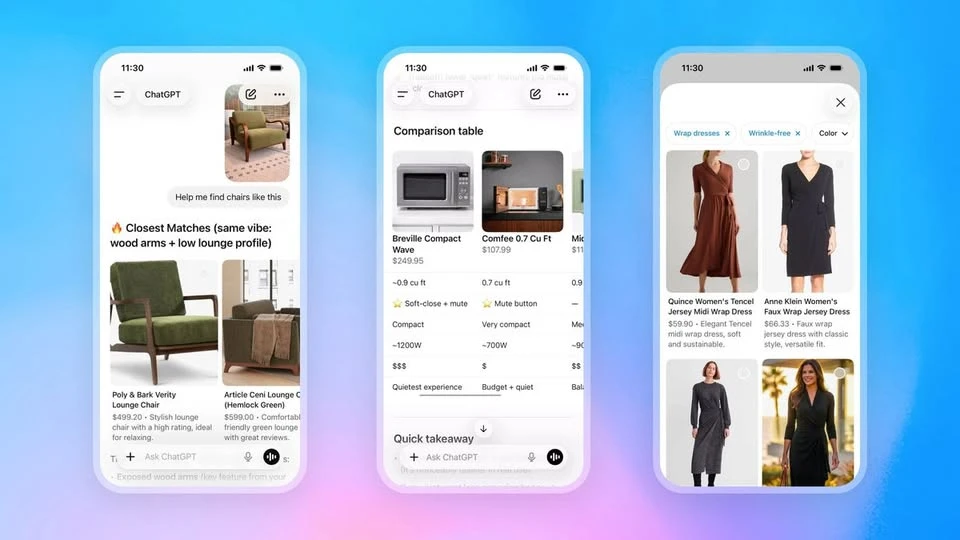
ChatGPT can now help you shop — and it's actually useful this time
OpenAI has been chasing the shopping use case for a while. Last year they launched Instant Checkout — a feature that let you complete purchases directly inside ChatGPT without leaving the app. The idea was bold but the execution was clunky. Retailers didn't love it because it removed their own checkout flows and loyalty programs. Users didn't love it because the product selection was limited. It quietly underperformed.
So OpenAI went back to the drawing board and came out with something more sensible: instead of trying to own the checkout, focus on the part where AI actually adds value — helping you figure out what to buy in the first place.
The new product discovery experience in ChatGPT is rolling out to all users — Free, Go, Plus, and Pro — and it's a meaningful upgrade to how the app handles shopping queries.
What the new shopping experience actually looks like
The core change is that ChatGPT's responses to product queries are now significantly more visual and structured. When you ask something like "I need a laptop under ₹60,000 for video editing" or "find me running shoes for overpronation," you don't just get a text list. You get visual product cards with images, prices, features, and user review summaries — laid out side by side so you can actually compare options at a glance.
The conversational refinement is where it gets genuinely useful. You can follow up naturally: "make it under ₹45,000," "only show me ones available for delivery this week," "what's the best one for someone who travels frequently?" ChatGPT understands these follow-ups in context and refines the results accordingly. This is closer to how you'd discuss a purchase with a knowledgeable friend than how you'd use a search engine.
There's also image-based product search. Upload a photo of something you want to find — a pair of sneakers you saw on Instagram, a lamp you noticed at a friend's place, a piece of clothing from a movie — and ChatGPT will try to surface similar products or exact matches from connected retailers. This is a feature that Pinterest and Google Lens have offered separately; having it in a conversational AI context adds a different dimension because you can immediately follow up with questions about what it finds.
The Agentic Commerce Protocol — what's powering this
The back-end infrastructure making this work is OpenAI's Agentic Commerce Protocol, or ACP. It's a system that lets retailers directly connect their product catalogs, pricing, availability data, and promotions into ChatGPT in real time. This is the key difference from ChatGPT's older shopping responses, which were pulling from general web data that could be outdated or incomplete.
With ACP integrations, when you ask ChatGPT about a product, it's pulling live inventory and pricing data from participating retailers — not scraping a product page from three months ago. The list of retailers who have connected their catalogs through ACP includes major US names like Walmart, Target, Sephora, Nordstrom, Best Buy, The Home Depot, and Wayfair.
Shopify is also building a direct integration through what they're calling Shopify Catalog — this lets merchants on the Shopify platform surface their products in ChatGPT results, with purchases completing through the merchant's own store (via in-app browser or redirect), keeping the merchant's brand experience and payment system intact. This is meaningfully better for small and mid-size retailers than being swallowed into a generic checkout flow.
What this means for Indian shoppers right now
Here's the honest picture for India: the retailer integrations announced — Walmart, Target, Sephora, Best Buy — are primarily US-focused. Indian users won't be seeing Flipkart or Amazon India product cards in ChatGPT yet. The ACP integrations are being rolled out in the US market first.
But that doesn't mean the feature is useless for Indian users right now. A few things are still genuinely valuable:
Conversational product research still works. Even without direct Indian retailer integrations, you can describe what you're looking for in natural language and ChatGPT will surface relevant options, spec comparisons, and guidance. "Best OLED TV under ₹80,000 in India right now" — ChatGPT's web search integration will find current pricing and availability from Indian sites even if it doesn't have a live catalog connection.
Import buying decisions. For electronics, bags, cosmetics, or clothing that you're considering buying from international sites (Amazon.com, iHerb, ASOS), the product discovery features work well since those retailers have better ChatGPT integration.
The research use case is solid. Using ChatGPT to research a category before going to Flipkart or Amazon India to actually buy — understanding which features matter, what to avoid, what the price-to-value sweet spot is — this has always been one of ChatGPT's better use cases and the new structured product cards make it even more useful for that research phase.
The India-specific integrations will come. The Shopify pathway is actually the most relevant near-term vector for Indian merchants, since a significant number of India's D2C brands (clothing, beauty, electronics accessories) run on Shopify. Once Shopify Catalog is live, those brands' products could surface in ChatGPT results globally.
How this compares to Google Shopping and Amazon
The honest comparison: Google Shopping is still better at surfacing current Indian pricing from a wider range of retailers. Amazon's own search is still better for in-depth filtering and purchase completion. ChatGPT's advantage is in the conversational, context-aware guidance that neither Google Shopping nor Amazon's search does well.
Google Shopping shows you results but can't explain why one option is better than another for your specific situation. Amazon search lets you filter by specs but doesn't let you describe a use case and get personalized recommendations. ChatGPT's product discovery sits between those and fills a specific gap: the "I don't know exactly what I want but here's what I need it for" phase of shopping.
Whether that gap is big enough to shift significant shopping behavior is the open question. Indian online shoppers are very habituated to Flipkart and Amazon for discovery and purchase. ChatGPT would need to be dramatically better for a meaningful number of users to change where they start their shopping journey.
TamilTech's take
This is a smart strategic pivot from OpenAI. Trying to own checkout was overly ambitious and failed. Owning the discovery and research phase — helping people decide what to buy before they go buy it — is a more defensible, more AI-suited role.
The feature is genuinely useful for research-heavy purchases: electronics, appliances, travel gear, software, fitness equipment. For quick commodity purchases ("buy me this specific thing"), existing e-commerce is still faster. For nuanced decisions where you need to understand trade-offs and match to your specific situation, ChatGPT's approach adds real value.
For Indian users: use it for research today, even if the direct Indian retailer integration isn't here yet. The conversational research phase — understanding what to look for before you go to Amazon India or Flipkart — is already genuinely useful and the new visual product cards make it better than before.




Comments (0)
Be the first to comment!