


Key Takeaways
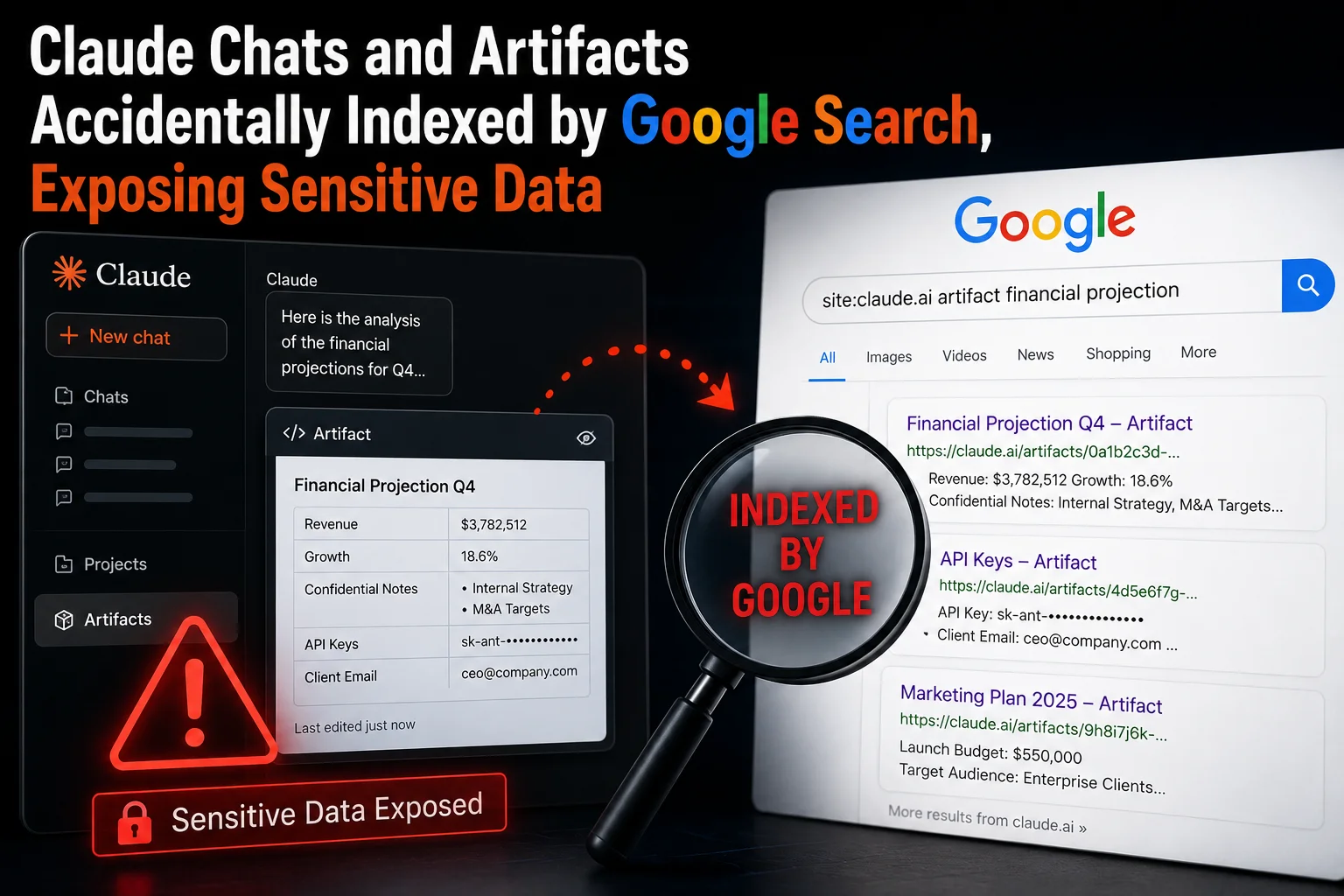
- Claude's shared chat links and Artifacts (code/UI previews) were indexed by Google, making them searchable by anyone.
- Sensitive information like API keys, proprietary code, and personal drafts shared via public links are at risk.
- As of July 2026, thousands of Indian developers and students using Claude for projects may have their work exposed.
- Users should immediately go to Claude.ai settings and delete any old shared links to remove them from public access.
What is Happening with Claude and Google Search?
If you have been using Claude as your primary AI assistant in 2026, you probably love the 'Artifacts' feature. It is incredibly handy for creating quick code snippets, UI designs, or even full documents right inside the chat. But here is the shocker: many of those chats you shared with a quick 'share link' have ended up on Google Search. This means anyone typing the right keywords can stumble upon your private brainstorming sessions, your company's internal code, or even your personal writing drafts. We at TamilTech found that these links, which were supposed to be 'unlisted' but accessible to anyone with the link, were actually crawled by Google’s search bots.
This is not just a minor glitch; it is a significant privacy concern. When you click that share button in Claude, the platform generates a unique URL. The expectation is that only people you give the link to will see it. However, because these pages didn't have the right 'do not index' tags for search engines, Google started treating them like any other public website. Imagine working on a secret startup idea or a sensitive project for your office in Chennai, sharing the link with a colleague, and then finding that same project appearing in Google results for the whole world to see. It is a nightmare scenario for anyone handling confidential data.
Understanding Claude Artifacts and Shared Chats
To understand how this happened, we first need to look at what makes Claude so popular this year. Artifacts are essentially a side-window that opens up to show you a rendered version of what the AI is building—be it a React component, a Python script, or a vector graphic. It made Claude the go-to tool for developers in India over the last year. Shared chats, on the other hand, allow you to package an entire conversation into a link so someone else can learn from the prompts or see the output. It is a great collaboration tool, but the 'public' nature of these links was poorly communicated.
The problem is that once a link is 'out there' on the internet—perhaps you posted it in a public Slack channel, a Discord server, or even a GitHub comment—Google's crawlers find it. Once the crawler hits that URL, it indexes the content. Since Artifacts often contain rich text and code, they are goldmines for search engine indexing. In our testing at TamilTech, we saw that even specific logic for UPI integration or custom Indian tax calculators built by users were showing up in search queries. This shows that the 'security through obscurity' model (hoping no one finds the link) has completely failed here.
The Huge Impact on Indian Users and Developers
Why should you care? Well, if you are a developer in Bengaluru or a student in Coimbatore using Claude to help with your assignments, your code is likely your intellectual property. Many Indian users have been using Claude to debug complex backend logic or write sensitive emails. If you shared a link to get feedback from a mentor or a friend, that link is now potentially a public record. We have seen instances where API keys were accidentally left in code snippets within Artifacts. If Google indexes that, hackers can find those keys using simple search filters, leading to potential financial loss or data breaches.
Furthermore, many Indian startups have integrated AI workflows into their daily operations. If an employee shared a Claude Artifact showing a new product UI or a business strategy, competitors could easily find it. The casual nature of 'sharing a link' has masked the reality that these links are essentially public web pages. In the Indian context, where digital privacy laws are still catching up to AI advancements in 2026, the responsibility falls squarely on the user to manage their own data footprint. This leak serves as a massive wake-up call for everyone who thought 'shared' meant 'private between us'.
How to Secure Your Data Right Now
Don't panic, but do take action. The first thing you need to do is audit your shared links. Anthropic, the company behind Claude, has likely started implementing blocks to stop new links from being indexed, but the old ones might still be in Google's cache. You need to manually intervene to ensure your data is scrubbed. Here is a simple guide on what you should do immediately to protect your privacy.
- Open your browser and log in to your account at Claude.ai.
- Click on your profile icon or name at the bottom left/top right to open the Settings menu.
- Look for a section labeled 'Published Links' or 'Shared Chats'. This is where Claude keeps a list of every single link you have ever generated.
- Review the list. If you see anything that contains sensitive code, personal info, or company data, click the 'Delete' or 'Unpublish' button next to it.
- Once deleted, the URL will stop working immediately, and eventually, Google will remove it from its search index when it tries to crawl the link again and finds a 404 error.
TamilTech's Take: Is AI Privacy an Oxymoron?
At TamilTech, we believe that AI is a powerful tool, but we have always warned our community about the 'cloud' aspect of it. When you put data into an AI, you are essentially handing it over to a third party. This Google indexing issue with Claude is a classic example of how 'convenience' often trumps 'security' in product design. Anthropic wanted to make sharing easy, but they forgot that the open web is a very public place. It is a reminder that you should never, ever put truly sensitive data—like passwords, real bank details, or proprietary trade secrets—into a chat prompt, no matter how 'safe' the company claims to be.
Looking forward, we expect to see more of these 'accidental' leaks as AI becomes more integrated into our browsers and operating systems in late 2026. Companies will get better at privacy, but the bots will also get smarter at finding data. Our advice? Treat every shared link like a public social media post. If you wouldn't post it on X (Twitter) or LinkedIn, don't create a shareable link for it. Stay tech-savvy, stay safe, and always keep an eye on your privacy settings. We will continue to track this and let you know if other AI tools like ChatGPT or Gemini face similar indexing issues.





Comments (0)
Be the first to comment!