


What happened?
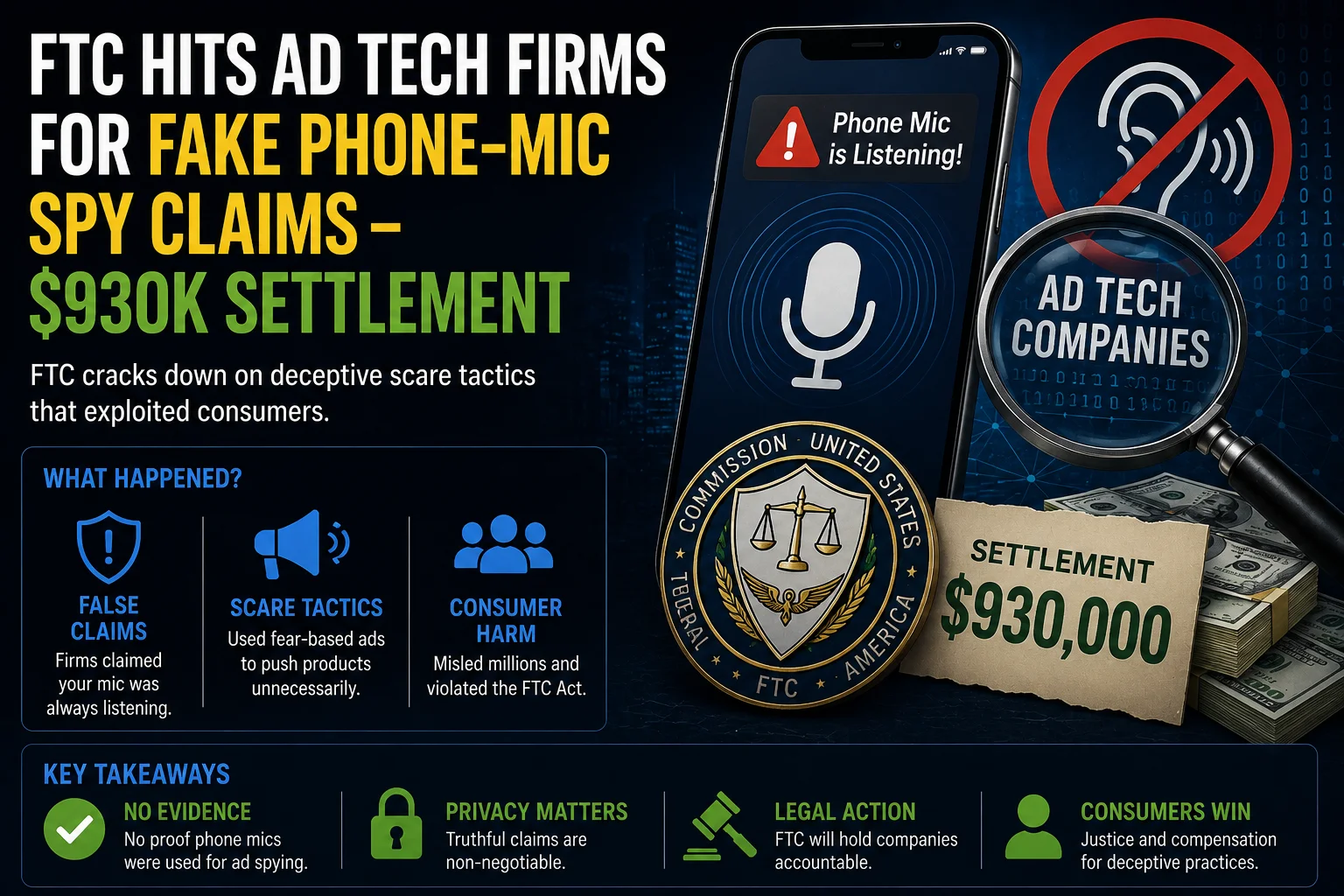
Earlier this week the Federal Trade Commission (FTC) announced that three advertising‑technology firms – Cox Media, MindSift, and 1010 Digital Works – have agreed to pay a combined $930,000 to settle allegations that they falsely told advertisers and publishers they could access a smartphone’s microphone to “listen in” on users and target ads based on what they heard.
In plain Tamil, these companies basically said, “We can hear what you’re saying on your phone and push you the right ad.” The reality? Their technology never actually recorded any audio. The FTC says the claims were nothing more than marketing hype designed to charge premium prices for ad placements.
The numbers
The settlement breaks down like this:
- Cox Media – $600,000
- MindSift – $250,000
- 1010 Digital Works – $80,000
All three firms also agreed to stop making these deceptive statements and to submit to future FTC oversight for three years.
How the claim worked
The companies marketed a feature they called “Audio Targeting” or “Microphone‑Based Ad Targeting.” In their sales decks they claimed a proprietary algorithm could detect background sounds – like a coffee shop chatter, a TV commercial, or a sports game – and instantly serve ads that matched the audio environment.
The pitch was slick: advertisers would get higher conversion rates because the ad would be relevant to what the user was literally hearing at that moment. For publishers, it meant higher CPMs (cost per thousand impressions) because the ad tech claimed it could deliver “hyper‑personalized” experiences.
Why it’s a problem
First, the claim crossed a privacy line. Even the suggestion that a company could listen to your phone’s mic without explicit consent triggers privacy red flags. In the US, the FTC has been cracking down on any ad‑tech that pretends to have invasive data‑collection capabilities without solid proof.
Second, it was outright false. Independent technical reviews and internal FTC investigations found no evidence that any audio was actually captured or processed. The firms were essentially selling a phantom feature.
Impact on Indian users
While the settlement is a US case, the ripple effect reaches India. Many Indian ad‑tech platforms partner with US‑based vendors for data‑enrichment services. If a foreign partner is caught lying about microphone access, Indian advertisers may start demanding more transparency from their own supply‑side partners.
Moreover, Indian privacy regulators, like the Data Protection Board, are watching FTC actions closely. A precedent that the FTC can fine companies for false privacy claims may embolden Indian authorities to act on similar violations here.
What this means for the ad‑tech market
1. Trust will be tighter. Brands will ask for proof‑of‑concept demos, third‑party audits, and clear consent flows before buying any “audio‑based” inventory.
2. Regulators will be more vigilant. The FTC’s move signals a broader shift toward policing deceptive data‑collection claims, not just actual breaches.
3. Innovation may slow down. Companies might become hesitant to experiment with novel data signals (like ambient sound) unless they can back it up with solid technical documentation.
TamilTech’s take
We think this is a classic case of hype over substance. In the Indian ad‑tech ecosystem, we already see a lot of buzzwords – “AI‑driven intent,” “voice‑first targeting,” and now “mic‑based ad serving.” If you can’t prove the tech works, you’re just selling a story.
For Indian marketers, the lesson is simple: demand data sheets, ask for privacy‑by‑design documentation, and never assume a vendor’s claim is legit just because it sounds futuristic.
What should you do next?
- Audit your current ad‑tech stack. Check if any of your partners claim to use microphone data. If they do, ask for a technical walkthrough and proof of user consent.
- Update your privacy policies. Make sure you disclose any audio‑related data collection clearly, even if it’s just a third‑party claim.
- Stay tuned to regulator updates. The FTC is just the start – keep an eye on India’s upcoming data protection rules for similar enforcement actions.
Bottom line: If a company tells you they can listen to your phone’s mic to serve you an ad, it’s probably a marketing gimmick. Don’t let the hype drive your ad spend.





Comments (0)
Be the first to comment!