


What happened?
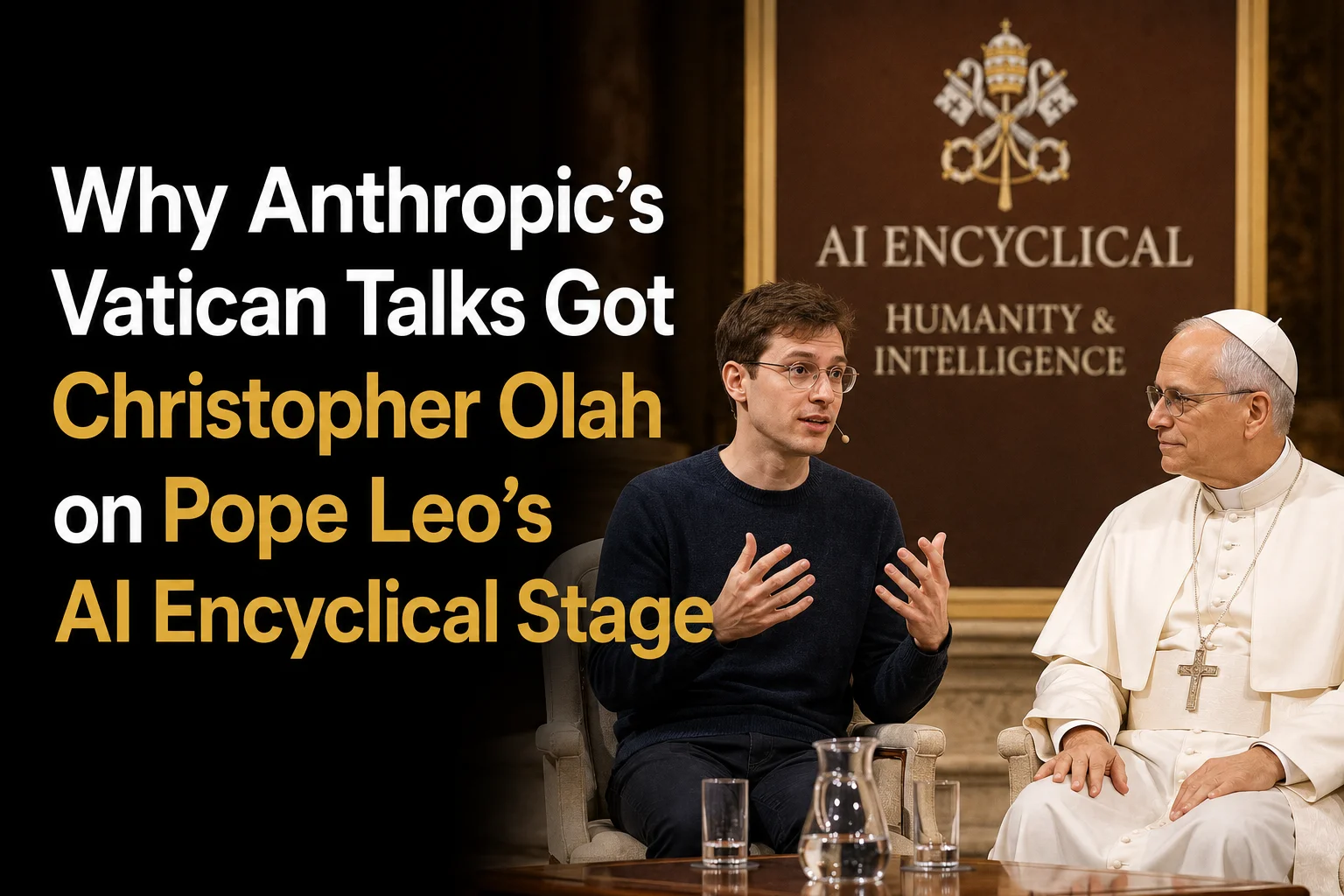
Last week Pope Leo III released an unprecedented encyclical on artificial intelligence. In a surprise move, the Vatican invited Christopher Olah – a former OpenAI scientist now leading research at Anthropic – to give a short talk right after the Pope’s address.
Why does a Catholic leader need a Silicon Valley researcher on stage? The answer lies in months‑long, behind‑the‑scenes talks between Anthropic and the Holy See, where both sides tried to map out a moral framework for AI that respects human dignity while still fostering innovation.
How the talks got started
Anthropic, the AI startup known for its “Constitutional AI” approach, began a formal dialogue with the Vatican’s Pontifical Academy for Life in early 2023. The goal was simple: get a seat at the table when the Church drafts its first AI‑related teaching.
Anthropic’s leadership – CEO Dario Amodei and head of policy Daniela Russo – argued that the Church’s influence could help shape global AI policy, especially in regions where Catholic teachings still guide public opinion. In return, the Vatican wanted a technical partner that could explain the nuances of large‑language models (LLMs) without the usual hype.
Christopher Olah’s role
Enter Christopher Olah. Known for his work on interpretability and the “AI‑safety” community, Olah left OpenAI in 2022 to join Anthropic’s research team. He’s the guy who broke down transformer attention maps into visual diagrams that even non‑engineers can read.
During the Vatican‑Anthropic meetings, Olah became the technical liaison. He translated the Church’s theological concerns – like the risk of AI‑generated deepfakes being used for blasphemy – into concrete research questions for Anthropic’s engineers.
When Pope Leo announced the encyclical, he specifically asked Olah to give a 5‑minute briefing on what “responsible AI” looks like from a developer’s point of view. The invitation was a first‑of‑its‑kind moment: a tech researcher speaking at a papal event.
What was said on the podium?
Olah’s talk was short but packed. He highlighted three pillars:
- Transparency: AI systems must expose how they reach decisions, especially in high‑stakes domains like healthcare.
- Human‑in‑the‑loop: No autonomous system should replace moral judgement – humans must retain final say.
- Global solidarity: AI benefits should be shared, not hoarded by a few corporations.
He also introduced Anthropic’s “Constitutional AI” – a set of built‑in guardrails that guide the model’s outputs according to a pre‑written set of principles, much like a moral code.
Why Indian readers should care
India is the world’s biggest Catholic population after Brazil, with over 20 million believers. The encyclical will soon influence Indian dioceses, schools, and NGOs that run AI‑driven projects – from language‑learning apps to agricultural advisory bots.
Moreover, Anthropic’s approach aligns with India’s own AI strategy, which stresses “ethical AI for inclusive growth.” If the Vatican backs a model that can be audited, Indian startups could adopt similar frameworks without fearing a clash with local religious sensibilities.
For the average Tamil‑speaking techie, this means:
- More clarity on how AI‑generated content is regulated in education and media.
- Potential new funding streams for AI projects that can demonstrate compliance with both Indian law and Catholic moral teaching.
- Opportunities to collaborate with Anthropic’s open‑source tools that are now being touted as “faith‑friendly.”
TamilTech-ஓட கருத்து
We think this is a watershed moment. It’s not just a PR photo‑op; it’s a concrete step toward a global AI ethic that respects both science and spirituality. In India, where religious values still shape policy, having the Vatican on board could accelerate the adoption of safe‑AI standards.
That said, the real test will be implementation. Will Anthropic’s “Constitutional AI” actually prevent harmful outputs, or will it become another marketing buzzword? And will the Church’s moral guidelines be flexible enough to keep pace with rapid model upgrades?
Only time will tell, but the fact that a tech researcher stood beside Pope Leo is a signal that the conversation is moving from ivory towers to the streets – and that includes our Chennai tech‑hubs and Bangalore labs.
What’s next?
Anthropic has pledged to share its interpretability tools with Vatican‑affiliated research centers. Expect workshops in Mumbai, Delhi, and Kochi later this year, where engineers will learn to audit LLMs against the Church’s ethical checklist.
Meanwhile, Pope Leo’s encyclical is being translated into 30 languages, Tamil included, and will be distributed to Catholic schools across India by the end of Q3 2026.
For Indian developers, the takeaway is simple: start building AI systems that can explain themselves, keep a human in the loop, and think about the broader social impact – because soon, even the Pope will be asking you about it.



Comments (0)
Be the first to comment!