


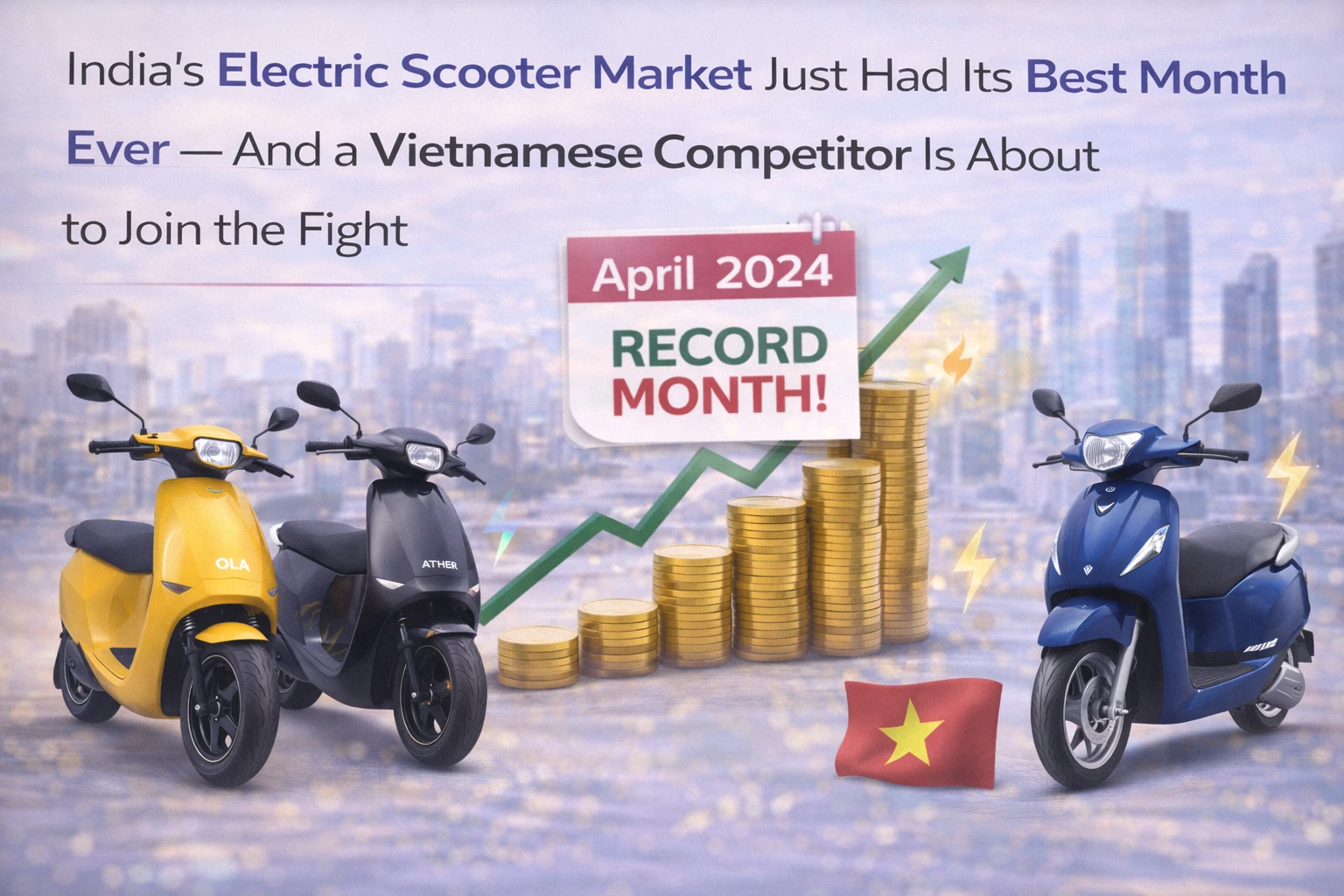
India's electric scooter boom just hit a new record — here's what the numbers actually mean
Electric two-wheeler sales in India crossed 189,000 units in March 2026. That's a 70% jump compared to February. To put that in context: India added nearly 80,000 extra electric scooter buyers in a single month. If that growth rate sounds wild, it's because it is. The electric two-wheeler segment is now unambiguously one of the fastest-growing consumer technology markets in India.
For most Indian households, two-wheelers are not a luxury or a hobby. They're how people get to work, pick up groceries, make deliveries, and navigate cities where traffic makes cars impractical for daily use. When that essential daily vehicle starts going electric — cheaper to run, quieter, lower maintenance — the market isn't just an automotive story. It's an energy transition story playing out in tens of millions of Indian homes simultaneously.
The March 2026 numbers confirm that this transition is accelerating, not slowing down.
Brand-by-brand: who won March 2026 and by how much
TVS Motor came in first with 49,453 units sold in March — a 55% jump over February. TVS has been building its electric scooter lineup methodically, and the iQube series has found genuine traction among urban commuters in Chennai, Bangalore, and Pune. The build quality and service network that TVS has spent decades developing in petrol two-wheelers is translating into trust in the electric segment.
Bajaj Auto was right behind TVS with 46,246 units — an 81% month-on-month surge. Bajaj's Chetak electric scooter has come a long way from its slow initial rollout. The Chetak Premium and Chetak 35 Series have expanded availability across tier-2 cities, and the brand's recognition especially in North and Central India has helped it close the gap with TVS at the top of the market.
Ather Energy held third place at 35,688 units, with 71% month-on-month growth. Ather's 450 series continues to be the premium end of the mainstream market — buyers who want a genuinely smart, connected scooter with a proper app and navigation experience. Ather's fast-charging network in South Indian cities remains the most developed among Indian EV brands, which matters specifically for Tamil Nadu and Karnataka buyers.
Hero MotoCorp's VIDA brand sold 21,434 units with 70% growth — a significant number that reflects Hero's gradual push of the VIDA V2 series beyond its initial metro focus. Hero has the largest petrol two-wheeler service network in India, and as VIDA models become available through that network, the conversion from service walk-ins to EV consideration is a real funnel.
Ola Electric had the most dramatic growth rate of any major brand: 154% month-on-month increase, reaching 10,117 units. That's impressive on a percentage basis, but the absolute number is lower than peers — context matters here. Ola had a rough patch earlier in the year with production and quality issues that suppressed sales. The rebound to 10,117 units suggests the worst of those problems may be behind them, and Ola reclaimed fifth position in the market rankings.
Why did March specifically see this explosion?
Several factors converged in March 2026. Financial year-end (FY26 ended March 31) means dealers push hard to clear inventory and hit targets, creating promotional pricing and attractive finance offers. The festive psychology of year-end purchases applies in B2B fleet buying too — delivery companies, corporate vehicle fleets, and last-mile logistics operators making EV purchases to close their fiscal year commitments. Subsidy programs tied to the fiscal year also created a time-sensitive purchase window for buyers who wanted to capture available incentives.
Rising petrol prices through Q1 2026 also accelerated the economics in favour of EVs for daily commuters. The per-kilometre running cost gap between a petrol scooter and an electric scooter on Jio or Airtel's home charging setup has widened meaningfully. For someone doing 40-50 km a day — a typical daily commute in Chennai or Bangalore — the monthly fuel savings now comfortably offset the higher upfront cost of an electric scooter within 2-3 years.
VinFast is coming — and it's building in Tamil Nadu
Right as India's electric two-wheeler market posts its best-ever month, a new competitor is lining up at the starting line. VinFast, the Vietnamese electric vehicle manufacturer backed by billionaire Pham Nhat Vuong, has confirmed plans to launch three electric scooters in India: the Evo, Feliz II, and Viper. Initial units will arrive as CKD kits — Completely Knocked Down, meaning assembled in India from imported parts — at VinFast's plant in Tamil Nadu, with longer-term localisation planned.
The Tamil Nadu connection is significant. VinFast has committed approximately $500 million (around ₹4,200 crore) to manufacturing infrastructure in the state, covering electric buses and e-scooters. Tamil Nadu's positioning as India's EV manufacturing hub — with existing supplier ecosystems, port infrastructure, and skilled workforce — makes it a natural base. For Tamil Nadu, this represents both jobs and supply chain development in the fast-growing EV space.
The three VinFast scooters cover different market positions. The Evo is a lightweight urban commuter: a 2.25 kW hub motor, two 2.4 kWh battery packs, and a top speed of approximately 70 km/h — suitable for city use. The Feliz II and Viper step up with 14-inch wheels, up to 4.8 kWh battery capacity, and a more capable 3 kW motor on the Viper. All three use LFP (Lithium Iron Phosphate) battery chemistry, which is more thermally stable than the lithium nickel manganese cobalt (NMC) batteries used in many competitors — an important advantage in India's hot climate, particularly in South India during summer months.
VinFast is also exploring battery swapping — a model where riders replace depleted battery packs at swap stations rather than waiting for charging. Bounce Infinity pioneered this in India with limited success, but VinFast's entry suggests renewed interest in the model, especially for delivery workers and urban commuters who need turnaround speed.
How VinFast stacks up against existing Indian brands
The honest assessment: VinFast is entering a competitive market where Indian brands have a significant head start. TVS and Bajaj have decades of service network infrastructure. Ather has a loyal following among tech-oriented buyers. Ola has an aggressive pricing strategy and its own manufacturing scale. Hero has unmatched distribution depth in tier-2 and tier-3 cities.
VinFast's competitive positioning will depend heavily on pricing, which hasn't been announced for India yet. In Vietnam, the Evo is positioned at the budget-to-midrange tier. If VinFast can price the Evo at ₹80,000-95,000 and the Viper under ₹1.2 lakh with competitive warranty and service coverage, it has a real chance. If it comes in above Ather pricing without Ather's product refinement and charging network, it'll struggle.
The LFP battery chemistry is a genuine differentiator in the Indian context — better heat management, longer cycle life, and lower fire risk than some competitors. If VinFast can communicate this effectively to Indian buyers who have heard about EV battery fires in the news, it could carve a niche as the reliability-focused option.
What this means for Indian electric scooter buyers right now
The best time to buy an electric scooter in India is becoming clearer: the market is maturing rapidly, competition is intensifying, and prices are heading down over the next 12-18 months. If you need a scooter now and can afford the current prices, TVS iQube and Ather 450 remain the strongest choices for urban South Indian riders — good products, good service networks, and proven performance.
If you can wait 6-12 months, the arrival of VinFast alongside continued competition between TVS, Bajaj, and Ather will likely push prices down and force further product improvements across the segment. The 189,000-unit March number also signals to every global EV brand watching India that this market is real and growing — expect more international entries over the next two years.
TamilTech's take
The March 2026 electric two-wheeler numbers are the clearest signal yet that India's EV transition at the mass market level is not a government-driven artificial trend but a genuine consumer preference shift. When sales jump 70% month-on-month without a major new product launch, it means the underlying demand is real. VinFast entering this market via Tamil Nadu adds an international dimension to what has been primarily a domestic brand battle. For Tamil Nadu specifically — as both a manufacturing base and a major consumer market — the next 18 months in electric two-wheelers will be more competitive and more consequential than anything the segment has seen before. If you're in the market for an electric scooter, the next year will likely reward waiting. If you need one now, you're buying into a market that's already past the early-adopter risk phase.



Comments (0)
Be the first to comment!