


Key Takeaways
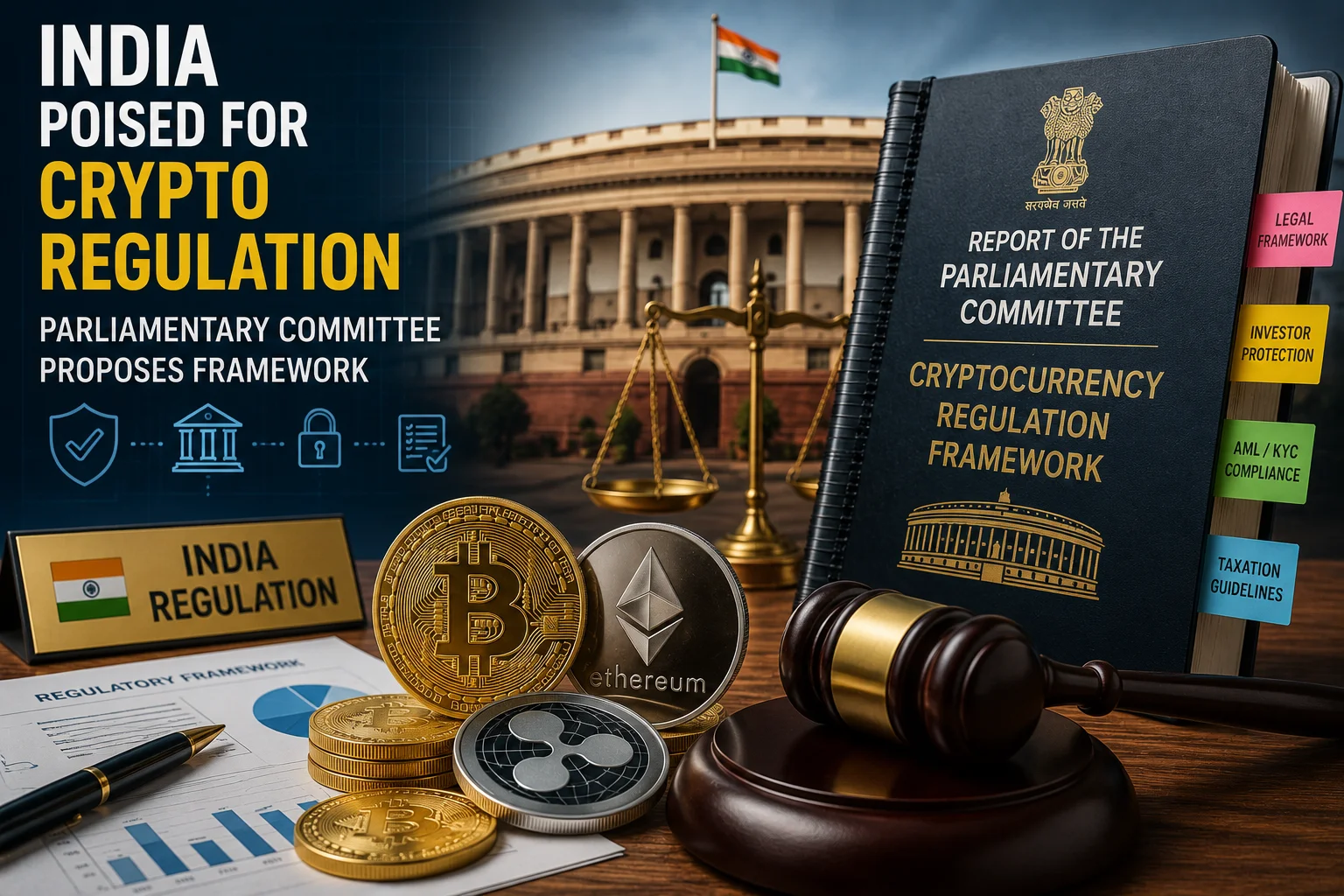
- The Parliamentary Standing Committee on Finance has formally proposed a dedicated regulatory body or expanded SEBI powers to oversee Virtual Digital Assets (VDAs) in India.
- New recommendations focus on mandatory KYC, anti-money laundering (AML) compliance, and strict consumer protection laws for crypto exchange users.
- The report suggests a clear distinction between 'utility tokens' and 'investment assets' to prevent financial instability in the Indian economy.
- For Indian investors, this could finally mean legal recourse in case of exchange hacks or scams, which is currently a major pain point in 2026.
The Long Wait for Crypto Clarity Might Be Over
So, here we are in 2026, and if you have been holding Bitcoin or any other altcoin in India, you know the struggle. For years, we have been paying a hefty 30% tax and 1% TDS without having any actual 'legal' status for our investments. It felt like the government was happy to take the money but didn't want to take responsibility for the safety of the investors. But things are finally moving in a concrete direction. The Parliamentary Standing Committee on Finance has just dropped a major report that calls for a full-fledged regulatory framework for Virtual Digital Assets (VDAs).
This isn't just another 'discussion' or a 'rumor.' This is a formal push from one of the most powerful committees in the Indian Parliament. They have realized that ignoring crypto or just taxing it into oblivion isn't working. With millions of Indians still trading despite the high taxes, the committee thinks it is high time we have a 'referee' on the field to make sure nobody gets cheated. Whether you are a HODLer or a day trader, this news is going to change how you interact with your favorite exchanges like WazirX, CoinDCX, or Binance in the coming months.
How We Got Here: The 2022-2026 Journey
To understand why this is such a big deal, we have to look back at the mess we have been in. Back in 2022, the government introduced the tax laws, which many thought would kill the industry. But Indians are resilient. Even through the bear markets of 2024 and the recent rallies of 2025, the volume of crypto transactions in India has stayed surprisingly high. However, the lack of a regulator meant that when an exchange went down or a scam happened, the police and the courts didn't really have a specific rulebook to follow. It was all very 'grey.'
Currently, in 2026, the global landscape has changed. The US has its ETFs, and Europe has the MiCA (Markets in Crypto-Assets) regulations fully active. India has been watching from the sidelines, trying to balance the RBI's concerns about financial stability with the Ministry of Finance's desire for innovation and tax revenue. This new recommendation from the Finance Committee is the bridge between those two worlds. They are basically saying, 'Look, we can't ban it, so let's control it properly.' This shift in mindset is the biggest takeaway from the recent sessions.
What the New Regulatory Framework Actually Proposes
The committee's report is quite detailed, and it doesn't mince words about the risks. One of the biggest suggestions is the creation of a dedicated regulator for VDAs. If not a new body, they want to empower SEBI (Securities and Exchange Board of India) to treat certain crypto assets like securities. This would mean that every crypto exchange operating in India would need a license, just like a stockbroker. No license, no business. This would immediately flush out the shady, fly-by-night operators who often disappear with user funds.
Another major point is the 'Investor Protection' clause. We have seen so many people lose money not just because the market crashed, but because they couldn't withdraw their funds from exchanges. The committee wants a grievance redressal mechanism where you can actually file a complaint and get a resolution. They are also pushing for strict Proof of Reserves (PoR) audits. This means exchanges must prove they actually have the coins they claim to hold for their users. No more 'paper crypto' or internal lending of user assets without permission.
The Impact on Indian Investors and the INR Market
Now, let's talk about the part that matters to you: your money. If these recommendations become law, the first thing that will change is the trust factor. Right now, many big Indian investors stay away from crypto because of the 'legal risk.' With a framework in place, we might see institutional money—like mutual funds or insurance companies—slowly getting exposure to digital assets. This could bring much-needed liquidity to the INR trading pairs, which have been quite thin lately.
However, don't expect the taxes to drop just yet. The committee is focused on 'regulation,' not 'tax relief.' In fact, regulated crypto might even come with more compliance costs for the exchanges, which they might pass on to us as higher trading fees. But honestly, most of us at TamilTech think that paying a slightly higher fee for the peace of mind that our funds are safe is a fair trade-off. Also, with regulation, the banking gates might finally swing wide open. No more 'P2P' struggles or banks blocking your account just because you sent money to a crypto exchange.
Step-by-Step: How to Prepare for the Regulated Era
If you are wondering what you should do right now, don't panic. Here is how we suggest you handle your portfolio while these laws are being drafted. First, move your long-term holdings to a hardware wallet. Regulation or not, 'Not your keys, not your coins' is the golden rule. Second, make sure your KYC is updated on all the major exchanges you use. Once the new framework kicks in, accounts with incomplete documentation will likely be frozen instantly.
Third, start keeping a very clean record of your trades. The new framework will likely involve deeper integration with the Income Tax department's systems. If you have been using multiple international exchanges to avoid the 1% TDS, be careful—the committee is calling for international cooperation to track such movements. It is better to be transparent now than to face a notice later in 2027. Lastly, stick to the 'Big Three' or 'Big Four' Indian exchanges. They are the ones most likely to get the first licenses when the laws are passed.
Comparison: India vs. The World
How does India's proposed plan stack up against others? If we look at the EU's MiCA, it's very comprehensive and covers everything from stablecoins to exchange licensing. The US is still fighting it out in the courts between the SEC and Ripple/Coinbase. India seems to be taking a middle path—not as liberal as Dubai or Singapore, but not as restrictive as China. The Indian approach is heavily focused on 'Anti-Money Laundering' (AML) because of our unique regional security concerns.
One thing India is doing differently is the focus on the 'Digital Rupee' (e-Rupee). The committee wants the VDA framework to complement the RBI's CBDC, not compete with it. This means they might make it very easy to trade crypto using e-Rupee, but might make it harder to use private stablecoins like USDT or USDC for daily payments. This 'India-first' approach is classic for our regulators, and while it might feel restrictive, it helps in keeping the domestic economy stable during global crypto volatility.
TamilTech's Take: Is This Good or Bad?
Look, we have been covering crypto for a long time at TamilTech, and our stance has always been clear: we need rules. The current 'wild west' situation only helps scammers and hurts the small retail investor who just wants to diversify their savings. This push by the Parliamentary committee is a massive win for the industry's legitimacy. It shows that the government acknowledges that crypto is here to stay and can't be ignored anymore.
What do we expect next? We think a draft bill will likely be introduced in the next Parliament session. Don't expect things to change overnight, but by the end of 2026, we could have a very different crypto landscape in India. Our advice? Stay informed, don't fall for 'get rich quick' schemes, and keep your assets secure. The road to a regulated crypto India is finally being paved, and while there will be speed bumps, the destination looks much safer than where we are now. Stay tuned to TamilTech for the latest updates on this!





Comments (0)
Be the first to comment!