


Key Takeaways
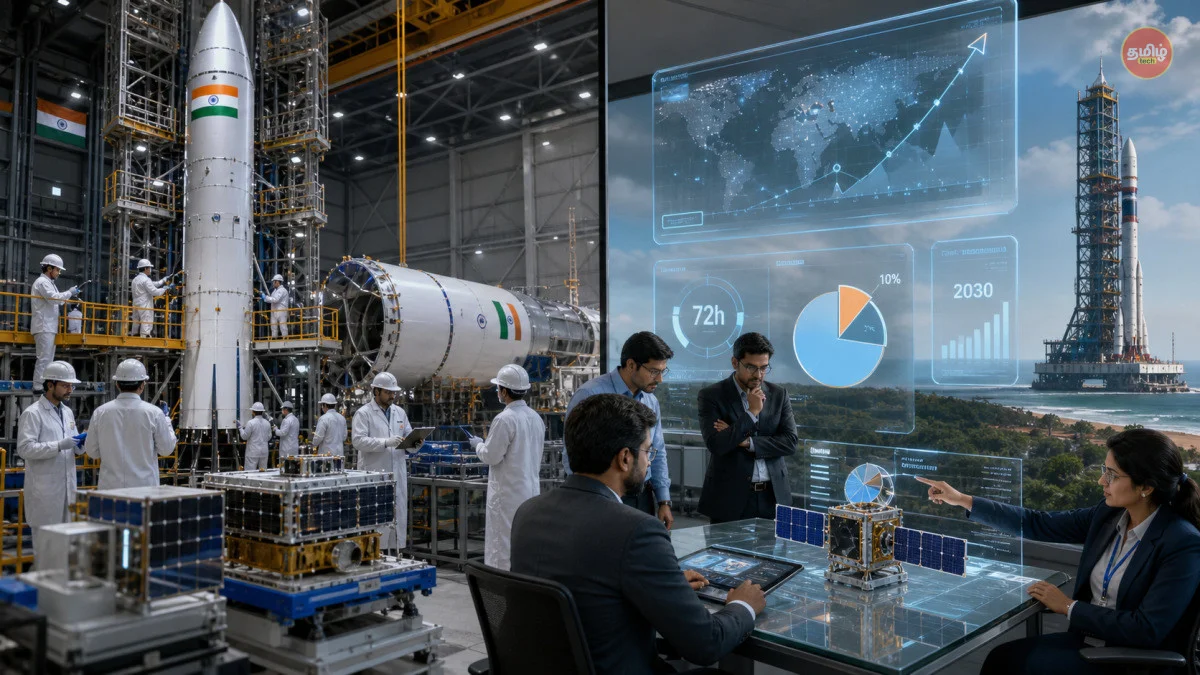
- India aims to capture 10% of the global space economy by 2030, up from the current 2% standing in 2026.
- The Small Satellite Launch Vehicle (SSLV) has been fully transferred to the private sector, significantly reducing launch turnaround time to just 72 hours.
- Private Indian startups like Skyroot and Agnikul are targeting a launch cost of under $10,000 per kg to compete with global players.
- New FDI norms implemented in 2024 have resulted in over $500 million in private investment flowing into Indian space-tech as of mid-2026.
- The bottom line: India has the tech, but scaling production and finding high-frequency customers is the next big hurdle for 2027.
The Shift from Science to Business
For decades, India’s space story was all about ISRO’s incredible ability to do the impossible on a shoestring budget. We reached Mars for less than the cost of a Hollywood movie, and we landed on the Moon’s south pole when others couldn't. But here in 2026, the conversation has fundamentally shifted. It’s no longer just about 'Can we reach space?'—we’ve proven that a hundred times over. The real question now is 'Can we make space a profitable business?' This is what we call Rocket Economics, and honestly, it’s a lot tougher than the physics of escaping Earth's atmosphere.
The global space market is currently valued at over $500 billion, and India’s share has historically been a tiny slice of that pie. For years, we were the 'budget launch provider' for the world, but that was a service-based model. Now, with the full operationalization of the Indian Space Policy, we are seeing a transition to a product-based model. We aren't just launching satellites for others; we are building the rockets, the ground stations, and the satellite constellations right here in India. But as any startup founder will tell you, building a cool product is one thing—making it pay for itself is another game entirely.
How We Got Here: From 2024 Policy to 2026 Reality
If we look back at the last two years, the 100% Foreign Direct Investment (FDI) allowance in the space sector was the real turning point. Before that, Indian space startups were struggling to find the massive capital required for R&D. By early 2025, we saw a surge of venture capital moving from traditional SaaS into 'Deep Tech' and 'Space Tech.' This influx of cash allowed companies like Agnikul Cosmos to perfect their 3D-printed engines, which are now being used in regular commercial flights. It’s wild to think that just a few years ago, 3D printing a rocket engine sounded like science fiction; today, it’s how these companies are keeping their manufacturing costs low.
Another major factor was the role of IN-SPACe. Think of them as the 'single window clearance' for everything space-related in India. They stopped being just a regulator and started being an enabler. By providing private players access to ISRO’s world-class testing facilities at Sriharikota and Thumba, the government effectively subsidized the most expensive part of rocket development. This 'infrastructure sharing' model is unique to India and has given our local startups a massive head start compared to private players in Europe or even some in the US who have to build everything from scratch.
The Core Challenge: The Cost Per Kilogram War
In the world of Rocket Economics, there is only one metric that matters: the cost per kilogram to Low Earth Orbit (LEO). This is where the competition gets brutal. SpaceX’s Falcon 9 changed the game with reusability, bringing costs down significantly. For Indian startups to survive in 2026, they can't just be 'good'; they have to be 'cheaper and faster.' While ISRO’s PSLV is a legendary workhorse, it wasn't designed for high-frequency commercial use. That’s where the SSLV (Small Satellite Launch Vehicle) comes in. Now that the private sector has taken over SSLV production, we are seeing a 'taxi service' for satellites.
But here is the catch—global players are also cutting prices. To stay ahead, Indian rockets need to achieve high launch frequency. It’s like a commercial airline; a plane only makes money when it’s in the air. A rocket only makes money when it’s launching. If an Indian startup only launches twice a year, their overhead costs will kill the business. They need to be launching every month, if not every week. This requires a massive supply chain of precision components, and building that ecosystem within India is the 'hard part' we are currently navigating. We have the engineers, but we need the specialized factories that can churn out space-grade valves, sensors, and composites at scale.
The India Impact: Why You Should Care
You might be wondering, 'How does this affect my daily life?' Well, the economics of space directly dictates the cost of data and connectivity. In 2026, we are seeing the rise of low-latency satellite internet in India, competing with traditional fiber and 5G. If Indian rockets can launch satellite constellations cheaply, your monthly bill for high-speed internet in a remote village in Tamil Nadu or Himachal Pradesh drops significantly. It’s not just about 'space'—it’s about the digital economy. From precision farming using satellite imagery to real-time tracking of logistics, the 'downstream' applications are where the real money is.
Moreover, the growth of this sector is creating a new breed of high-paying tech jobs in India. We are seeing engineers move from traditional IT roles into aerospace engineering. Cities like Bangalore, Hyderabad, and Chennai are becoming global hubs for space-tech. If you are a student or a professional in the tech space, the opportunities in 2026 are no longer limited to coding apps for Silicon Valley; you could be designing the guidance system for a rocket that’s launching from Kulasekarapattinam in Tamil Nadu.
TamilTech’s Honest Take: Is the Hype Real?
Look, let’s be real for a second. We love the hype around 'New Space,' but we have to look at the numbers. The reality of 2026 is that the space sector is still very risky. We’ve seen some startups struggle with failed launches, and in this business, one explosion can wipe out years of funding. While the 'science' is cracked, the 'economics' requires these companies to find a steady stream of customers. Most of the current demand comes from international satellite operators. To be truly sustainable, we need more Indian companies—from agriculture to mining—to start using space data.
We think the next 18 months will be a 'survival of the fittest' phase. The companies that can master the manufacturing process and keep their launch costs under that $10k/kg mark will thrive. The others might get acquired or pivot. But one thing is for sure: India is no longer just a participant in the space race; we are setting the pace for how 'frugal innovation' can be turned into a global business model. If you’re looking to invest or build a career, this is the sector to watch, but keep your eyes on the balance sheets, not just the launch videos.




Comments (0)
Be the first to comment!