


Key Takeaways
- Skyroot Aerospace successfully completed the first orbital commercial launch of Vikram-1 today, July 24, 2026.
- The Vikram-1 rocket features a 100% 3D-printed liquid engine and an all-carbon fiber body for maximum payload efficiency.
- Skyroot can launch a satellite within 24 hours of notice, a feat that even SpaceX currently struggles to match for small-scale missions.
- The cost per launch is significantly lower than international competitors, making India a global hub for small satellite deployments.
The Big News: India's Private Space Race Just Went Global
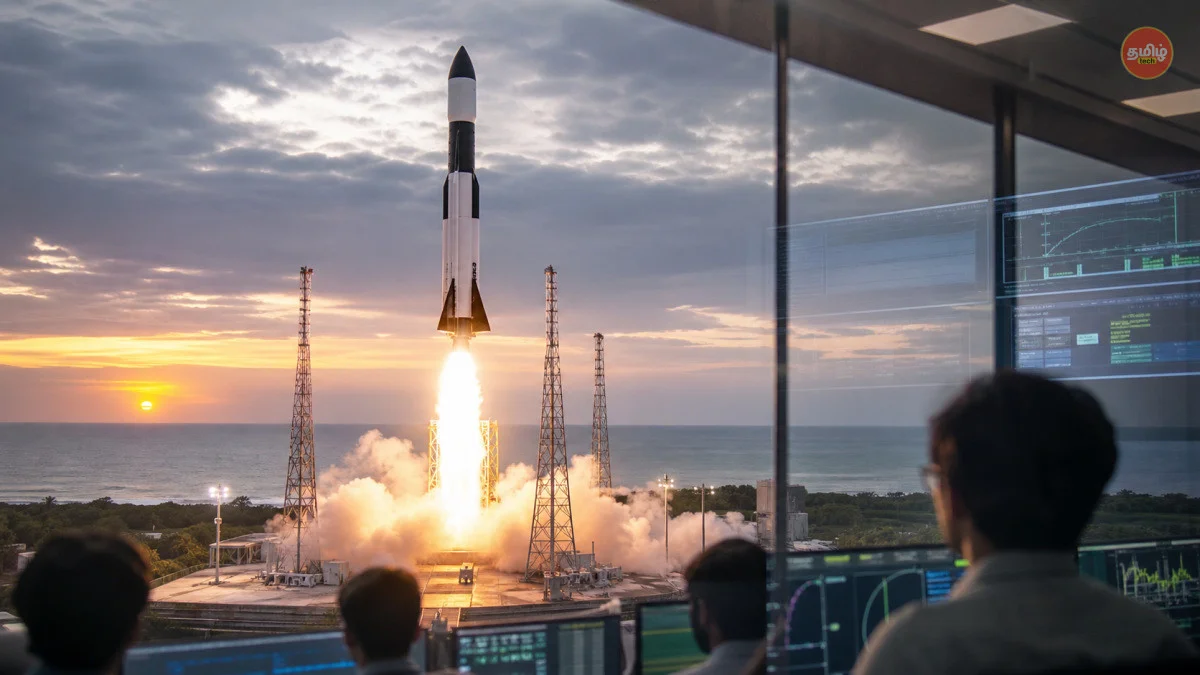
It’s a massive day for the Indian tech ecosystem. Today, July 24, 2026, Skyroot Aerospace successfully completed the full-scale commercial launch of its Vikram-1 rocket. This isn't just another test flight; it is the moment India officially enters the private commercial space-launch market with a bang. While ISRO has been doing the heavy lifting for decades, seeing a private startup from Hyderabad pull off an orbital mission with such precision is something we at TamilTech find absolutely incredible. This launch proves that the "New Space" era in India isn't just a dream anymore—it's happening right now.
The Vikram-1 isn't your typical rocket. It’s designed specifically for the small satellite market, which is currently the hottest sector in the space industry. Think of it like this: if SpaceX’s Falcon 9 is a massive bus that carries 50 people to a fixed destination, Skyroot’s Vikram-1 is like an Uber or a private taxi. It takes you exactly where you want to go, exactly when you want to go. This "on-demand" capability is what sets Skyroot apart from almost every other player in the world right now. Let’s dive deep into why this matters and if Elon Musk should be looking over his shoulder.
The Tech Behind Vikram-1: 3D Printing and Carbon Fiber
What makes Vikram-1 a beast? First, the material. Most rockets use heavy metal alloys, but Skyroot has gone with an all-carbon-fiber structure. This makes the rocket incredibly light but stronger than steel. Why does this matter? In rocket science, every gram you save in the rocket's weight is a gram you can add to the satellite payload. By using carbon fiber, Skyroot has maximized the efficiency of Vikram-1, allowing it to carry up to 480kg to Low Earth Orbit (LEO). This is the sweet spot for the thousands of communication and imaging satellites being planned by global tech companies today.
The real magic, however, happens in the engines. The Vikram-1 uses the 'Kalam' series of solid-fuel motors for its initial stages and the 'Raman' liquid-fuel engine for the final orbital adjustment. Here’s the kicker: these engines are almost entirely 3D-printed. By using additive manufacturing, Skyroot has reduced the number of parts in the engine from hundreds to just a handful. This drastically cuts down the chance of mechanical failure and, more importantly, slashes the manufacturing time. While traditional rockets take months to build, Skyroot can churn out these engines in a matter of days. This is high-tech engineering happening right here in India, and it's beating global standards.
Skyroot vs. SpaceX: The David and Goliath Battle
Now, let's address the elephant in the room: SpaceX. Can a startup from India really take on the giant that is Elon Musk's SpaceX? On paper, SpaceX is much bigger. Their Falcon 9 can carry over 22,000kg. But here is the catch—SpaceX prefers "rideshare" missions. If you have a small 100kg satellite, you have to wait for SpaceX to find 50 other people to fill up the rocket before they launch. You don't get to choose the exact orbit or the exact time. You are basically a passenger on someone else's schedule.
This is where Skyroot wins. Skyroot offers "dedicated" launches. If you want your satellite in space tomorrow at 4:00 PM in a very specific 500km orbit, Skyroot can do it. They have designed Vikram-1 to be assembled and launched within 24 hours from any mobile launchpad. SpaceX cannot do that. For small satellite operators who need quick deployment—especially for military or urgent communication needs—Skyroot is a much more attractive option. While SpaceX is focused on Mars and massive Starlink batches, Skyroot is dominating the "SmallSat" niche, which is expected to be a $100 billion market by 2030.
The India Impact: Why This Matters to You
You might be wondering, "Why should I care about rockets? I just want my 5G to work!" Well, that’s exactly why this matters. The future of high-speed internet, GPS, and even weather forecasting depends on thousands of small satellites. Currently, India relies heavily on ISRO, but ISRO is busy with massive missions like Gaganyaan and moon explorations. By having private players like Skyroot, we can launch our own communication satellites much faster and cheaper. This means better connectivity in rural India, more accurate farming data, and even cheaper satellite-based internet services like Starlink or JioSpaceFiber.
Financially, this is a goldmine for India. By offering the world's cheapest and most reliable small-satellite launch service, Skyroot is bringing massive foreign investment into the country. We are moving from being a country that just uses tech to a country that builds the infrastructure for the global space economy. With the new launchpad in Kulasekarapattinam, Tamil Nadu, becoming fully operational this year (2026), Skyroot will have an even better advantage for southern launches, directly boosting the local economy and creating thousands of high-tech jobs in the region.
How to Launch a Satellite (If You Were a Billionaire)
If you were a tech founder looking to put a satellite in space, the process with Skyroot is now simpler than ever. First, you'd choose your payload capacity—Vikram-1 is perfect for anything under 500kg. Next, you'd specify your orbit. Because Vikram-1 uses a multi-restart liquid engine in its final stage, it can drop off multiple satellites in different orbits in a single mission. This is like a delivery van making multiple stops in one trip.
Once the paperwork is done, Skyroot’s modular design comes into play. The rocket is transported in sections and can be put together like LEGO blocks. This modularity is what allows them to hit that 24-hour launch window. While we aren't at a point where an average person can launch a satellite, the cost has dropped so much that even universities and small research labs in India are now planning their own space missions for 2026 and 2027. We are literally democratizing space.
TamilTech’s Honest Take: Is the Hype Real?
We’ve been following Skyroot since their first sub-orbital flight in 2022, and honestly, what they’ve achieved by 2026 is nothing short of a miracle. Many people thought a private Indian company could never compete with the likes of Rocket Lab or SpaceX. But Skyroot has proven everyone wrong. Their focus on 3D printing and carbon fiber wasn't just for show; it was a calculated move to make space travel affordable.
What do we expect next? Skyroot is already working on Vikram-2 and Vikram-3, which will have even higher capacities and reusable stages. If they manage to make their rockets reusable like SpaceX, the cost of space travel from India will hit rock bottom. Our verdict? Skyroot isn't just a SpaceX competitor; they are the leaders of a new category of "on-demand" space travel. If you're a student or a tech enthusiast, this is the field to watch. The sky is no longer the limit for India—it's just the beginning.


Comments (0)
Be the first to comment!