


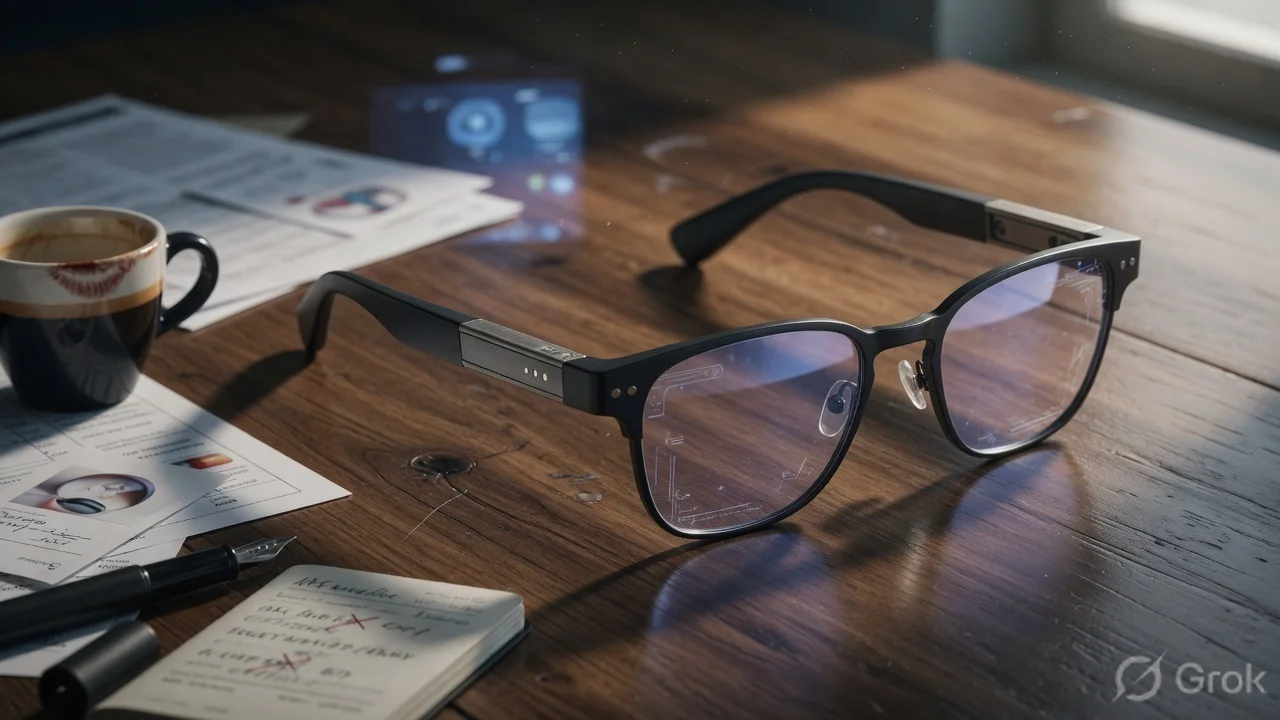
India is building its own AI glasses — and they're actually impressive
Meta Ray-Ban AI glasses are genuinely cool. But they cost upward of ₹30,000 when imported into India, they don't natively support UPI payments, and they're not designed with Indian use cases in mind. Lenskart — yes, the eyewear company — is about to change that.
B by Lenskart smart glasses are launching in India, and the specs are not what you'd expect from an eyewear company making its first hardware play. These aren't rebranded Chinese tech. They're engineered in India, built on the same Qualcomm chip that powers Meta's glasses, and loaded with Google Gemini 2.5 Live AI. The company's CEO Peyush Bansal called it their attempt to show "India can lead the next wave of consumer technology."
What 'B by Lenskart' actually is
B by Lenskart is a pair of smart glasses — regular-looking eyewear with built-in AI, a camera, and a speaker. They weigh just 40 grams, which the company says is about 20% lighter than comparable smart glasses from other brands. They're designed for all-day wear, not just occasional use.
The chip inside is Qualcomm's Snapdragon AR1 Gen 1 — the same platform that powers Meta's Ray-Ban glasses and most premium AR-adjacent devices on the market. This isn't a budget chip slapped onto a fashion accessory. The AR1 is purpose-built for AI-enabled wearables, handling on-device AI processing efficiently without killing the battery.
The camera is a Sony sensor — for hands-free photos and videos. Combined with the Gemini AI, you can point your gaze at something and ask about it. What is this dish? Translate this menu. Who is this person? What's the nutritional content of this meal? The AI sees what you see and responds through the speaker in the frames.
The Google Gemini 2.5 Live integration — this is the real story
Gemini 2.5 Live is Google's real-time multimodal AI — it processes audio and visual input simultaneously and responds conversationally. On a phone, you open an app to access it. On B by Lenskart, it's ambient — always available, activated by voice, responding through the glasses' built-in audio.
What this means practically: you're walking through a market in Chennai and spot something you don't recognise. Ask the glasses what it is. You're in a restaurant in Mumbai where the menu is in Marathi. Ask for a live translation. You're at a medical store and want to know what a drug does. Ask. The AI has camera context — it sees what you're looking at — so the answers are contextual rather than generic.
The food logging feature is genuinely interesting for Indian users. Point at your thali and ask for a nutritional breakdown. Log meals by looking at them rather than manually entering them in a fitness app. This kind of passive health tracking is something people talk about wanting but rarely actually do because manual entry is tedious. Glasses that see your food and log it automatically remove that friction.
UPI payments — this is the India-first differentiator
B by Lenskart supports hands-free UPI payments. Point at a QR code, confirm through voice, transaction done. No phone in hand required. This is the feature that distinguishes this product from Meta Ray-Ban more clearly than anything else. Meta glasses are built for the US market. UPI didn't even exist there until recently and it's not native to those glasses. Lenskart built UPI into the product from the ground up because India is the market.
The UPI integration alone makes these glasses practical for daily life in India in a way that no imported smart glasses product currently achieves. Street vendor, petrol pump, grocery store — anywhere you pay with QR code, you can now do it without taking your phone out of your pocket.
Prescription lens support — the massive market differentiator
This is the detail that makes B by Lenskart a genuinely mass-market product rather than a niche gadget. The glasses support prescription lenses. Not as an afterthought — Lenskart is literally an optical retail company. They have the manufacturing infrastructure, the retail network, and the lens expertise to make prescription smart glasses a standard offering rather than an expensive custom order.
India has one of the largest populations of spectacle wearers in the world. Every person who wears prescription glasses currently faces a choice between wearing their prescription glasses (no smart features) or switching to smart glasses (no prescription, blurry vision). B by Lenskart eliminates that choice. Your regular eyewear can now also be your AI assistant.
Meta is working on prescription Ray-Ban glasses (reportedly coming soon as the Scriber and Blazer models), but those will be imported products at premium prices. Lenskart already has thousands of retail stores across India with optometrists. Getting prescription smart glasses fitted through Lenskart will be as simple as getting regular prescription glasses fitted through them today.
Open platform strategy — developers can build for this
Lenskart isn't keeping B as a closed product. They're opening the platform to developers, inviting them to build applications across categories — food delivery, entertainment, fitness, healthcare, education. The glasses become a platform for daily use rather than a standalone gadget.
Indian developers building for this platform are essentially building for a prescription-compatible, UPI-integrated AI wearable with a national retail distribution network behind it. That's a very different market than building an app for Meta glasses that have limited India presence and no prescription infrastructure.
The company has also invested in AR and AI startups including Ajna Lens to expand its technology ecosystem — so the platform ambition is backed by real investment in the underlying tech stack.
Pricing and availability expectations
Lenskart hasn't officially announced the price of B smart glasses. But given their existing product range and the company's stated mission to make smart glasses accessible to Indian consumers, pricing significantly below imported alternatives is the obvious play. Meta Ray-Ban glasses imported into India land at ₹25,000-₹35,000. Lenskart's glasses, manufactured domestically and sold through their own retail network, could plausibly land between ₹15,000-₹22,000 at launch — potentially lower in subsequent product generations.
The official launch was targeted for March 2026, with some delay possible into Q2 2026. Watch Lenskart's official website and their 2,000+ stores across India for announcements.
Why this matters for India's tech story
India is the world's largest democracy, one of its fastest growing economies, and now building its own AI hardware for global consumption. Lenskart's B glasses aren't just a consumer product — they're a signal that Indian companies can build at the frontier of hardware-AI integration, not just import foreign products and adapt them.
Peyush Bansal's letter to shareholders described B as an effort to prove "India can lead the next wave of consumer technology with products that are intelligent, personal, and globally relevant." That's a larger ambition than selling glasses. It's an attempt to build a Made-in-India consumer tech category that didn't exist before.




Comments (0)
Be the first to comment!