


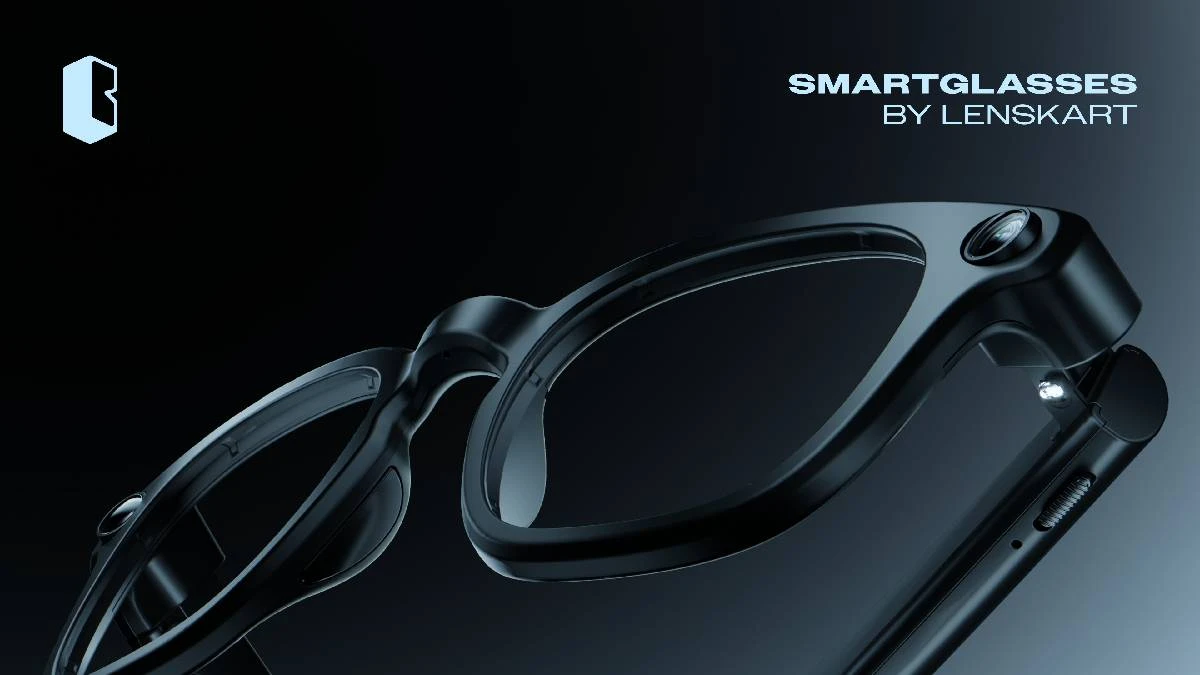
India just built its own smart glasses — and the spec sheet is actually impressive
For the past two years, the smart glasses conversation in India has been dominated by two foreign products: Ray-Ban Meta (₹19,990 upwards) and whatever Apple Vision Pro was supposed to become for the masses. Both are excellent pieces of technology. Both are designed for Western consumers first, with India as an afterthought.
Lenskart just changed that with the launch of B by Lenskart — India's first full-stack AI smart glasses, built entirely in India, for Indian users first. The specs are not a compromise. This is a real product with real technology that directly competes with the best smart glasses in the world right now.
The headline numbers: Qualcomm Snapdragon AR1 Gen 1 chip, Google Gemini 2.5 Live AI assistant, Sony camera module, hands-free UPI payments, 40 gram weight (20% lighter than Ray-Ban Meta), open developer platform. CEO Peyush Bansal has been calling this India's moment to lead the next wave of consumer technology. Looking at the spec sheet, it's hard to argue with that.
Let's break down every feature that matters
The chip: Qualcomm Snapdragon AR1 Gen 1
The same chipset that powers other leading AR devices globally — including Ray-Ban Meta. This is the dedicated wearable AI chip Qualcomm built specifically for smart glasses. It handles always-on AI processing without destroying battery life, manages the camera, and runs the AI assistant locally for fast responses. Lenskart choosing this chip means B by Lenskart is running on tier-1 hardware, not a cheaper compromise.
The AI: Google Gemini 2.5 Live
This is the standout feature for Indian users. Gemini 2.5 Live enables natural, conversational interaction — you speak to the glasses in a normal voice, the way you'd talk to a person, and the AI responds through a small speaker. It can understand context across a conversation, answer follow-up questions, and process what the camera is seeing in real time.
For India specifically, Gemini's multilingual capabilities are critical. Gemini 2.5 supports Indian languages including Hindi and Tamil. The live translation feature can translate spoken conversations in real time — potentially transforming how people navigate language barriers in business meetings, travel, or daily interactions.
The camera: Sony module
Sony camera hardware in a 40-gram wearable is a meaningful choice. Sony makes the image sensors used in most flagship smartphone cameras globally, including the sensors in Pixel and iPhone. A Sony module in Lenskart's glasses means photo and video quality that doesn't feel like a compromise for having hands-free capture.
UPI payments — this is the India-first feature
This is where B by Lenskart goes beyond anything Ray-Ban Meta or even Apple offers: hands-free UPI payments. You can authorize a payment through the glasses — at a street vendor, a restaurant, a retail store — without pulling out your phone. The mechanism for authentication hasn't been fully detailed yet, but the capability of initiating UPI transactions through a wearable is a genuinely novel feature for India's digital payments ecosystem.
Think about what this means in practice. Standing at a busy Saravana Bhavan, hands full, paying through your glasses. At a vegetable market, asking the price of tomatoes and paying without reaching for your wallet. It sounds futuristic but UPI already handles ₹20+ lakh crore in monthly transactions in India — adding a glasses-based payment interface onto that infrastructure is a natural next step.
Health monitoring
B by Lenskart includes health monitoring with food logging capabilities. The camera can identify what you're eating, estimate nutritional content, and the AI can provide dietary recommendations based on your health goals. This is more novel than it sounds — current health monitoring wearables (Apple Watch, Fitbit) don't do food logging through a camera. It requires visual AI capabilities that are only now becoming feasible in a wearable form factor.
The weight matters more than people realize
40 grams. 20% lighter than Ray-Ban Meta. This sounds like a small number but it's the difference between a device you wear all day without noticing and one you're aware of after two hours. Smart glasses that are uncomfortable to wear don't get worn — the product fails in the market regardless of how good the software is.
Lenskart has been making glasses for over a decade. Their entire business is built on understanding what makes people comfortable wearing frames all day. That domain expertise in frame design and wearability is something Apple and Meta genuinely don't have to the same degree. The 40-gram, 20%-lighter-than-competition achievement is probably the most underappreciated part of the B by Lenskart story.
The glasses are also prescription-lens capable — meaning people who actually need corrective lenses can use B by Lenskart as their daily glasses, not just as an additional device. This dramatically expands the potential market compared to smart glasses that only work with flat lenses.
The open developer platform — this is Lenskart's big bet
Lenskart is opening B by Lenskart to third-party developers. Confirmed app integrations already include Zomato, Swiggy, and BookMyShow. This means you'll be able to check your Swiggy order status through your glasses, get a notification when your food delivery is nearby, or check available show times without touching your phone.
The developer platform play is ambitious. Lenskart is essentially positioning B by Lenskart not just as a product but as a platform — an operating system for Indian consumer wearables. If developers build for it and users adopt it, the glasses become more useful over time as the app ecosystem grows. This is the same strategy that made the iPhone valuable: the hardware was good, but the App Store made it indispensable.
The difference is that Apple had ₹several lakh crore in resources to build an ecosystem. Lenskart needs to convince Indian developers that B by Lenskart will have enough users to justify building for. That's the hard part. The technology is there. The adoption question is what will determine whether this becomes a platform or just a product.
The price question — nobody knows yet, and that's a problem
Lenskart hasn't officially announced pricing for B by Lenskart. This is either a deliberate strategy (announcing price too early creates competitive intelligence for rivals) or a sign that pricing decisions are still being finalized. Given that Lenskart's core business serves the mass market — their retail stores are everywhere from Chennai's T Nagar to Tier 3 towns — the expectation is that B by Lenskart will be priced more accessibly than Ray-Ban Meta (₹19,990) or Apple Vision Pro (₹3,49,900).
The smart guess based on Lenskart's positioning and manufacturing capabilities in India: ₹12,000-18,000 range. That would put it below Ray-Ban Meta on price while matching or exceeding it on features. If they can hit under ₹15,000 at launch, this could be a genuine mass-market product in India rather than a premium gadget purchase.
Made in India — what that actually means
B by Lenskart is designed and engineered in India. Lenskart is manufacturing it using its existing production infrastructure and plans to scale using its Indian manufacturing capabilities, data analytics, and omnichannel retail network.
This is significant for multiple reasons. India's electronics manufacturing ambitions under PLI schemes need marquee products to anchor around. A globally competitive smart glasses product manufactured in India, shipping internationally, is exactly the kind of proof-of-concept that the government's Make in India narrative needs in the consumer electronics space beyond smartphones.
For Tamil Nadu in particular: Lenskart has manufacturing and distribution infrastructure across South India. If the B glasses achieve commercial scale, the supply chain and retail jobs will benefit the region.
TamilTech's take
We've been covering smart glasses products for three years — the hype, the disappointments, and the occasional genuine breakthrough. B by Lenskart feels like the most credible India-made wearable we've seen. The hardware is tier-1 (Qualcomm AR1, Sony camera), the AI is class-leading (Gemini 2.5 Live), and the India-specific features (UPI payments, multilingual support, prescription-capable) show that Lenskart actually thought about who their customers are.
The unknowns: pricing, battery life (not disclosed), the real-world reliability of hands-free UPI, and whether the developer platform gains the traction it needs. These aren't small questions.
But if the price lands under ₹15,000 and the UPI feature works reliably in everyday conditions, B by Lenskart could be the first smart glasses product that genuinely penetrates India's mass market. Not just early adopters and tech journalists — but the person at the vegetable market, the college student in Chennai, the professional navigating a multilingual meeting in Bengaluru. That would be genuinely historic.



Comments (0)
Be the first to comment!