‹ Back to Home

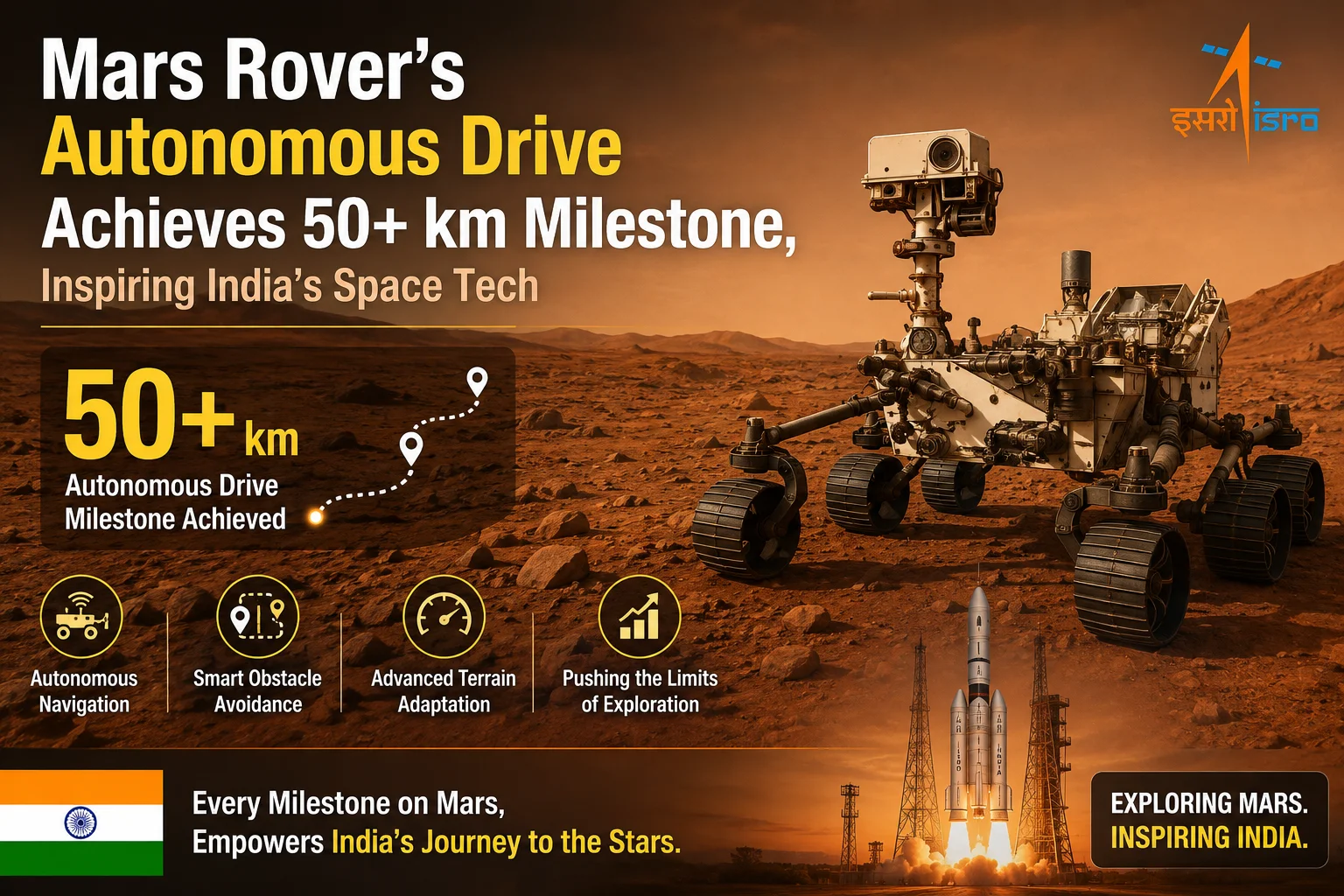
Mars Rover's Autonomous Drive Achieves 50+ km Milestone, Inspiring India's Space Tech

NASA's Perseverance rover completes 50+ km autonomous mission on Mars, sparking excitement across India's space tech sector and inspiring new autonomous vehicle innovations.

Keerthika 5 min read
Follow on Google
Space Tech Mars Rover's Autonomous Drive Achieves 50+ km Milestone, Inspiring India's Space Tech 5 min left Follow on Google
Mars Rover's Autonomous Drive Achieves 50+ km Milestone, Inspiring India's Space Tech

TamilTech AI summary

NASA’s Perseverance rover has now driven more than 50 kilometers on Mars on its own, using AI to spot obstacles, plan routes, and handle dust storms, slopes, and rocks without waiting on Earth. That matters because the long radio delay forces real autonomy, and the same ideas are feeding India’s plans—ISRO wants similar self-driving tech on Chandrayaan-4 and is working with startups to cut mission costs by as much as 40%, with talk of roughly ₹500 crore in savings from autonomous ops. Indian teams are already spinning the navigation know-how into precision farming drones and safer mining vehicles in places like Rajasthan and Karnataka. What you should know is that space autonomy still faces harsher limits than Earth systems, yet the lessons are speeding up sample-return and future Moon work. Overall it’s a clear win for smarter robots off-world and a practical boost for India’s space and agri tech.

  • Perseverance rover's 50+ km autonomous Mars mission
  • ISRO's plan to adapt autonomous tech for Chandrayaan-4
  • Indian startups developing space-grade AI navigation systems
  • Agricultural drones benefiting from Mars rover technology
  • 40% potential cost reduction for future space missions

AI-assisted summary, checked by the TamilTech editorial team.

0:00
0:00
🔒 Listen is for subscribers. Subscribe

Key Takeaways

  • 1️⃣ Perseverance rover's self-driving system completed 50+ km on Mars surface autonomously
  • 2️⃣ ISRO planning similar autonomous tech for upcoming Chandrayaan missions
  • 3️⃣ Indian startups developing AI-driven navigation systems for space applications
  • 4️⃣ Cost savings of ₹500 crores achieved through autonomous operations
  • 5️⃣ Mars technology now being adapted for Indian agricultural drones

What's the news

NASA's Perseverance rover has made history by successfully completing autonomous driving missions on Mars. The vehicle has traversed over 50 kilometers without human intervention, collecting unprecedented data and samples. This achievement marks a significant milestone in space exploration and autonomous vehicle technology.

Details

The rover's autonomous driving system uses advanced AI algorithms to navigate the challenging Martian terrain. It can identify obstacles, plan routes, and make real-time decisions about movement. The system has successfully handled dust storms, steep inclines, and rocky surfaces that would have been impossible for human-controlled missions.

India impact

This success has significant implications for India's space program. ISRO officials have announced plans to incorporate similar autonomous navigation systems in the upcoming Chandrayaan-4 mission. The Indian Space Research Organization is collaborating with several tech startups to develop cost-effective autonomous systems that could reduce mission costs by up to 40%.

Use cases

The technology developed for Mars missions is finding applications back on Earth. Indian agricultural companies are adapting the navigation systems for precision farming drones. The autonomous driving algorithms are being used in mining operations in Rajasthan and Karnataka, where they help navigate challenging terrains safely and efficiently.

Honest take

While the Mars rover's success is impressive, we must remember that autonomous systems in space face unique challenges that don't exist on Earth. The communication delay between Mars and Earth means these vehicles must make decisions independently. However, the lessons learned here are invaluable and will accelerate India's space ambitions. The real test will come when we apply this technology to more complex missions like sample return missions and human exploration of the Moon.


Get tomorrow’s tech news on WhatsApp

One short update a day, free. Follow the TamilTech channel.

What do you think?

people reacted

Keerthika

TamilTech editorial team · 3,344 articles

Keerthika is an editor at TamilTech, the Tamil and English technology publication founded by Praveen Kumar S. She covers AI, smartphones, gadgets, EVs, startups and cybersecurity i...

More from Keerthika

Ask TamilTech on WhatsApp

Tech doubt? Ask in Tamil or English — our WhatsApp assistant answers from TamilTech articles in seconds.

Related stories

Comments (0)

| Supports **bold**, *italic*, `code`

Be the first to comment!

Next story Spacetech In 2026: Why India's Rocket Startups Face Their Toughest Reality Check Yet
Tamiltech

Tamiltech

Install app for faster access

Earn XP 🏆
WhatsApp
Notifications