


Key Takeaways
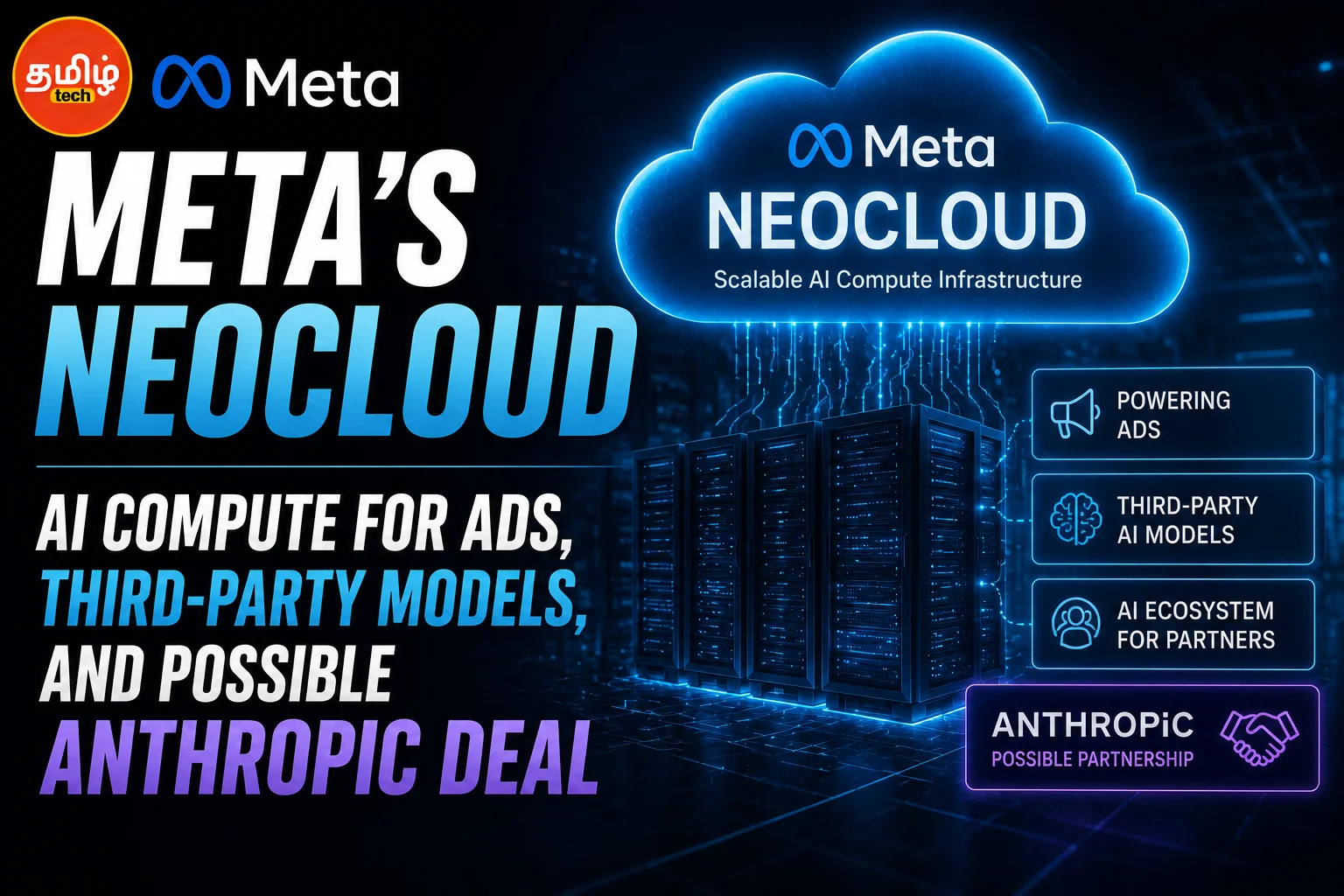
- Meta plans to redirect up to 30% of its AI compute towards its own ad‑scaling models and a new neocloud service that rivals SpaceX’s Starlink for compute.
- The neocloud will offer third‑party AI model hosting, with early talks suggesting a possible hosting deal for Anthropic’s Claude series.
- In India, Meta will provide ₹150 per GPU‑hour credits to qualifying startups through its Meta for Startups program, making large‑scale AI experiments more affordable.
- Bottom line: If the neocloud launches in Q4 2026, Indian developers could get access to hyperscale AI power at a fraction of current cloud costs.
Meta’s Compute Play: From Ads to AI Cloud
So here's the thing — Meta is not just building bigger AI models for Facebook and Instagram; it is turning its massive GPU farms into a cloud that anyone can rent. The company announced internally that up to 30% of its AI compute will be earmarked for its own ad‑scaling models and a new neocloud offering that could rival SpaceX’s Starlink for compute power. Early signals suggest the neocloud will launch in the last quarter of 2026, initially serving select partners before opening to the public.
Meta’s move comes as advertisers demand more real‑time bidding and creative generation at scale, which needs huge amounts of AI inference. By dedicating a slice of its infrastructure to these ad‑scaling models, Meta hopes to cut latency and cost while improving ad relevance. Simultaneously, the neocloud will let external developers run large language models, diffusion models, or custom AI workloads on the same hardware, billed per GPU‑hour. This dual‑use approach mirrors how Amazon started with internal retail tools before opening AWS to the world.
How Meta Built Its AI Infrastructure
Meta’s AI journey began with the FAIR lab and the early adoption of GPUs for vision and language tasks. Over the years the company poured billions into building its own silicon‑friendly data centers, culminating in the Research SuperCluster (RSC) that debuted in 2022 with 16,000 NVIDIA A100 GPUs delivering about five exaflops of AI performance. Since then Meta has continuously upgraded the fleet, swapping older GPUs for the latest H100 and Blackwell chips.
By mid‑2026 Meta’s compute estate reportedly exceeds 200,000 H100‑equivalent GPUs, giving it roughly two exaflops of sustained AI throughput. This scale puts Meta in the same league as the largest public clouds, but unlike those providers the hardware is tightly integrated with Meta’s internal software stack, including PyTorch, Triton, and its own model serving framework. The result is a highly optimized environment that can spin up thousands of instances in seconds for training or inference.
Inside Meta’s Neocloud Strategy
The neocloud will be built around a modular rack design where each rack holds 64 H100 GPUs connected via NVLink and InfiniBand, managed by Meta’s custom orchestrator called Atlas. Atlas schedules workloads based on priority: internal ad‑scaling jobs get guaranteed slots, while external customers receive best‑effort capacity with optional reservations. Storage is handled by a distributed object system that mirrors Meta’s existing Tectonic filesystem, offering low‑latency access to petabyte‑scale datasets.
For ad scaling, Meta plans to run models that predict click‑through rates, generate ad copy, and optimize creative assets in real time. These models are expected to consume about 15% of the neocloud’s capacity. The remaining space will be offered to third early‑access partners, and talks are underway with Anthropic to host its Claude 3 family on Meta’s neocloud. If the deal closes, developers could call Claude via an API that runs on Meta hardware, priced competitively against existing model‑as‑a‑service offerings.
What This Means for Indian Developers and Startups
In India, Meta will introduce a startup credit program that gives qualifying companies ₹150 per GPU‑hour for the first 100 hours each month. This translates to roughly $1.80 per hour, which is well below the prevailing rates on AWS EC2 p4d instances (around $3.20 per hour). The credits can be applied to any neocloud service, from model training to inference endpoints, and are aimed at Indian AI startups working on language, vision, or multimodal projects.
Meta is also negotiating a partnership with Jio Platforms to place neocloud nodes in Jio’s upcoming data centers in Chennai and Hyderabad. This would reduce latency for Indian users and allow data residency compliance. Initially the neocloud will be accessible via a web console and a set of CLI tools, with SDKs for Python, Java, and Go. Indian developers can request early access through the Meta for Startups portal, which opens registration in August 2026.
How to Tap Into Meta’s AI Cloud: A Quick Guide
Getting started with Meta’s neocloud is straightforward. First, visit the Meta for Startups portal and fill out the short application form; approval usually arrives within 48 hours. Once approved, you receive an API key and a credit balance visible in the console. Next, install the Meta CLI (npm i -g @metacloud/cli) and configure it with your key using mcloud configure.
To deploy a model, you can pull a pre‑built container from Meta’s model registry or bring your own Docker image. For example, to run a Llama‑2 7B inference endpoint, execute mcloud run --gpu 1 --image meta/llama2:7b --port 8080. The CLI will provision a GPU instance, download the image, and expose a REST endpoint. You can monitor usage and costs in real time, and the system will automatically shut down idle instances after ten minutes to save credits.
Meta vs AWS, Google Cloud, and Azure for AI Workloads
When it comes to raw price, Meta’s neocloud aims to undercut the big three clouds. At ₹150 per GPU‑hour, the effective cost is about $1.80, whereas AWS p4d, Azure NDm A100 v4, and Google A2 instances hover between $3.00 and $3.50 per hour. For startups that need bursty GPU workloads, the credit‑based model can save up to 45% compared to on‑demand pricing, especially if they stay within the free‑tier limits.
Performance-wise, Meta’s hardware is identical to what the hyperscalers use, but the software stack is tuned for PyTorch workloads, giving a slight edge in training speed for models that rely heavily on Meta’s custom operators. However, the neocloud currently lacks the breadth of managed services offered by AWS SageMaker or Azure Machine Learning — there is no built‑in AutoML, no integrated notebook service, and limited third‑party tool integrations. For teams that need a full‑featured MLOps platform, the public clouds still hold an advantage, while pure compute‑heavy tasks may find Meta’s offering attractive.
Our Verdict and What’s Coming
Our take is that Meta’s neocloud could be a disruptive force for Indian AI developers who are cost‑sensitive but still need access to top‑tier GPUs. The startup credit program lowers the barrier to experiment with large models, and the potential Anthropic hosting deal adds credibility. On the downside, the ecosystem is still nascent, and enterprises that require compliance certifications or extensive support may hesitate to move workloads to a new provider.
Looking ahead, we expect Meta to open the neocloud to the general public in early 2027, expand GPU offerings to include the upcoming Blackwell‑based chips, and possibly bundle the service with its Meta Quest enterprise suite. For now, Indian startups should keep an eye on the Meta for Startups portal, test the credits with a small proof‑of‑concept, and decide whether the neocloud fits their long‑term AI strategy.


Comments (0)
Be the first to comment!