

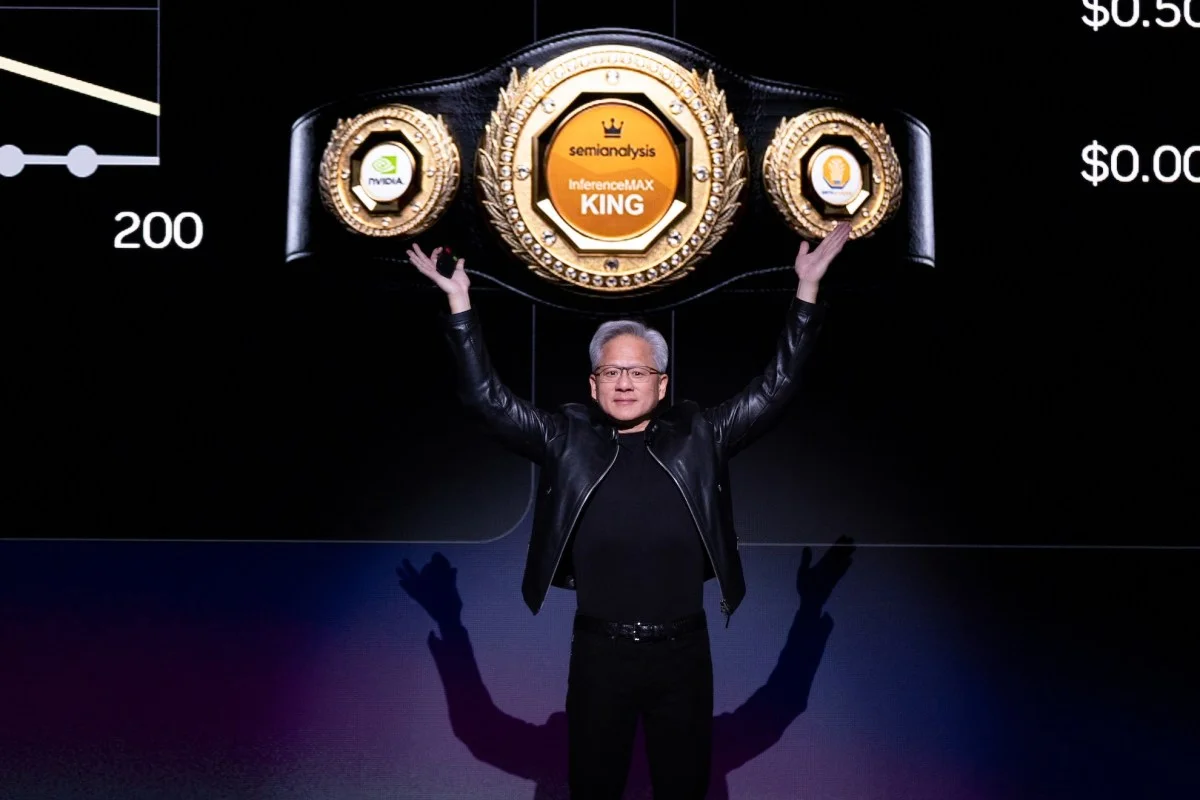
The most bullish AI pitch ever delivered — and the stock went down
Picture this: Jensen Huang, leather jacket on, stands in front of thousands of people at Nvidia's GTC conference and rattles off some of the biggest numbers ever said out loud in tech history. $35 trillion AI agent market. $50 trillion physical AI and robotics market. $1 trillion in chip purchase orders for just two of Nvidia's products by end of 2027.
And Nvidia's stock? It dropped. Right as he was speaking.
This is the weird paradox of Nvidia in 2026 — the company is posting genuinely insane numbers, making real products that real companies are buying, and yet Wall Street investors are increasingly nervous. Here's what's actually going on.
Translation: AI is moving so fast that even the people making money off it don't fully know where it's going. And that scares investors.
The bubble fear is real
There's a growing nervousness on Wall Street that AI might be overhyped — that companies are spending billions on Nvidia GPUs and not getting the returns they expected. Headlines about low enterprise adoption of AI have been circulating. If big companies aren't actually deploying AI at scale, who's going to buy all these chips?
Now, Neuman says those headlines don't paint the full picture — in his conversations with enterprises, adoption is actually happening. But the gap between Silicon Valley's confidence and Wall Street's skepticism is real and growing.
Think about it from an investor's perspective. Nvidia is a $4 trillion company. To justify that valuation, the company needs to keep growing massively. The trillion-dollar chip order projection sounds incredible — but what if AI spending slows? What if a cheaper competitor emerges? What if the enterprise AI boom plateaus? These are legitimate questions, and trillion-dollar numbers don't make them go away.
What this means for someone in India
You might be thinking — I'm in Chennai or Bangalore, why do I care if Wall Street is nervous about Nvidia's stock price?
Here's why it matters. Most of the AI tools Indians use daily — whether it's the AI features in your phone, the recommendation algorithms on Flipkart and Swiggy, or the AI assistants that Indian IT companies are building for global clients — all of it runs on Nvidia hardware in data centers.
If Wall Street's nervousness leads to reduced AI investment globally, that slows down the pace of AI development. Indian IT companies like TCS, Infosys, and Wipro that are betting their next decade on AI services would feel the slowdown. The startup ecosystem in Bangalore and Hyderabad that's building on top of AI APIs would feel it too.
On the flip side, if Nvidia's stock pressure forces them to be more aggressive on pricing or partnerships in emerging markets like India — that's actually good for Indian developers and companies accessing GPU compute through cloud platforms.
The Silicon Valley vs Wall Street split
What I find genuinely fascinating about this story is the disconnect. In San Francisco and the Bay Area right now, the AI vibe is almost manically optimistic. Every startup pitch, every VC conversation, every conference keynote is dripping with confidence that AI will transform everything.
But on Wall Street, the mood is more cautious. They've seen tech bubbles before — dot-com in 2000, crypto in 2022. They know that transformational technology doesn't always translate to proportional investment returns, at least not on the timeline everyone expects.
Both sides have valid points. AI is genuinely transformational — I don't think that's hype. But $4 trillion valuation for a chip company requires things to go almost perfectly for years. Any bump in the road — a major customer cutting AI spending, a credible chip competitor, a macro slowdown — and that valuation looks very stretched.
My honest take
Look, I've been following Nvidia closely, and the truth is somewhere in the middle. Jensen Huang isn't lying — the numbers he quoted about AI market size are based on real analyst projections, and Nvidia really is central to all of it. The technology is real.
But stocks aren't just about technology being real. They're about price relative to future earnings, and at $4 trillion, Nvidia is priced for perfection. Any sign of slowdown — even a pause — causes a selloff.
The GTC keynote was impressive. The products are real. The vision is ambitious. But Wall Street has heard ambitious visions before, and they want to see the cash flow catch up to the narrative. Until that gap closes more convincingly, expect this tension between Silicon Valley optimism and Wall Street skepticism to continue.
For what it's worth — I still think Nvidia is central to India's AI future, and that matters more for everyday tech users here than the stock price gyrations in New York.
Frequently asked questions
5
Why did Nvidia stock drop during GTC 2026?
Despite Jensen Huang's bullish $35-50 trillion AI market predictions, investors were nervous about AI uncertainty, bubble fears, and questions about whether enterprise AI adoption will be fast enough to justify Nvidia's $4 trillion valuation.
What numbers did Jensen Huang announce at GTC 2026?
Huang called the AI agent ecosystem a $35 trillion market, physical AI and robotics a $50 trillion market, and projected $1 trillion in chip purchase orders for Blackwell and Vera Rubin chips by end of 2027.
Is Nvidia stock overvalued?
That depends on whether AI spending continues to grow as fast as projected. At $4 trillion market cap, Nvidia is priced for near-perfect execution. Any slowdown in AI investment or rise of competitors could put pressure on the stock.
How does Nvidia's Wall Street performance affect India?
Most AI tools used in India run on Nvidia hardware. If AI investment globally slows due to investor nervousness, Indian IT companies, AI startups, and cloud-based AI services would all feel the slowdown. Conversely, pricing pressure could make GPU access cheaper for Indian companies.
What is the difference between Silicon Valley and Wall Street views on AI?
Silicon Valley is highly optimistic about AI's transformational potential. Wall Street is more cautious — they've seen tech bubbles before and want to see AI investment translate into actual enterprise cash flow before fully committing to trillion-dollar valuations.
Get tomorrow’s tech news on WhatsApp
One short update a day, free. Follow the TamilTech channel.
What do you think?

Keerthika is an editor at TamilTech, the Tamil and English technology publication founded by Praveen Kumar S. She covers AI, smartphones, gadgets, EVs, startups and cybersecurity i...
More from KeerthikaAsk TamilTech on WhatsApp
Tech doubt? Ask in Tamil or English — our WhatsApp assistant answers from TamilTech articles in seconds.
Related stories



 Next story
India's New AI Law Coming Soon: What Ashwini Vaishnaw's Consultation Paper Means for You
Next story
India's New AI Law Coming Soon: What Ashwini Vaishnaw's Consultation Paper Means for You

TamilTech
Install app for faster access
Only the big updates. No spam, switch off any time.
Comments (0)
Be the first to comment!