


Key Takeaways
- Ollama/ollama, a Go-based tool with 178,998 GitHub stars, lets you run powerful AI models like Kimi-K2.6 and GLM-5.2 directly on your machine.
- It's a massive cost-saver for Indian developers and students, eliminating the need for expensive cloud API calls for many projects.
- The tool is perfect for building custom AI applications, from college projects to freelance gigs, without high recurring costs.
- Setup is incredibly simple: a single command installs everything, making it accessible even for those new to AI/ML.
- While powerful, it requires decent local hardware (a good GPU is recommended) to run larger models effectively.
What's the News
In the world of AI, running large language models (LLMs) has traditionally meant renting expensive cloud computing power. But a project on GitHub is changing that game for developers, and it's one every Indian techie should have on their radar. Meet ollama/ollama, a tool that's racking up 178,998 stars on GitHub and is making waves for its ability to run state-of-the-art AI models locally on your own computer.
Think of it as a personal, offline AI server. Instead of sending your requests to OpenAI, Google, or Anthropic and paying per API call, you download the model once and run it on your hardware. This isn't just a technical curiosity; it's a practical solution that addresses real-world constraints for developers in India, from budget limitations to data privacy concerns.
Details: How It Works
At its core, ollama/ollama is a command-line tool written in Go. It's designed to be simple and effective. The magic happens in three steps:
- Installation: You install the ollama binary on your system (Windows, macOS, or Linux). It's a single, straightforward command.
- Model Download: You tell ollama which model you want to use. For example,
ollama run llama3will download and start the popular Llama 3 model. - Interaction: Once the model is running, you can chat with it directly in your terminal or use its API in your own applications.
The tool supports a wide array of models, including Kimi-K2.6, GLM-5.2, MiniMax, DeepSeek, gpt-oss, Qwen, and Google's Gemma series. This variety is crucial because different models excel at different tasks, from coding and reasoning to creative writing.
India Impact: Why This Matters Here
For the Indian developer ecosystem, ollama/ollama is more than just a cool tool; it's an enabler. The high cost of cloud AI services can be a significant barrier for students, startups, and freelancers. This tool levels the playing field.
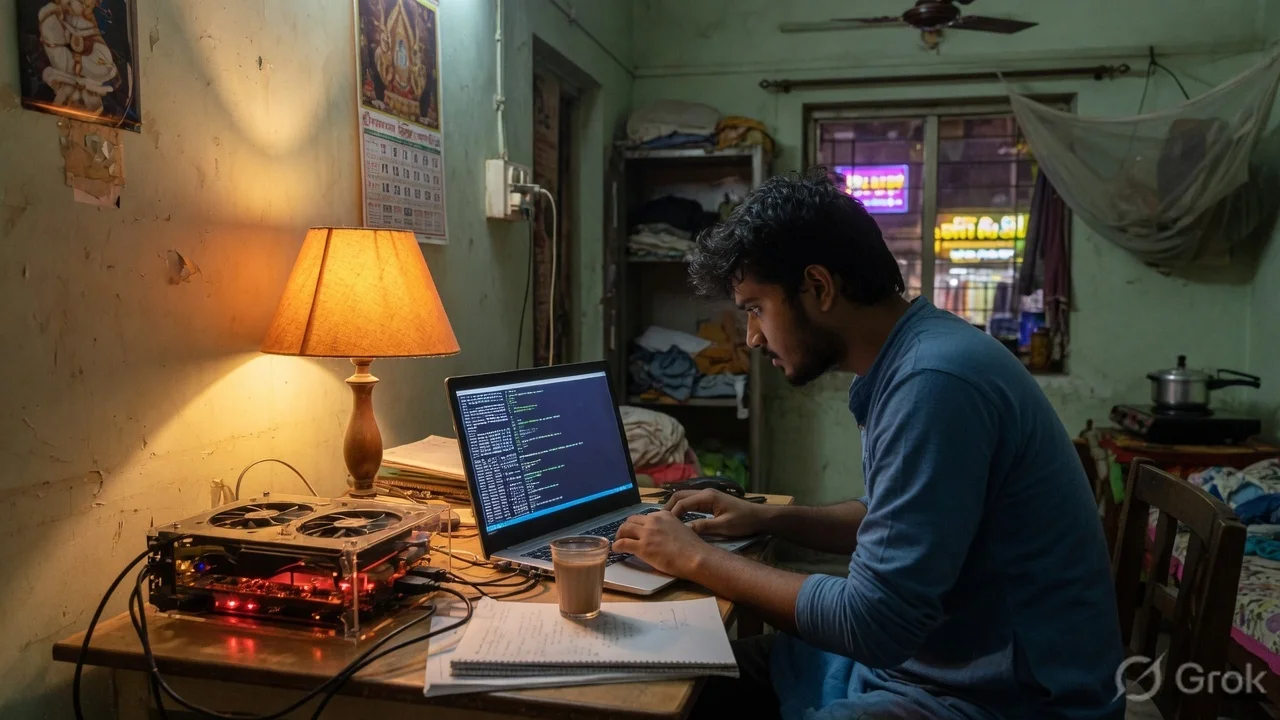
Imagine a computer science student in a tier-2 city building a final year project that requires an AI assistant. With ollama, they can run a capable model for free on their personal laptop, avoiding the recurring costs of API subscriptions. Similarly, a freelance developer in Bangalore can offer AI-powered features to clients without worrying about a ballooning cloud bill, making their services more competitive and profitable.
For IT services companies, this opens up new avenues. They can build bespoke AI solutions for clients, train models on proprietary data without sending it to third-party servers, and offer more secure and private AI deployments. This is a huge selling point in an era where data sovereignty is a major concern.
Use Cases in the Indian Context
Here are three practical ways Indian developers can leverage ollama/ollama right now:
1. College Projects & Hackathons: Need an AI-powered chatbot for your project? Or an application that summarizes text? Instead of building a complex backend to call an API, you can integrate ollama directly into your project. It's perfect for hackathons where you need to build and deploy something impressive in a short time without worrying about API keys and costs.
2. Freelance Development: A freelance web developer can integrate a local LLM into a client's website to provide a unique feature, like an AI-powered code explanation tool or a custom content generator. This adds significant value to their service offering and can be priced competitively since the operational cost is near zero.
3. Internal IT Tools: An IT services firm can use ollama to build an internal knowledge base assistant. The model can be trained on the company's internal documentation, helping employees find information quickly. This improves productivity and keeps sensitive company data secure within the company's own infrastructure.
Honest Take: The TamilTech Verdict
Ollama/ollama is a fantastic piece of engineering and a must-have tool for any Indian developer interested in AI. Its simplicity and power are a winning combination. The ability to run powerful models locally is a game-changer for accessibility and cost-effectiveness.
However, it's not a magic bullet. The primary limitation is hardware. Running large models requires a decent computer with a powerful GPU. While smaller models can run on a CPU, the experience will be slow. So, while it's accessible, the best experience is reserved for those with capable hardware.
But for the price of a one-time download, the potential it unlocks is immense. It empowers developers to experiment, build, and innovate without the financial constraints of the cloud. For the Indian tech community, which is known for its ingenuity and resourcefulness, ollama/ollama is a tool that will undoubtedly fuel the next wave of AI-powered innovation.
Frequently Asked Questions
Q: Is ollama/ollama completely free?
A: Yes, the ollama software itself is open-source and free to use. The models you download are also free, though some may have their own licensing terms. The only cost is the electricity your computer uses to run them.
Q: Do I need a powerful GPU to use it?
A: You can run smaller models on a CPU, but for a smooth experience with larger models, a good GPU (like an NVIDIA card) is highly recommended. The performance difference is significant.
Q: How does it compare to using OpenAI's API?
A: Using the API is easier for simple tasks and doesn't require local hardware. But ollama is better for privacy, cost-control on long-term projects, and when you need to work offline. It also gives you access to a wider variety of open-source models.


Comments (0)
Be the first to comment!