


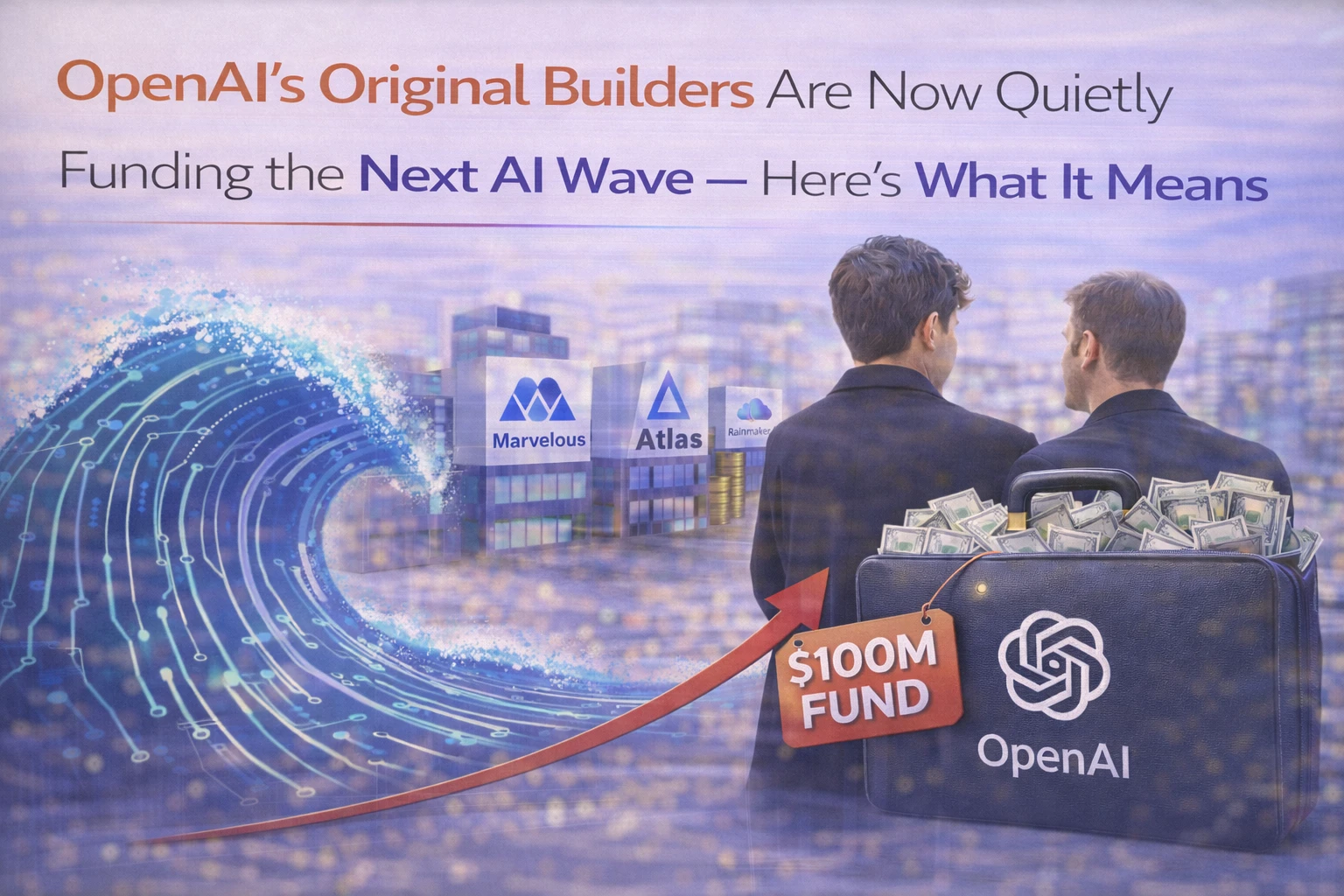
The Builders Are Now the Backers
So here's the thing — the people who actually wrote the code and trained the models behind ChatGPT are no longer just building AI. They're funding it. A brand new venture capital fund called Zero Shot just quietly closed on its first tranche, aiming for a $100 million target. And they've already started writing checks.
Who's Actually Behind This?
If you're tracking AI funding, you've probably noticed most VCs are just finance guys trying to guess which tech will pop. Zero Shot is different. The founding team is literally the original OpenAI engineering crew. Evan Morikawa ran applied engineering when DALL-E and ChatGPT launched. Andrew Mayne was OpenAI's first prompt engineer. Shawn Jain worked on research before spinning up his own GenAI startup. They're joined by seasoned VC Kelly Kovacs and Brett Rounsaville, who previously led tech at Twitter and Disney.
Here's how this happened: these guys have been friends for years inside OpenAI. Once they left, every VC and founder in Silicon Valley started calling them for consulting. Instead of just giving advice over coffee, they realized they should just cut the middleman out and fund the companies themselves.
What Does 'Zero Shot' Actually Mean?
The name isn't just random branding. In AI, zero-shot learning means a model can perform a task it's never seen before, without any prior examples. It just figures it out. The fund operates on the exact same philosophy. They aren't looking for startups that just copy-paste existing SaaS templates. They want teams building foundational, untested, but highly scalable AI tech. No rigid checklists, just pure technical execution.
Why Indian Startups Should Pay Attention
India's AI ecosystem is currently flooded with wrapper apps — basically, companies that just slap an OpenAI API onto a basic website and call it a day. That era is ending. Global investors like this crew are tired of seeing the same chatbot clones. They want deep tech. They want proprietary data pipelines, edge AI for manufacturing, robotics, and enterprise-grade automation.
If you're building an AI startup in Bengaluru, Chennai, or Hyderabad, this is your signal. You don't need a Silicon Valley office anymore. Funds like this invest remotely based on technical traction. If your model solves a real, expensive problem for industries like logistics, agriculture, or healthcare, you're exactly who they want to back. Indian AI teams already have the engineering talent. Now we just need to pivot from cheap API integrations to actual model optimization and domain-specific training datasets.
My Honest Take
I've been tracking AI funding for three years now, and honestly, this shift is overdue. When the actual engineers become the VCs, the noise drops. They can look at your architecture, spot the technical debt from a mile away, and understand why your latency matters. That's a massive advantage for serious builders.
But let's keep it real — this isn't free money. Zero Shot and funds like it will be ruthless about unit economics. If your AI product costs more to run than customers are willing to pay, you're dead in the water. The winners in the next 24 months will be teams that optimize inference costs, build proprietary fine-tuned models, and actually ship to enterprise clients who will sign multi-year contracts. The hype phase is over. The execution phase just started.
What's Coming Next
Once Zero Shot fully closes at $100M, expect a wave of targeted investments in robotics, enterprise AI deployment, and specialized LLMs. Indian founders should start preparing their technical documentation, benchmarking their models publicly, and focusing on real customer retention metrics instead of vanity download numbers. The capital is there. The bar is just higher now.



Comments (0)
Be the first to comment!