


Key Takeaways
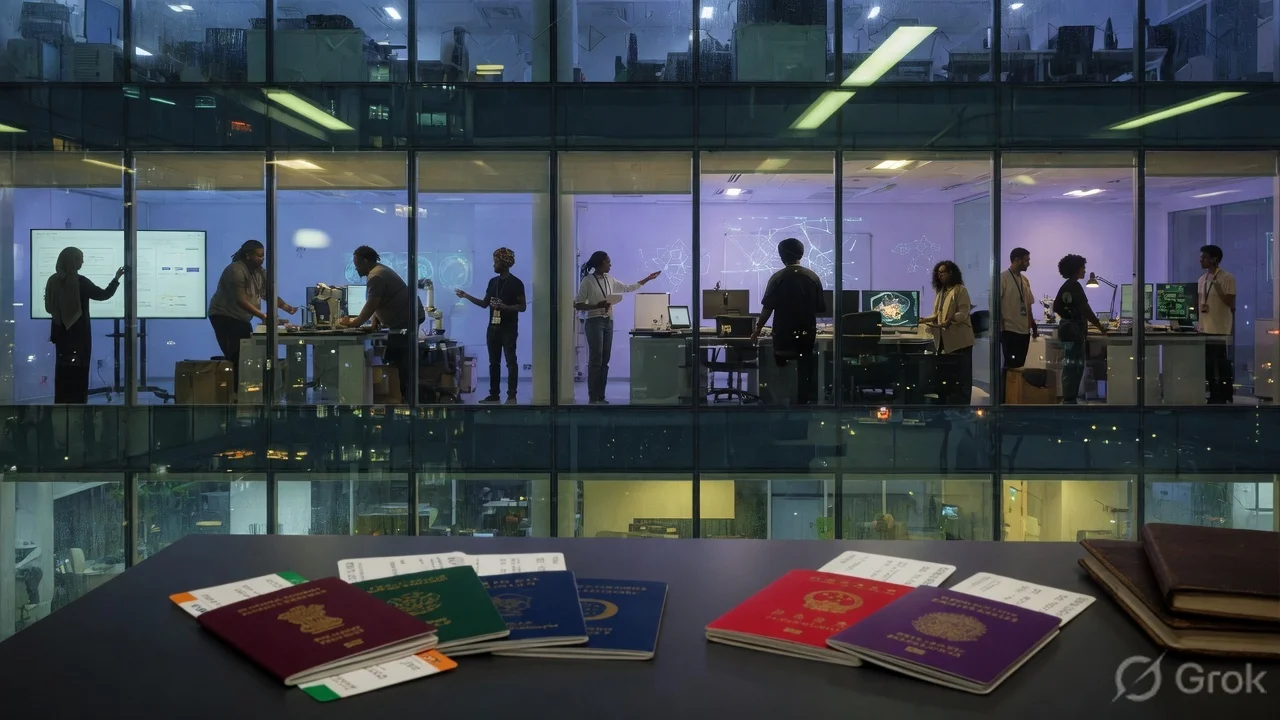
- OpenAI CSO Jason Kwon sent an internal memo stating the company is "strongly" lobbying the US government for open immigration for AI talent.
- The company argues that AI leadership requires the top 0.1% of global researchers, many of whom are currently outside the US.
- In 2026, the competition for AI engineers has reached a fever pitch, with top-tier salaries now touching $1.5 million per year.
- This policy push could significantly benefit Indian tech graduates looking for H-1B or O-1 visa sponsorship at OpenAI or Microsoft.
- TamilTech's Verdict: OpenAI is realizing that hardware (GPUs) is useless without the human brains to program them.
The AI Talent War of 2026
So, here is the thing — the AI race in 2026 isn't just about who has the most NVIDIA chips or the biggest data centers anymore. It has turned into a brutal, high-stakes game of 'capture the genius.' OpenAI, the company that started this whole revolution with ChatGPT, is now feeling the heat. Their Chief Strategy Officer (CSO), Jason Kwon, recently sent out a message to the staff that basically says, "We told the US government they need to let the best people in, or we all lose."
I’ve been tracking these developments for a while, and honestly, the desperation in Kwon's tone is telling. OpenAI isn't just asking for a few more visas; they are demanding a fundamental shift in how the US handles global talent. They are arguing that building Artificial General Intelligence (AGI) isn't a national project — it’s a global one. If the US government keeps the doors closed, those geniuses will just go to London, Paris, or even stay in Bangalore and Beijing to build the competition. That is a nightmare scenario for Sam Altman and his team.
Decoding Jason Kwon's Message
What exactly did Jason Kwon say? In a memo that leaked to the staff, he made it clear that OpenAI has been in deep talks with Washington officials. The core of their argument is simple: the best AI minds are scattered across the globe. You might have a brilliant coder in Chennai or a math prodigy in Tokyo; if you can't get them a visa to work at OpenAI's San Francisco headquarters, you are essentially handing that talent to someone else. Kwon emphasized that OpenAI "strongly" pushed this point, making it a cornerstone of their political strategy in 2026.
This isn't just corporate talk. OpenAI is currently competing with the likes of Google, Meta, and Elon Musk’s xAI. Every single one of these companies is hunting for the same 500 or so people worldwide who actually know how to scale these massive models. By telling the government that AI "requires the best talent from around the world," OpenAI is trying to clear the path for their own hiring spree. They want the government to understand that national security and AI leadership are directly tied to immigration policy.
The Geopolitical Chessboard
Why is this happening now? Well, in 2026, the US government has been tightening security around AI, fearing that foreign talent might leak secrets back to their home countries. But OpenAI is pushing back, saying that the risk of not having that talent is far greater. If the US shuts its doors, the center of gravity for AI could shift. We are already seeing massive AI hubs popping up in the UAE and France. OpenAI knows that if they want to remain the kings of AI, they need to be able to hire anyone, anywhere, instantly.
Think about it — a huge chunk of the research papers that built the foundation of LLMs were co-authored by people born outside the United States. If you look at the current roster at OpenAI, it’s a mini-United Nations. Kwon's message is a reality check for politicians who think they can build a digital wall around AI technology. You can't fence in math and logic; you can only hope to be the place where the people doing the math want to live and work.
The 'India Factor': Why OpenAI Needs Us
Now, let’s talk about the India angle because this is where it gets interesting for us. India produces more engineers than almost any other country. In 2026, the demand for specialized AI talent — people who understand transformer architectures, reinforcement learning, and AI safety — is through the roof. Many of the top students from IITs and other premier institutes are exactly who OpenAI is talking about. If Jason Kwon gets his way and the US government eases visa restrictions for AI researchers, it opens a massive door for Indian talent.
Currently, many Indian engineers face a decade-long wait for green cards or the lottery-based stress of the H-1B visa. OpenAI is essentially lobbying for a 'fast track' for AI experts. They want these people in the US, working on their models, rather than starting their own companies in India or working for European rivals. For a talented engineer in Bengaluru, this could mean a direct ticket to the heart of Silicon Valley with the red carpet rolled out. However, this also raises the question of 'brain drain' — if all our best minds go to OpenAI, what happens to the Indian AI ecosystem?
Salary Explosions and the Cost of Innovation
Let's talk numbers, because they are wild. In 2026, a mid-level AI researcher at a place like OpenAI or Google DeepMind is easily pulling in $500,000 to $800,000. For the real superstars — the ones Jason Kwon is fighting for — we are talking about total compensation packages in the $1.5 million to $3 million range. That’s more than what most star athletes make. OpenAI is willing to pay this, but they can't pay someone who can't get a work permit.
This is why the lobbying is so intense. It’s not just about the money; it’s about the legal right to work. OpenAI is telling the government, "We have the money, we have the compute, but we are being blocked by paperwork." This bottleneck is slowing down the development of GPT-6 and beyond. For the US government, it’s a tough pill to swallow because they have to balance national security with the needs of these tech giants. But as Kwon pointed out, without the people, the technology stalls.
TamilTech's Verdict: Talent is the New Oil
What do we think about this? At TamilTech, we believe OpenAI is 100% right on the facts, even if their motives are purely for their own profit. You cannot build the future of humanity by looking at passports. If you want to solve the hardest problems in science and technology, you need the smartest people in the room, period. The fact that OpenAI is being so vocal about this shows that the 'talent gap' is the biggest threat to their survival right now.
What should you expect next? Expect more 'Special AI Visas' or exemptions to be discussed in the US Congress. For our followers who are students or developers, the message is clear: if you become an expert in AI, the world’s biggest companies will literally fight the government to hire you. The next two years are going to be a golden era for AI professionals. Keep upskilling, keep learning, and who knows? You might be the 'global talent' Jason Kwon is talking about. Stay tuned to TamilTech for more updates on this!





Comments (0)
Be the first to comment!