


Key Takeaways
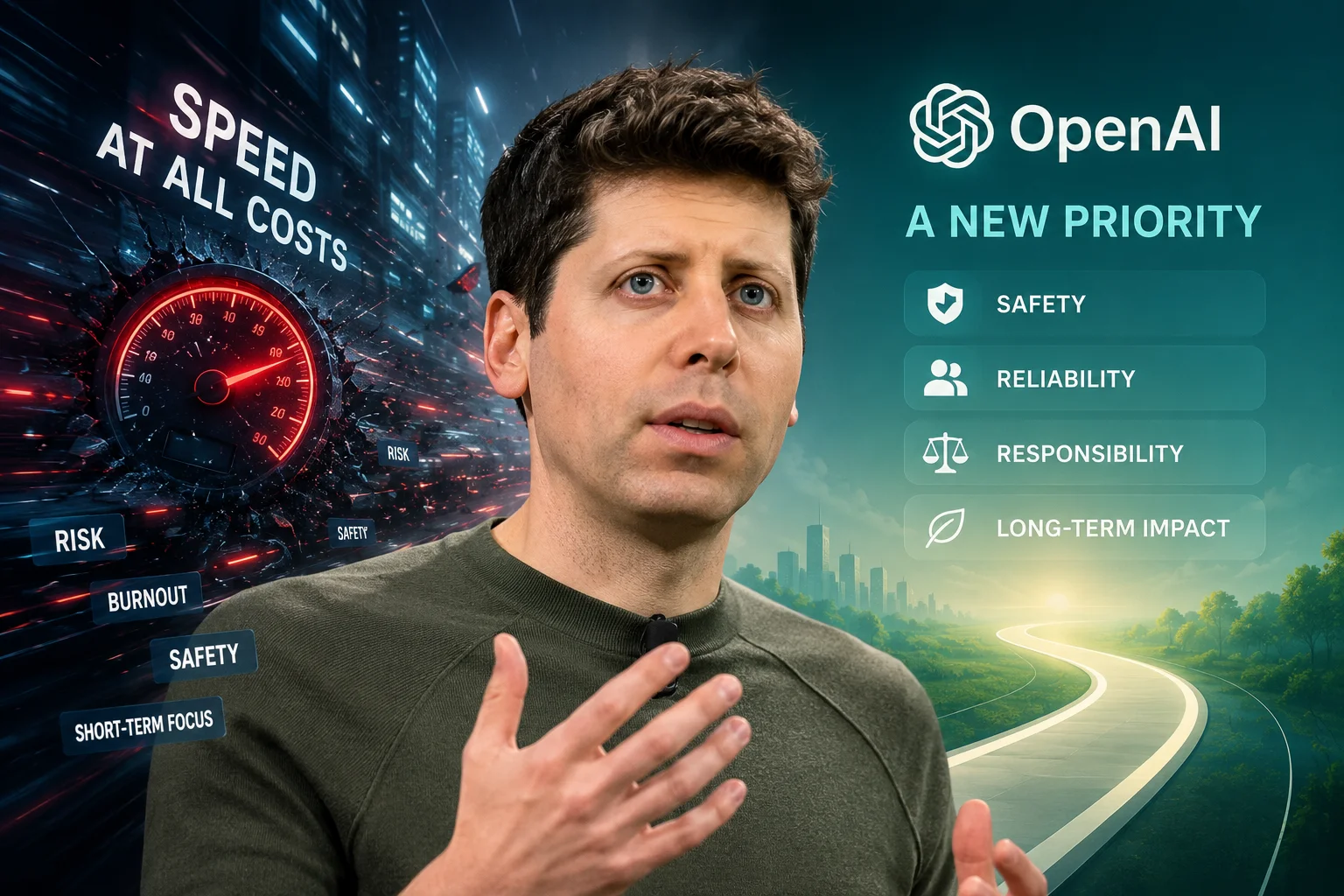
- OpenAI CEO Sam Altman has officially signaled a 'deceleration' phase for the company, moving away from the rapid release cycles of 2024 and 2025.
- The shift is driven by a massive global energy crunch and the 'Compute Wall' where adding more data is no longer yielding 10x improvements.
- For Indian developers, this means GPT-5 and GPT-6 API pricing will likely stabilize, but new 'groundbreaking' features will arrive less frequently.
- The focus is moving from 'bigger models' to 'more reliable and safer models' that can be used in critical sectors like healthcare and law.
The Man Who Rushed the World is Now Slowing Down
For the last few years, Sam Altman has been the face of the 'move fast and break things' era of Artificial Intelligence. Since the launch of GPT-4 and the subsequent madness that followed, the world has been in a constant state of FOMO. Every week there was a new update, a new model, or a new 'Sora-level' breakthrough that made us feel like we were living in a sci-fi movie. But as we sit here in July 2026, the vibe at OpenAI has shifted. Sam Altman is now talking about 'deceleration.' If you think this is just a random corporate statement, think again. This is a massive pivot that will change how every tech company in India and the world operates for the next decade.
We have spent the last three years chasing AGI (Artificial General Intelligence) like it was a gold rush. But now, the reality is hitting home. It’s not that AI isn't getting better; it’s that the cost—both in terms of money and environmental impact—has become unsustainable. When Sam Altman says he is ready to decelerate, he isn't saying OpenAI is losing. He is saying that the era of 'brute-forcing' intelligence by throwing trillions of dollars at GPUs is hitting a ceiling. This is a wake-up call for the entire industry that has been blindly following the 'scaling laws' without looking at the exit signs.
The Background: How We Got to This 'Cooling Off' Period
To understand why this is happening now in 2026, we have to look back at the chaos of 2024 and 2025. Those were the years of the 'Model Wars.' Google, Meta, Anthropic, and OpenAI were releasing new versions of their LLMs almost every three months. It was exhausting for developers and even more expensive for the companies. By the end of 2025, we realized that while GPT-5 was significantly better than GPT-4, the jump wasn't as magical as the jump from GPT-3 to GPT-4. We started seeing 'diminishing returns.'
Then came the energy problem. In 2026, the demand for electricity to power these massive AI data centers has reached a breaking point. Governments across the globe, including India, have started asking tough questions about how much power an AI query consumes compared to a simple Google search. Sam Altman has realized that if OpenAI keeps pushing for bigger and bigger models without focusing on efficiency, they will eventually run out of planet to power them. This deceleration is a strategic move to focus on 'Small Language Models' (SLMs) and more efficient reasoning rather than just raw size.
The Real Reason: It’s All About Safety and Regulation
Another huge factor is the global regulatory landscape. In 2026, AI laws are no longer just 'suggestions.' From the EU AI Act to India's own emerging AI framework, the rules have become very strict. If an AI model hallucinates and causes a financial loss or a medical error, the liability is now on the company that built it. Sam Altman knows that 'moving fast' is a liability in a world where governments are ready to hand out billion-dollar fines. By slowing down, OpenAI can spend more time on 'Alignment'—making sure the AI actually does what it’s told without being creepy or dangerous.
There is also the 'Data Wall.' We have literally run out of high-quality human text on the internet to train these models. In 2025, companies started using 'synthetic data' (AI-generated data to train AI), but that led to 'Model Collapse' where the AI started becoming weird and repetitive. Deceleration allows OpenAI to figure out new ways to learn from video, physical world interactions, and specialized private datasets instead of just scraping the public web. It's a shift from quantity to quality, and honestly, it's about time.
What This Means for India: Pricing and Startups
How does this affect us in India? First, let’s talk about the money. Most Indian AI startups are built on top of OpenAI’s APIs. In the past, every time a new model came out, developers had to scramble to update their prompts and adjust their budgets. With a slower release cycle, we will see much-needed price stability. You won't have to worry that the model you integrated today will be obsolete in three months. This is great news for companies in Bengaluru and Hyderabad that are building long-term enterprise solutions.
However, there is a catch. If OpenAI slows down, it gives more room for Indian-grown models like Krutrim and Sarvam to catch up. We are seeing a huge push for 'Sovereign AI' in India right now. If the global leaders decelerate, it’s a golden opportunity for Indian tech giants to build models that are specifically tuned for Indian languages and cultural contexts without the pressure of competing with a new 'GPT' every few weeks. The focus will shift from 'who has the smartest AI' to 'who has the most useful AI for Indian users.'
Step-by-Step: How to Pivot Your AI Strategy in 2026
Since the 'hype cycle' is slowing down, your business strategy needs to change. Here is how you should handle this deceleration period. Step one: Stop waiting for the 'next big model' to solve your problems. If GPT-5 or current open-source models like Llama 4 aren't solving your use case, a slightly faster GPT-6 probably won't either. You need to focus on 'Fine-tuning' and 'RAG' (Retrieval-Augmented Generation) using your own data. This is where the real value lies in 2026.
Step two: Focus on 'Agentic Workflows.' Instead of just asking an AI to write an email, start building systems where AI agents can talk to each other and complete complex tasks like managing your GST filings or handling customer support from start to finish. Step three: Optimize for cost. Now that we know models won't be changing every week, invest time in making your AI calls cheaper by using smaller, specialized models for simple tasks and only using the big 'OpenAI' guns for the hard stuff. This 'hybrid' approach is what will save you lakhs of rupees in API bills.
Comparison: OpenAI vs. The Rest of the World
While OpenAI is hitting the brakes, others might not. Anthropic is still pushing hard on their 'Claude' series, focusing heavily on long context windows. Meta, with Mark Zuckerberg’s 'Open Source' obsession, is continuing to release Llama models that are getting scarily close to GPT-4o levels of performance. The difference is that while OpenAI is becoming a 'Product Company' (focusing on ChatGPT as an app), Meta is becoming the 'Infrastructure Company' of the AI world.
In India, we are seeing a different trend. While Sam Altman talks about deceleration, Indian firms are accelerating. We are seeing a massive increase in 'Edge AI'—running AI locally on your phone or laptop without needing the cloud. This is crucial for India because of our varied internet connectivity. So, while the 'Brain' (the massive cloud models) might slow down its growth, the 'Body' (how we use AI in our daily lives) is actually going to speed up. It’s a shift from 'Research' to 'Utility.'
TamilTech's Take: Is This Good or Bad?
TamilTech-ஓட கருத்து என்னன்னா, this deceleration is actually a blessing in disguise. For too long, we have been running like headless chickens trying to keep up with every AI tweet. This 'cooling off' period will allow the industry to mature. We need AI that we can trust, AI that doesn't hallucinate our bank balances, and AI that doesn't cost a fortune to run. Sam Altman is playing a long game here. He knows that to win the marathon, you can't sprint the whole way.
Expect 2026 to be the year of 'Polished AI.' Instead of mind-blowing demos that don't work in real life, we will get features that actually make our lives easier. Think of it like the transition from the early, buggy smartphones to the stable iPhones we have today. The 'wow factor' might be less, but the 'usefulness factor' will be much higher. So, don't worry about the slowdown—use this time to actually master the tools we already have. The AI revolution isn't stopping; it’s just growing up.




Comments (0)
Be the first to comment!