


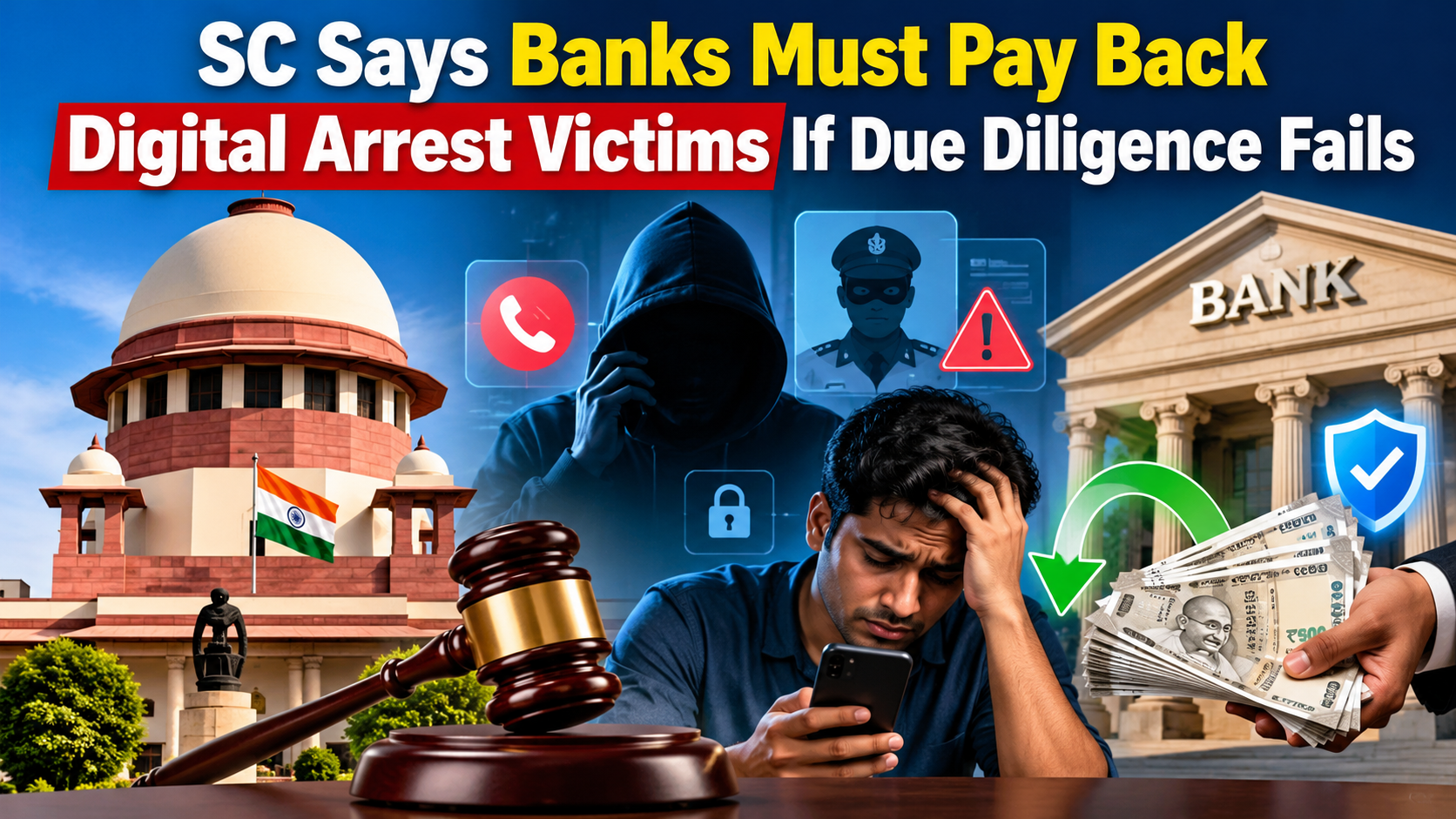
- The Supreme Court observed that RBI regulations must hold banks accountable to fully compensate victims of digital arrest scams when internal due diligence lapses occur.
- Digital arrest frauds force victims to authorise bank transfers under extreme psychological duress, making standard 'customer authorised' disclaimers legally questionable.
- Mule accounts with compromised KYC remain the primary gateway for siphoning illicit money, placing the operational burden squarely on banking security controls.
- The court's stance pushes Indian banking toward stronger transaction monitoring, delayed clearance on suspicious transfers, and strict liability frameworks.
What just happened?
Picture this scene playing out in a quiet living room in Chennai or Bengaluru. An elderly retiree receives a WhatsApp video call. On screen sits someone wearing a police uniform, complete with state emblems, a realistic office backdrop, and convincing police radios crackling in the background. The caller claims an illegal parcel containing drugs or fake passports was intercepted in Mumbai under the victim's Aadhaar number.
What follows is sheer terror. The callers insist on a 'digital arrest', keeping the victim on video for hours or even days. Under relentless psychological threats of prison and public disgrace, the victim rushes to their banking app, breaks fixed deposits, and transfers ₹20 lakh or ₹50 lakh via RTGS to an 'escrow verification account' provided by the fraudsters.
For years, whenever victims approached their banks after the fog of panic cleared, the response was cold and formulaic. Banks pointed to existing Reserve Bank of India circulars and argued that the customer willingly entered their OTP, NetBanking password, or UPI PIN. Because the transfer was technically 'authorised' by the account holder, the bank washed its hands of any liability.
The Supreme Court has now challenged that convenient defence. According to recent court proceedings examining the surge of cyber fraud across India, the bench indicated that RBI rules must be updated so that banks fully compensate digital arrest victims whenever the institution fails in its due diligence. The apex court stressed that people transferring money under intense coercion cannot simply be dismissed as careless users, especially when the banking system itself allows illegal financial pipelines to operate unchecked.
How does this actually work?
To understand why the court is pointing fingers at banks, you have to look at the plumbing of cybercrime in India. Con artists cannot steal your money unless they have somewhere to put it. That destination is almost always a mule account opened in an Indian commercial or cooperative bank.
A mule account is a regular bank account opened using forged documents, stolen Aadhaar and PAN credentials, or bought from impoverished individuals for a few thousand rupees. When a digital arrest victim hits send on an RTGS or IMPS transfer, the money lands in this mule account. Within ninety seconds, automated bots or cash-out networks split that lump sum into dozens of smaller UPI transactions, routing them through layers of micro-accounts before pulling the cash out of ATMs across the country.
This is precisely where bank due diligence collapses. How does a newly opened savings account with a zero balance suddenly receive ₹25 lakh on a random Tuesday morning? Why do bank automated fraud-monitoring algorithms stay silent when that entire sum is drained to ten different virtual payment addresses within three minutes? Even more fundamentally, how did the bank verify the identity of the person holding that account during KYC onboarding?
If the receiving bank skipped strict verification, or if the sending bank ignored glaring red flags—such as an eighty-year-old customer who never transfers more than ₹5,000 suddenly liquidating decades of savings to an unknown account in another state—that is an institutional failure. The court's perspective is straightforward: cybercrime syndicates rely on the weaknesses of the banking network, and banks should not be allowed to profit from transaction fees while treating customer safety as an afterthought.
What changes for people in India?
This development fundamentally alters the power dynamic between everyday depositors and large financial institutions. Under the existing framework, dating back to RBI guidelines on unauthorised electronic banking transactions, customers enjoy zero liability only if fraud occurs through third-party breaches without their involvement, such as an ATM skimming incident or a server-side hack.
The moment an OTP is entered by the customer, banks historically treated the transaction as customer negligence. But digital arrest is not simple phishing. It is extortion executed through sophisticated psychological manipulation. Recognizing that transfers made under duress do not equal voluntary financial transactions closes a massive regulatory loophole.
If the RBI codifies the Supreme Court's direction into mandatory directives, banks will face genuine financial consequences for sloppy oversight. Instead of merely sending SMS warnings urging customers not to share OTPs, lenders will be forced to build actual technical guardrails into their NetBanking portals and mobile apps.
We could soon see mandatory cooling-off periods for large-value transfers sent to newly added beneficiaries, especially when those funds originate from prematurely broken deposits. Banks might also deploy behavioral anomaly alerts that temporarily pause transactions when an account holder's spending patterns deviate radically from their historical data. When banks know they might have to foot the bill for lost funds, their appetite for lax KYC and unmonitored mule accounts will dry up quickly.
What should you do now?
While the legal and regulatory wheels turn, the threat of digital arrest remains active across the country. Fraud rings continue to call unsuspecting citizens every single day, posing as officials from the CBI, Enforcement Directorate, state cyber cells, or customs departments. Protecting yourself and your family requires a few unshakeable ground rules.
First, burn this into your mind: there is no such legal concept as a 'digital arrest' anywhere in Indian law. No police officer, ED director, customs agent, or Supreme Court judge will ever interrogate you on Skype, Zoom, or WhatsApp video calls. Real law enforcement agencies serve physical notices under the Code of Criminal Procedure or Bharatiya Nagarik Suraksha Sanhita. They never demand money to 'clear your name' or verify your funds.
Second, if you or an elderly relative receives a video call from someone claiming to be a police officer demanding you stay on camera, disconnect immediately. Block the number. Talk to a trusted family member or neighbor right away. Fraudsters depend on panic, isolation, and urgency to shut down your critical thinking.
Third, if money has already left your account, time is your only ally. Call the National Cyber Crime Helpline at 1930 immediately or log on to cybercrime.gov.in within the first two hours. This 'golden hour' window allows law enforcement and nodal bank officers to freeze the transaction before the cash is dispersed through mule networks.
Finally, keep a paper trail. If you report a scam to your bank and suspect they allowed the transfer without following basic security checks, register a formal complaint with the bank's internal grievance cell. Under the court's evolving stance, having proof that the destination account lacked proper KYC verification can become crucial evidence when filing a case with the RBI Banking Ombudsman.




Comments (0)
Be the first to comment!