


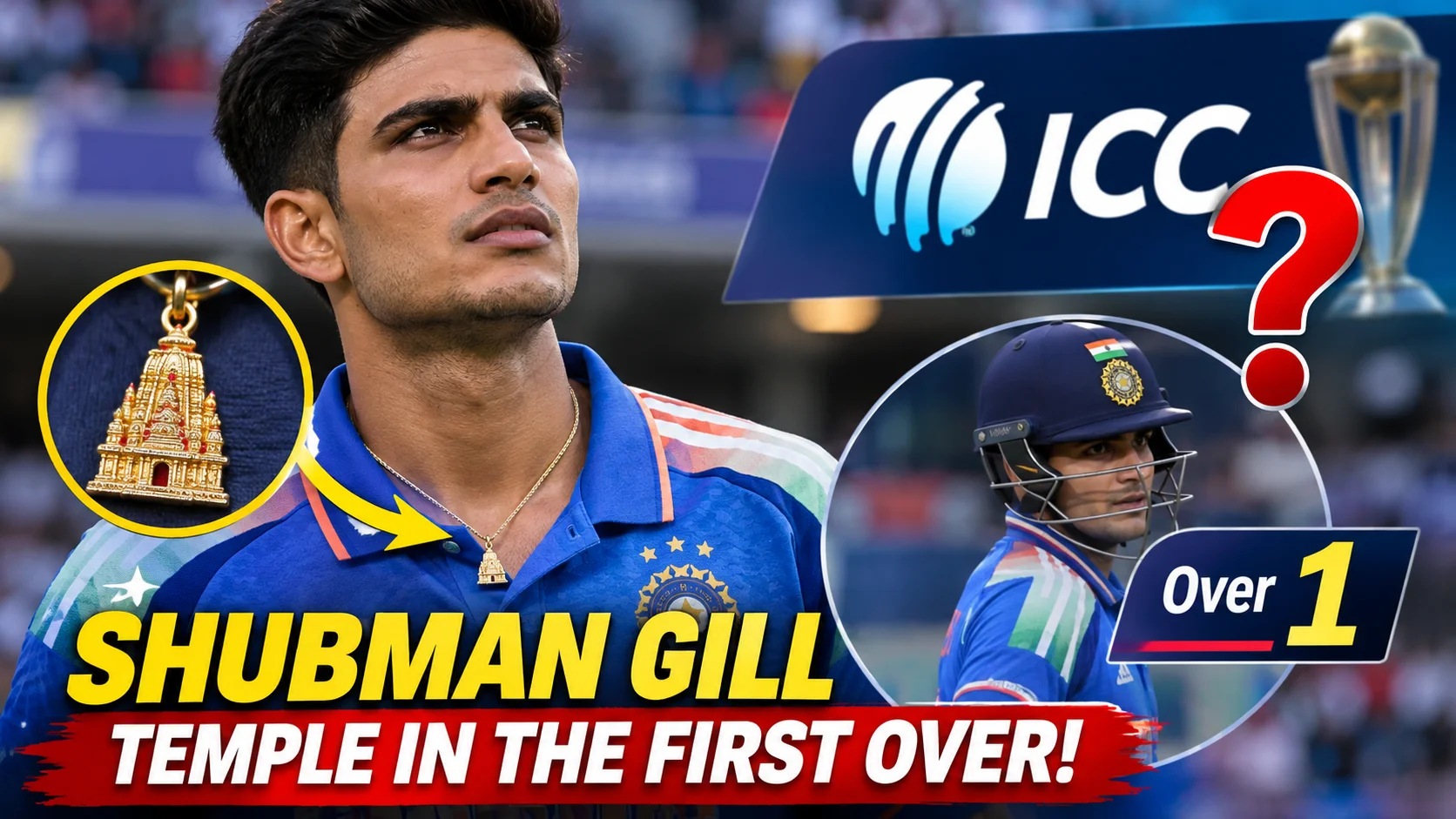
The first thing a lot of Indian cricket fans noticed in the opening overs was not the score. It was a small device on the side of Shubman Gill’s forehead. Business Today, updated 4 November 2026 at 3:47 PM IST, says the India captain was spotted wearing Temple during the first ODI against New Zealand at Eden Park in Auckland. The gadget comes from a team associated with Zomato founder Deepinder Goyal. Fans immediately split into two questions. What does it actually measure, and is a player allowed to wear it in an international match?
Gill had already been seen with it in India’s training sessions before this ODI series. Training gear and match gear are not the same argument. A net session is a closed practice. The opening overs of an ODI are a televised international, with clothing rules, a match-officials area, and a broadcast close-up. That is why the same object became a story only after it showed up in the middle.
What Temple says it is measuring
Business Today describes Temple as a health and performance wearable built to track changes in cerebral blood flow, meaning the movement of blood through the brain. It uses optical sensors and a technology the paper calls BrainFlow. Those sensors collect physiological signals that may offer clues about how the body responds to physical activity, stress and mental workload.
There is also an Entropy score. The paper says it is intended to indicate changes in physiological strain, the sort of pattern a performance team might look at when it is trying to understand exertion and recovery. "Intended" and "could potentially" are doing a lot of work in those sentences. This is not a lab paper, and Business Today does not print a match reading, a baseline, or a claim that Gill’s score changed because of a shot, a sprint, or the Auckland humidity.
The useful contrast is with the band already on half the wrists in a corporate cricket tournament. A normal fitness tracker is mostly heart rate, steps and sleep. Temple, as described here, is aimed at cerebral blood flow and the body’s response around it. That is a different sensor story. It is also why the paper adds the line everyone should keep: the readings should not be treated as a definitive measure of sporting performance or of medical fitness. A number on a forehead device is not a selection report, and it is not a doctor.
Gill is not the first Indian athlete on this thing
Business Today says badminton player PV Sindhu has also been seen using Temple during international competitions. The same page links a separate piece in which she calls the wearable a game changer and says she has been using it herself. That is her comment in that other story, not a medical endorsement printed as fact in this one. Two elite Indian athletes wearing a new sensor will always travel faster on social media than a methods paragraph. It still does not tell you the device is legal in an ODI, or that the ICC has signed off.
Curiosity is fair. Deepinder Goyal is a name people already attach to food delivery. A bean-sized object on the India captain’s temple, in a New Zealand ODI, is going to get screenshotted. The honest version of the screenshot is narrower than the caption most people will write. He was spotted wearing it. The paper does not say he wore it for the whole innings, that the umpires discussed it, or that anyone asked him to take it off.
What the ICC rules actually turn on
Business Today does not deliver a yes or a no. It lays out the frame. The ICC regulates technology and equipment through its playing conditions, its clothing and equipment regulations, and its anti-corruption framework. Three questions sit underneath that. Does the device communicate? Does it comply with the equipment rules? Has its use been authorised?
Under the Player and Match Officials Area regulations, communication devices such as mobile phones and internet-connected devices are prohibited in restricted areas, with specified exceptions. The point of those rules is the integrity of the game: no quiet channel for information that should not be in the dressing room or on the field. A phone in a pocket is an easy example. A sensor on a forehead is only in that bucket if it can send or receive.
The paper draws the distinction carefully. A non-communicating performance monitor may be treated differently from a gadget that transmits or receives. A passive device that only collects physiological data raises a different question from one that can move data during play. Even then, use in an international match depends on the regulations that apply and on any approval that is required. "May be treated differently" is not "therefore it is allowed." Business Today does not cite a clearance for Temple, and it does not cite a ban.
There is a second, less glamorous rule. Clothing and equipment regulations also cover commercial branding on what a player wears. A visible logo on a wearable can be its own compliance problem, separate from whether the sensor talks to a phone. Nobody in this story has published a photo caption that settles the logo question. If you are arguing from a paused frame in a group chat, you are ahead of the article.
What I would not conclude tonight
I would not say Gill broke a rule. I would not say the ICC waved it through because the broadcast showed it for a few overs. Television showing an object is not a ruling. I would not tell a club cricketer to stick a sensor on his forehead for a TNCA league game and call it the same thing Gill did. International playing conditions and a college ground are not the same document.
I also would not buy, or skip, a health gadget because a batter wore it at Eden Park. The only performance claim this article supports is a limited one. The device is designed to track changes in cerebral blood flow, using optical sensors and BrainFlow, with an Entropy score meant to flag changes in physiological strain. It might help an athlete’s staff see exertion and recovery patterns. It should not be read as proof of form, fitness, or a medical result. Goyal’s team built it. Gill was seen in it, first at training, then in the opening overs of the first ODI against New Zealand. That is the sighting. The permission is still a question the paper raises and does not answer.
If you are the person refreshing for a verdict
Wait for the board, not for a reel. The facts that are stable tonight are the place, the match and the object. Eden Park, Auckland. First ODI, India versus New Zealand. Temple, on the side of the forehead, associated with Deepinder Goyal’s team, already seen in training, then noticed once the match started. Sindhu has been seen in it too. The ICC issues the article actually explains are communication, authorisation, and branding. Until someone official says the device was approved, or that it had to come off, "spotted" is the verb. It is not "cleared," and it is not "banned."





Comments (0)
Be the first to comment!