


Key Takeaways
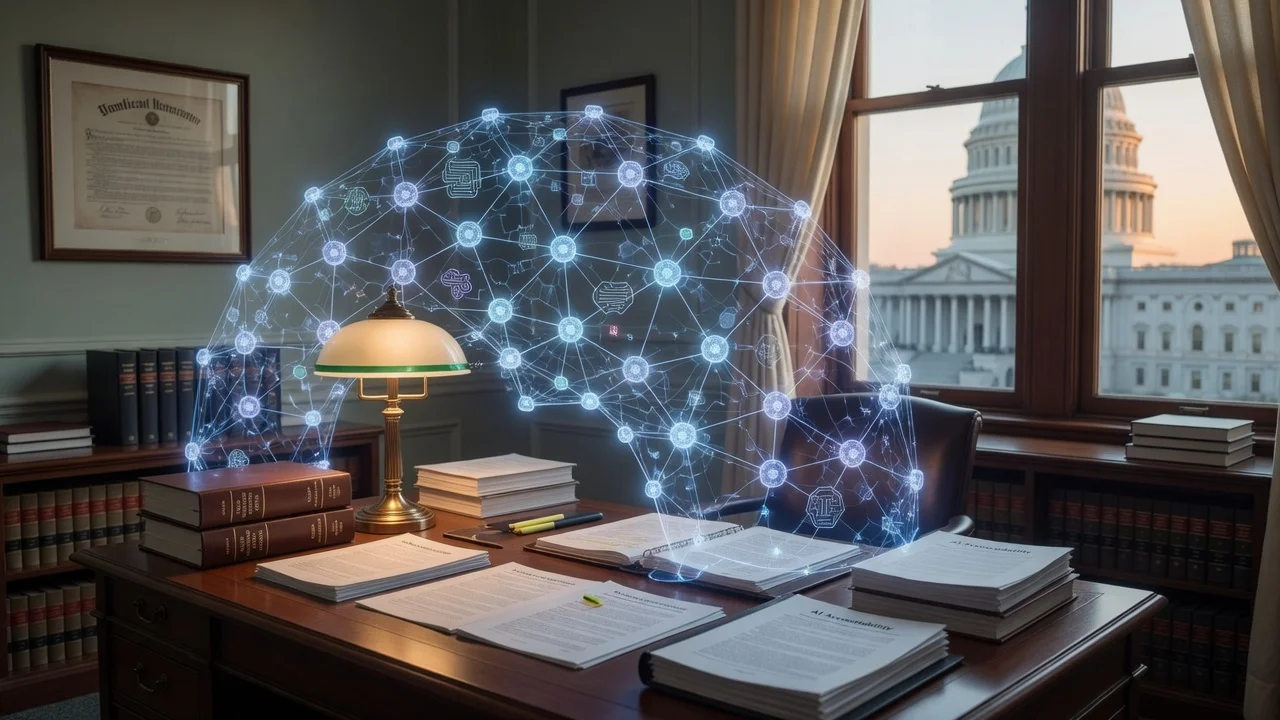
- Trump posted on Truth Social that AI needs no new guardrails beyond a strong, high-IQ US president and that America already has tools to police the industry.
- He argued that casting doubt on AI development mainly helps China ahead of a planned meeting with Xi Jinping.
- Indian firms building on US models - from Flipkart recommendation stacks to Jio AI assistants - now face a clearer US deregulatory signal for 2026.
- Existing US levers (antitrust, consumer protection, export controls) are being framed as enough instead of fresh AI-specific statutes.
- For India this raises the stakes on domestic AI safety rules under the IndiaAI Mission while keeping access to frontier US models open.
What's the news
Donald Trump has publicly dismissed the latest wave of AI safety alarm. On Truth Social he wrote that the only control or "guardrails" AI needs is a strong and smart (high IQ) president, and that the USA already has that in spades. He added that China would benefit from the doubt being cast on AI development. The post lands as he is scheduled to meet Chinese President Xi Jinping, turning a tech-policy spat into a geopolitical signal.
The core claim is simple: stop the panic, keep building, and let existing US enforcement tools do the policing. No fresh AI safety bureaucracy. No slowdown that hands the lead to Beijing. For Indian tech watchers this is not abstract Washington noise. It shapes which models Indian developers can fine-tune, how cloud credits from US hyperscalers get priced, and whether Indian regulators feel pressure to copy heavy Western rules or stay lighter.
Details
Trump's message targets the growing chorus of researchers, labs, and lawmakers who want tighter limits on frontier models - things like mandatory safety evaluations, compute caps, or licensing for large training runs. His counter is that America already possesses the legal and institutional tools to police the industry. Think competition law, consumer-protection statutes, export-control regimes on advanced chips, and agency powers that already cover fraud, discrimination, and national-security risks.
He framed extra "guardrails" talk as self-doubt that China can exploit. The timing matters. A meeting with Xi puts AI competitiveness on the same table as trade and chips. If the US side signals it will not throttle its own labs, Chinese planners get a clearer picture of the race. Trump's Truth Social style - capital letters, IQ jab, America-first swagger - is classic, but the policy substance is deregulatory: keep the pedal down and trust presidential judgment plus existing statutes.
What he did not do is list new bills or name specific agencies. The argument rests on confidence that current tools are sufficient and that leadership IQ is the missing ingredient. Critics of that view usually point to the speed of model capability jumps, dual-use risks, and the difficulty of applying old statutes to black-box systems. Supporters say over-regulation kills startups and hands open-source and Chinese labs the advantage. The post plants Trump firmly in the second camp.
For the industry the practical read is: expect less appetite in Washington for sweeping AI safety laws in the near term, more emphasis on export controls aimed at China, and continued pressure on big tech via classic antitrust and consumer routes. Labs that already run internal red-teaming and evals will keep doing so; the political cover for mandatory external audits looks thinner.
India impact
India sits in the middle of this fight. We import a huge share of frontier model access through APIs and cloud platforms. Flipkart's ranking and personalisation stacks, Jio's consumer AI experiments, UPI fraud-detection models at banks, and countless SaaS startups all lean on US-origin models or chips. A US posture that rejects heavy new safety rules keeps those pipes open and pricing competitive. That is good for Indian builders who cannot yet train GPT-class models from scratch.
At the same time India is writing its own AI playbook. The IndiaAI Mission, compute clusters, and draft guidelines on responsible AI are still forming. If Washington says "we already have tools," New Delhi has more room to craft lighter, India-first rules instead of copying the strictest European templates. That could favour rapid adoption in agriculture advisory bots, vernacular voice assistants, and public-health triage systems - areas where Indian language data and UPI-scale transaction graphs give us an edge.
China competition is the other half. Trump's claim that safety doubt helps Beijing echoes what many Indian strategists already worry about: if the US slows, Chinese open-weight models and chip workarounds fill the gap. Indian enterprises then face a harder choice between US closed APIs and Chinese stacks that may carry different data-residency and security questions. Keeping US labs aggressive helps India maintain optionality.
Rupee costs matter too. Cloud and API bills are often dollar-denominated. A less regulated, more competitive US AI market can mean better INR pricing over time for Indian startups. Conversely, if export controls on chips tighten further in the name of national security (while soft safety rules stay light), Indian cloud providers and research labs could still feel supply squeezes. Watch the fine print on GPU availability more than the rhetoric on "guardrails."
Use cases
Where does "US already has tools" actually show up for Indian users and builders?
First, consumer AI. Chatbots and shopping assistants on Indian apps already sit under existing IT Act and consumer-protection frameworks. If the US side refuses new model-licensing regimes, Indian product teams can keep shipping features - vernacular customer support, UPI payment reminders, Flipkart-style deal finders - without waiting for a global safety certificate that may never arrive.
Second, enterprise and BFSI. Banks using AI for credit scoring or fraud already answer to RBI guidelines and data-localisation rules. US deregulatory noise does not erase those. It does mean the underlying foundation models may iterate faster, giving Indian fintechs fresher capabilities to fine-tune on local transaction data.
Third, public sector and language AI. Government and startup efforts on Indian-language models benefit when frontier US research stays open and fast. Safety filters still matter for hallucination and bias in Hindi, Tamil, or Telugu outputs, but those can be handled with evaluation suites and human review rather than waiting for a US federal AI licence.
Fourth, defence and dual-use. Export controls and chip restrictions remain the real hard tools. Trump's framing separates soft safety culture from hard national-security levers. Indian defence AI projects will still navigate those controls; the Truth Social post does not loosen them.
Fifth, education and skilling. Coding copilots and tutoring bots used by Indian students will keep improving if US labs stay in build mode. Institutions can layer their own content filters and academic-integrity rules on top.
Honest take
Trump's post is classic political theatre wrapped around a real policy bet. The bet is that existing American legal tools plus presidential swagger beat new AI-specific regulators. On the China point he is not wrong that hesitation has a cost - capability races do not pause for white papers. On the "high IQ president is the only guardrail" line, that is marketing, not a governance design. Institutions matter when models can write code, generate deepfakes, or optimise cyber attacks at scale.
For India the useful move is not to cheer or jeer the Truth Social tone. It is to treat the US signal as one input: keep access to frontier models, accelerate domestic compute and data sets under IndiaAI, and write practical rules that fit UPI-scale systems and 22 official languages. We do not need to import either American panic or American bravado wholesale.
Watch what happens after the Xi meeting. If the US doubles down on chip controls while keeping soft AI safety light, Indian builders get a clearer map. If the rhetoric softens into actual new statutes later, the map changes again. Until then, ship products, measure real harms in Indian contexts, and do not wait for Washington to invent the perfect guardrail. The tools that matter most for us are still the ones we build and enforce at home.


Comments (0)
Be the first to comment!