


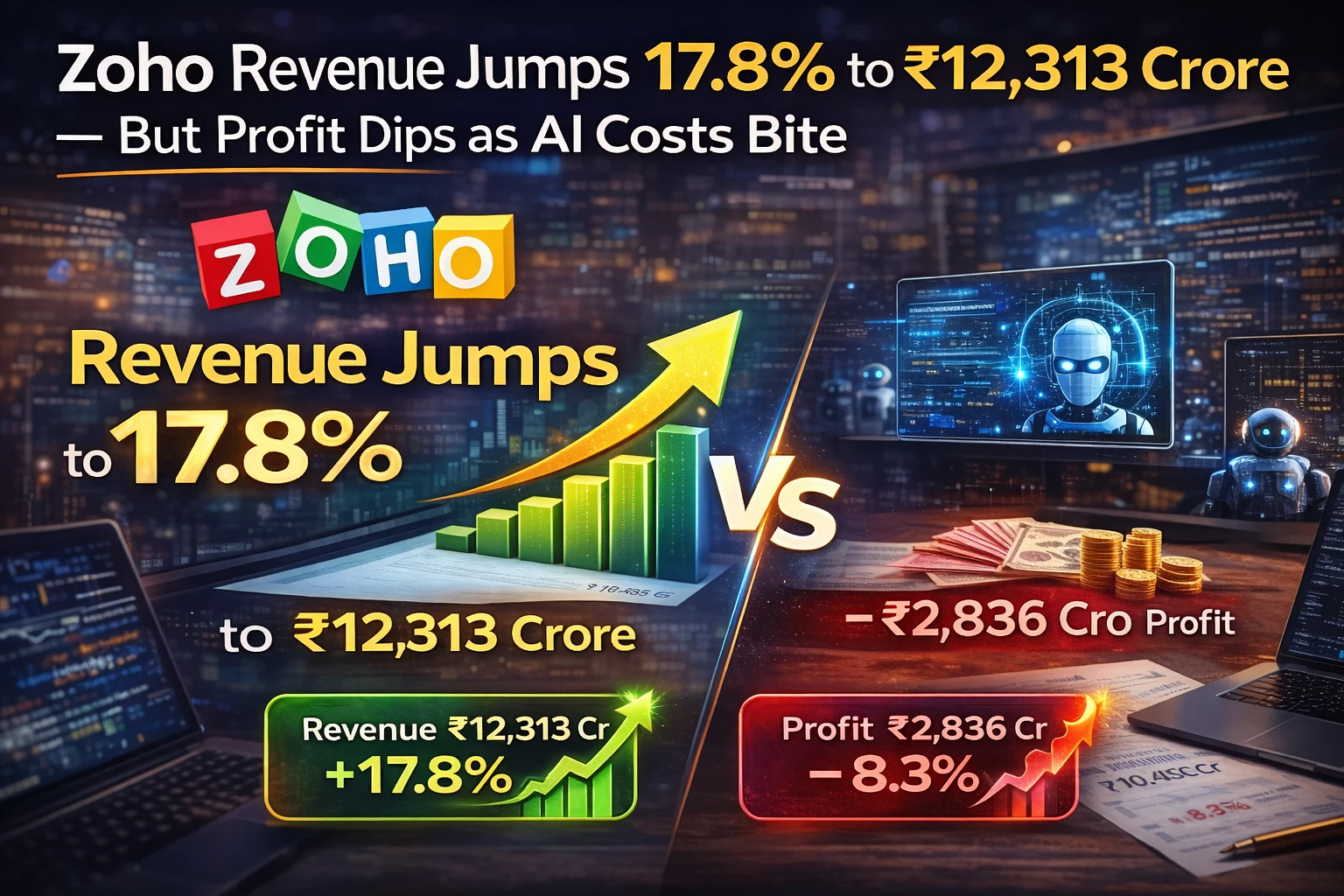
The numbers everybody is panicking about
Let me just drop the headline numbers from Zoho's FY25 filing and then we'll talk about what they actually mean.
| Metric | FY24 | FY25 | Change |
|---|---|---|---|
| Revenue (India entity) | ₹10,451 crore | ₹12,313 crore | +17.8% |
| Total expenses | ₹7,062 crore | ₹9,216 crore | +30.5% |
| Net profit | ₹3,318 crore (approx) | ₹3,191 crore | -3.8% |
| Cash reserves | ₹710 crore | ₹1,878 crore | +164% |
| Global revenue (est) | ~$1.4B | ~$1.5B+ | +10-12% |
| New customers (global) | — | 110,000+ | — |
| Employees worldwide | ~22,000 | ~24,000 | +9% |
So here's what a lot of people are reading this wrong. They look at the profit dip and go "Zoho is in trouble." They look at expenses up 30.5% and go "they're overspending." Both takes are wrong. Let me walk you through why.
The cash reserves number nobody is talking about
Look at that cash reserves line again. ₹710 crore to ₹1,878 crore. That's a 164% jump. A company that's actually struggling does not more than double its cash reserves in a single year. Zoho is sitting on more cash than ever, even after spending aggressively. That tells you the business is generating serious free cash flow — they just chose to reinvest most of it rather than bank it.
This is the kind of thing public-market investors would lose their minds over. "Why not return it to shareholders?" But Zoho isn't public. It never took VC money. Sridhar Vembu owns the company and runs it his way. And his way right now is: pour money into AI before Microsoft, Google, and Salesforce eat your lunch.
Where did the ₹2,154 crore extra expenses actually go?
Expenses jumped from ₹7,062 crore to ₹9,216 crore — an increase of ₹2,154 crore in a single year. Zoho hasn't published a line-by-line breakdown, but based on what's been publicly discussed, here's where the money is going:
- AI infrastructure and GPUs — Zoho is building out its own AI compute. They're not just renting from AWS or Azure, they're buying GPUs and building data centers. This is expensive but it keeps their margin structure intact long-term.
- Zia AI development — Zoho's in-house AI assistant "Zia" is being embedded across all 55+ apps in the Zoho One suite. Training models, building inference pipelines, and rolling out features to millions of users costs real money.
- Hiring — Employee count grew from 22,000 to 24,000. That's 2,000 new salaries, many of them for AI engineers and researchers who aren't cheap even in India.
- Rural campus expansion — Zoho continues investing in its rural campuses across Tamil Nadu (Tenkasi), Andhra Pradesh, Kerala. These aren't profit centers, they're social infrastructure.
- Ulaa browser and new products — Zoho launched its own privacy-first browser (Ulaa) and continues building new products alongside the core SaaS suite.
Every single one of these is a long-term bet. None of them show up as FY25 revenue. Most of them will pay off in FY27, FY28, FY29. The profit dip is the price Zoho is paying to not become irrelevant in the AI era.
Why this is a defensive play against Microsoft, Google, Salesforce
Here's the context that matters. In the last 18 months, Microsoft baked Copilot into Office 365 at $30/user/month. Google rolled out Gemini for Workspace. Salesforce launched Einstein GPT and is betting the entire company on Agentforce. These are Zoho's biggest competitors, and they're all suddenly shipping AI features at a breakneck pace.
If Zoho doesn't match them — if "Zia" stays dumb while Copilot gets smarter — customers will churn. Not immediately, but steadily. Over two or three years, Zoho could lose its mid-market and SMB customers to the AI-powered American giants. The ₹2,000+ crore in extra FY25 spending is the cost of not letting that happen.
Think of it this way: would you rather Zoho maintain its profit margin and slowly die over 5 years, or take a temporary 3.8% profit dip and stay competitive for the next decade? Vembu is choosing option B. It's the right call.
The India growth story is wild
One number that genuinely impressed me: Zoho's India business grew 32% in FY24 and continued strong growth in FY25. Zoho is adding Indian customers faster than any other major market. The 110,000+ new customers globally include a disproportionate chunk from India — SMBs, startups, manufacturing companies, retailers — all looking for affordable alternatives to the American SaaS giants.
Zoho One suite at approximately ₹3,000/user/month for 55+ apps is an insane deal compared to Microsoft 365 Business Premium at ₹1,800/user just for Office + Teams. Indian SMBs are doing the math and switching.
Bootstrapped in an era of VC excess
This is the part I love. Zoho has never taken a single rupee of venture capital. Sridhar Vembu started the company from Tenkasi, Tamil Nadu, built it slowly, profitably, and still owns 100% of it. In an industry where every startup raises ₹500 crore on a PowerPoint deck and burns it in 18 months, Zoho is a 24,000-person profitable company generating over ₹3,000 crore in annual profit without a single outside investor.
Compare Zoho with its bootstrapped or semi-bootstrapped peers in India:
| Company | FY25 Revenue (approx) | Profit | Status |
|---|---|---|---|
| Zoho | ₹12,313 crore | ₹3,191 crore | Bootstrapped, profitable |
| Freshworks | ~₹6,200 crore | Losses shrinking | VC-backed, public |
| Postman | ~₹2,200 crore | Growing | VC-backed, private |
| Chargebee | ~₹1,800 crore | Near break-even | VC-backed, private |
Zoho is bigger than Freshworks, Postman, and Chargebee combined. And it did it without any external funding. That's not luck — that's disciplined capital allocation and a patient founder who doesn't care about quarterly narratives.
What Indian founders should actually learn from this
If you're an early-stage founder reading this in Chennai, Bengaluru, Hyderabad or Pune, take notes:
- Profitability buys you the right to take long bets. Zoho can afford a 3.8% profit dip to invest in AI because they have ₹1,878 crore cash. VC-backed companies with runway anxiety can't make this play.
- Bootstrapping is not dead. It's harder but it gives you control. Vembu does not have to explain AI spending to a board that wants quarterly EPS growth.
- Defensive investments matter. Sometimes the smartest move is to spend money to prevent future losses, not generate new revenue. AI infrastructure for Zoho is a defensive moat against Microsoft.
- Geography is a strategy. Zoho building from Tenkasi instead of Bengaluru isn't a charity project — it's lower costs, lower attrition, better employee retention, and a story no one else can copy.
The bottom line
Zoho's FY25 results look worrying on a surface reading but are actually one of the strongest financial statements from an Indian SaaS company in years. Revenue up 17.8%, cash reserves up 164%, and a deliberate profit dip caused by proactive AI investment. This is what a mature, confident, well-run business looks like when it decides to pivot into a new era.
If Vembu executes the AI bet — and given his track record, betting against him is a bad idea — Zoho will come out of this investment cycle in FY28 with Zia powering the entire suite, 55+ AI-enabled apps, and a cost structure their American competitors simply cannot match. ₹12,313 crore today could easily be ₹25,000 crore by FY29.
The "profit dip" headline is clickbait. The real story is Zoho quietly turning itself into India's first AI-native enterprise software company — while staying 100% founder-owned. That's a masterclass in Indian SaaS, and it's happening right now in Tenkasi.



Comments (0)
Be the first to comment!