


Key Takeaways
- Android Developer Verification, now active across the Play Console in 2026, forces every publisher to submit identity proofing through a centralised platform, disproportionately burdening India's bootstrapped app economy outside major metros.
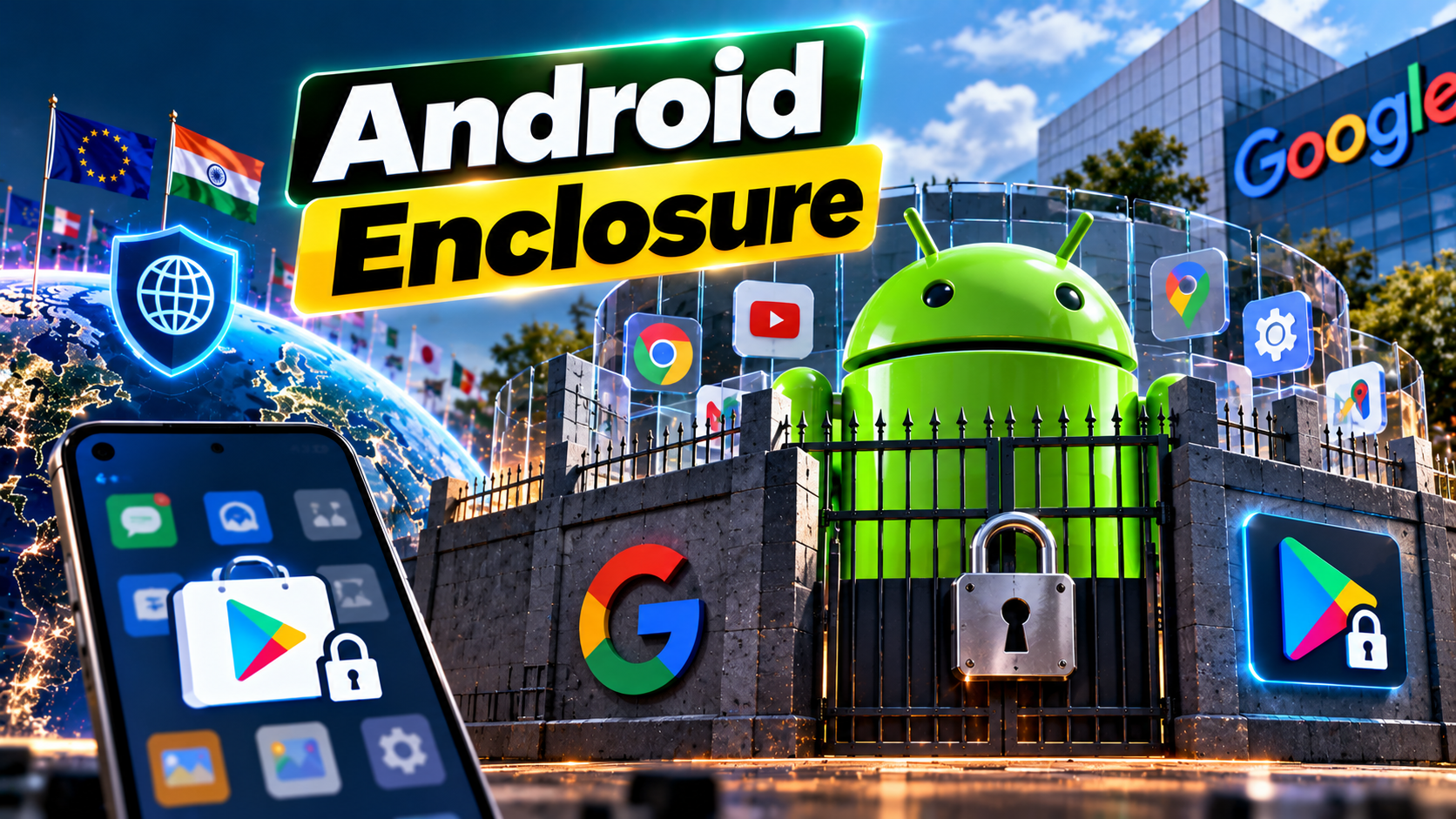
- The programme shifts Android from an open ecosystem to a gated marketplace, handing Google unilateral authority over who can distribute software on devices used by over 700 million Indians.
- Alternative app stores such as Aurora Store and F-Droid currently capture a negligible share of India's mobile traffic, meaning developers who skip Play Console verification still face severe monetization and discoverability penalties.
- Government-backed digital infrastructure like UPI and India Stack provides seamless domestic layers, yet application-level policies such as ADV remain exempt from local jurisdiction, creating a governance black hole.
- While security is the stated justification, the policy effectively functions as an economic filter that advantages large Indian conglomerates with compliance teams while raising exit barriers for category-zero startups.
What's the news
For half a decade, the promise of Android in India has been freedom with a catch. You could open a studio in Tiruchi, code a regional-language utility app, and within a week push it to millions of Jio and Micromax handsets without asking Silicon Valley for permission. That playbook worked because Google treated Play Console as a wide-open mailbox rather than a controlled gate. As of early September 2026, that era is clearly ending. Google is now widening the Android Developer Verification programme across the Play Console, requiring every publisher to link verified identity records to their account before they can easily distribute paid or promoted content.
The stated rationale is straightforward: India has become a global hotspot for bot-driven Play Store accounts, fake utility apps, and SMS-hijacking campaigns. A lack of real-world identity checks made it trivial for bad actors to mask their origins behind throwaway email addresses and stolen credit cards. By forcing real-person verification attached to PAN cards, GST registrations, or equivalent business records, Google says it can warm the spam problem. But the side effect is a hardening of the walls around the world's most popular mobile operating system.
What makes this notable is not the security alone. It is the centralisation. When verification is managed by a single US company, the criteria for approval, suspension, and delisting become opaque to both the Indian government and the average app developer. A studio in Kochi cannot appeal to a local regulator if an algorithm flags their app for policy drift. The only channel is a Help Center queue operated from Mountain View.
Details
Under the current ADV rules, Google distinguishes between basic and verified accounts. Basic accounts can continue to publish, but they face a restricted feature set: no in-app billing support above certain thresholds, limited beta testing, and reduced trust signals in search results. Verified accounts, achieved after phone number, government ID, and sometimes business registration validation, unlock the full Play Console suite including granular user analytics, pre-launch reports, and monetization features.
The rollout is not an on-off switch. Google is migrating legacy accounts in batches, and while the exact timeline varies by country and account age, new participants in 2026 are already being subjected to tightened rubrics. For India, where millions of smaller advertisers and service-oriented startups operate outside traditional incorporation structures, the documentation burden is significant. A micro-SME running a hyper-local delivery aggregator might lack GST registration because their revenue falls below statutory thresholds, yet Google still demands it to process UPI-linked reward coupons safely.
There is also the control loop that verification creates. By tethering every app to a personally or criminally identifiable entity, Google can now blacklist entire geographies or developer personas with greater precision. If a game studio replicates thirty clones of a popular Ludo variant, the algorithm can trace the next account to an earlier verified device and block it preemptively. While this can stop clone armies, it also means that individual publishers lose the ability to reset their digital identity after a mistake.
India impact
The sovereignty angle is what separates this policy from a routine product change. Local alternatives are thin. Flipkart has hinted at app discovery features, but its core business is e-commerce, not software distribution, while JioStore remains blocked from default device pre-loads without GMS. India has invested billions in sovereign digital infrastructure, from Aadhaar and UPI to the Open Network for Digital Commerce. These layers grant the country control over identity and payments. Yet the application layer remains dominated by a single American gatekeeper. If Google can unilaterally decide which developers may publish on Android, it indirectly controls the software economy that sits on top of the India Stack.
This asymmetry becomes politically sensitive whenever policy clashes occur. Should the government mandate a new class of public-service apps or push a national health or ed-tech platform, Google could demand migration of verification records it stores outside Indian data-localisation boundaries. Right now, no such legal conflict exists, but the precedent is clear: trust and distribution in the Indian mobile market must be routed through a foreign walled garden.
For startups, the chilling effect is already visible. Funding conversations in Bengaluru and Gurugram increasingly treat Play Store dependency as a risk factor equivalent to algorithmic censorship on Google Search. VCs now ask founders how many paid users they have on Android versus iOS, understanding that ADV-related suspensions can wipe out revenue overnight without warning.
Use cases
Consider a small studio in Chennai building a Tamil-language children's storytelling app. Without ADV, she uploaded the APK to a personal website and accepted direct UPI collections. After Google tightened rules, she now faces a choice: submit a GST certificate she does not possess, or watch her app's reach wither because she is stuck on a basic account with no visibility in search. She experiments briefly with Aurora Store, but discovers that in-app purchases there are fragmented and lead-generation campaigns are smaller than the mainstream.
Now look at a franchise-turned-localisation studio in Ahmedabad that develops fleet-management tools for electricians. Their clients need basic access to the builds, so they created an internal company Play Store. ADV requires every employee uploaded as a publisher to be individually verified, costing time and legal paperwork. The same friction appears for hospitals using white-labeled patient apps; they must now align developer profiles with corporate tax records just to push a patch.
Finally, think of an indie gamer in Kochi who released a Beatmap-compatible rhythm title. She monetises via Play Billing, which locks her to a verified account with a verified bank KYC. When Google flagged her map for copyright overlap, she spent three weeks in a review hold because her support tickets were routed through an automated queue that demanded extra documentation from





Comments (0)
Be the first to comment!