


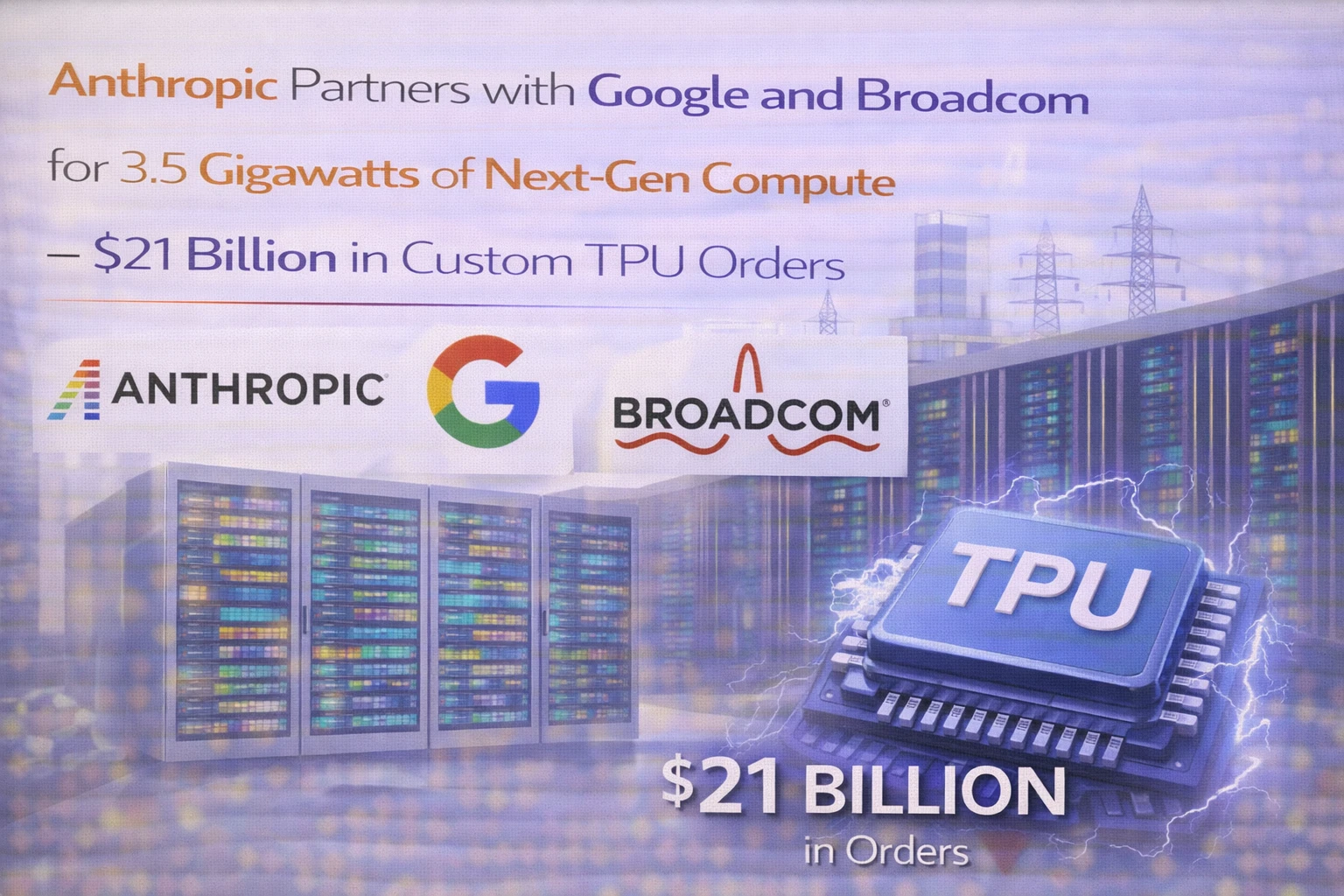
Anthropic's Biggest Infrastructure Bet — 3.5 Gigawatts of AI Compute
On April 6-7, 2026, Anthropic announced its single largest infrastructure commitment: an expanded partnership with Google and Broadcom to secure approximately 3.5 gigawatts (GW) of next-generation Google TPU compute capacity via Broadcom, starting in 2027. This is on top of the 1 GW already being supplied in 2026, bringing Anthropic's total to 4.5 GW.
To put that in perspective: 1 GW can power about 750,000 homes. Total US data center power consumption was around 17 GW in 2022. Anthropic alone is locking up roughly 26% of that capacity.
The Deal by the Numbers
| Metric | Details |
|---|---|
| Total Compute | 4.5 GW (1 GW current + 3.5 GW new) |
| Custom Chip Investment | $21 billion via Broadcom |
| Hardware | ~1 million Google TPU v7p (Ironwood) units |
| Order Timeline | $10B in Q3 FY2025 + $11B in Q4 |
| Delivery | Starting 2027 |
| Location | Primarily United States |
| Part of | $50 billion US AI investment commitment |
What Is TPU v7p (Ironwood)?
The hardware at the center of this deal is Google's latest custom AI chip:
| Specification | TPU v7p (Ironwood) |
|---|---|
| Process Node | TSMC 3nm (N3P) |
| Design | Dual-chiplet |
| Memory | 192 GB HBM3e per unit |
| Bandwidth | 7.4 TB/s peak |
| Performance | 4,614 FP8 TFLOPS |
| Focus | Performance-per-watt for LLM inference |
Broadcom will deliver fully assembled "Ironwood Racks" — complete rack-level AI systems that Anthropic can drop straight into its data centers. This isn't just chips; it's complete rack-scale infrastructure including silicon, interconnects, and networking.
Cost Advantage over NVIDIA
According to SemiAnalysis estimates:
- Internal deployment cost: Ironwood is 44% cheaper than an equivalent NVIDIA system
- External customer pricing: TPU v7 TCO is about 30% lower than NVIDIA
- This cost advantage is critical for Anthropic's inference economics — with over 1,000 enterprise customers spending $1M+ annually, lower per-query costs directly impact margins
Why Does Anthropic Need This Much Compute?
Anthropic's compute hunger is driven by three factors:
- Training frontier models — Each new Claude generation (like the upcoming Claude 5) requires exponentially more compute for pre-training
- Inference at scale — With Claude Opus 4.6, Sonnet 4.6, and enterprise deployments, Anthropic needs massive inference capacity to serve millions of API calls daily
- Safety research — Anthropic's Constitutional AI and alignment research requires significant compute for experiments and evaluation
Anthropic CFO Krishna Rao stated: "This groundbreaking partnership with Google and Broadcom is a continuation of our disciplined approach to scaling infrastructure: we are building the capacity necessary to serve the exponential growth we have seen in our customer base."
How This Compares to Other AI Infrastructure Deals
| Company | Partner | Investment | Hardware |
|---|---|---|---|
| Anthropic | Google + Broadcom | $21B (chips) + $50B (US total) | TPU v7p Ironwood |
| OpenAI | Microsoft + SoftBank | $500B (Stargate project) | Custom + NVIDIA H200 |
| Meta | In-house + NVIDIA | $65B (2026 capex) | NVIDIA H100/H200 + custom MTIA |
| Google DeepMind | Google (internal) | Part of Google's $75B capex | TPU v7 |
Impact on India
While the infrastructure is primarily US-based, the deal has significant implications for India:
- Claude API access — More compute means better availability and potentially lower pricing for Indian developers using Claude through Amazon Bedrock or direct API
- Enterprise adoption — Indian enterprises like TCS, Infosys, and Wipro that deploy Claude for their clients benefit from improved inference capacity
- Broadcom's India connection — Broadcom has major engineering centers in Bangalore and Hyderabad. Some chip design work for Ironwood racks likely involves Indian engineers
- AI cost reduction — The 30-44% cost advantage of TPUs over NVIDIA could eventually translate to cheaper AI services for Indian startups
- Power infrastructure — India is watching global AI power consumption trends closely as it plans its own data center expansion, with projects in Chennai, Mumbai, and Hyderabad
The Bigger Picture — AI Infrastructure Arms Race
The AI industry is in a full-blown infrastructure arms race. Companies are spending hundreds of billions to secure compute capacity. This creates both opportunities and risks:
- Opportunity: More compute means more powerful AI models, better inference speeds, and lower costs eventually reaching consumers
- Risk: Massive capital concentration in a few companies could create oligopolistic AI access
- Environmental concern: 4.5 GW is enormous — equivalent to several nuclear power plants. The carbon footprint is significant
- Geopolitical implications: US-based infrastructure strengthens America's AI lead but raises questions about global AI access equity
CoinDesk notably reported that Bitcoin miners now face a new rival for cheap power as AI companies lock up multi-gigawatt capacity. The competition for energy is reshaping how we think about power infrastructure.
Anthropic's $21 billion bet on custom TPUs through Broadcom — rather than relying solely on NVIDIA — signals a strategic shift in the AI chip market. If Ironwood delivers on its cost-performance promises, it could accelerate the transition away from NVIDIA's dominance.





Comments (0)
Be the first to comment!