


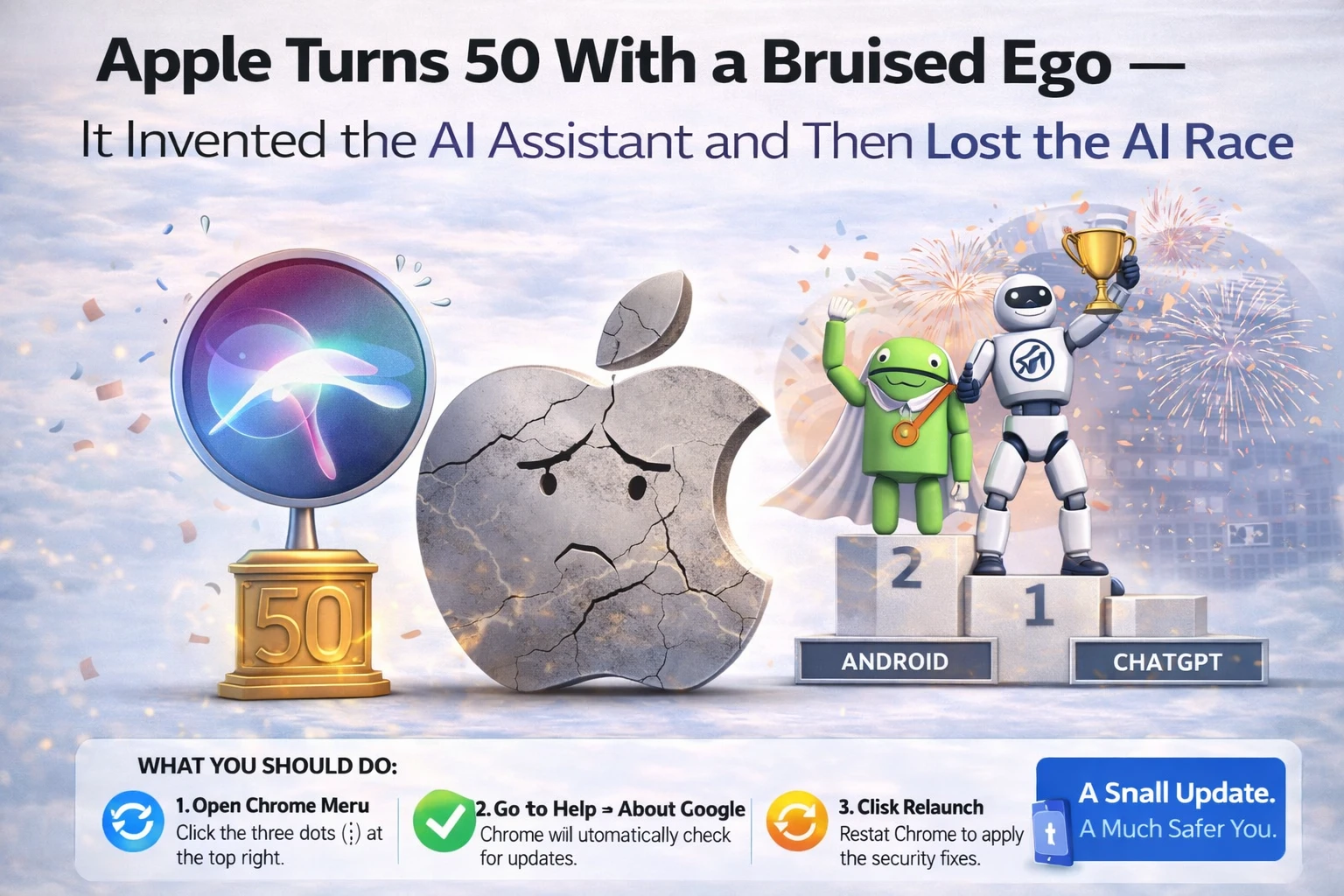
Apple had AI before AI was cool — and still managed to fall behind
In October 2011, Apple put a voice assistant on the iPhone 4S and called it Siri. This was years before Amazon launched Alexa (2014), years before Google Assistant became a standalone product (2016), and well before the phrase "large language model" had entered everyday conversation. Apple's pitch was simple: talk to your phone, get things done.
Fifteen years later, Apple is 50 years old and paying Google to rebuild the thing it invented. In January 2026, Apple struck a multiyear deal to license Google's Gemini AI to power a rebooted Siri. Apple — a company that has spent 15 years telling you that your data is yours and Google can't have it — is now writing checks to Google for intelligence it couldn't build fast enough on its own.
How did this happen? That's the question worth asking as Apple enters its second half-century.
The privacy bet that backfired — at least in the short term
Apple's entire brand identity for the past decade has been privacy. While Google and Meta built trillion-dollar empires by collecting user data and selling targeted ads, Apple took the opposite road. Buy our devices, pay a premium, and your data never leaves your ecosystem. No ad targeting. No data mining. What happens on your iPhone stays on your iPhone.
This was good ethics and, for a long time, good business. iPhone buyers — particularly in premium markets — valued the privacy argument. Apple could charge ₹80,000 to ₹1,50,000 for a phone and people paid it specifically because of this trust premium.
The problem is that training a competitive AI requires enormous amounts of data. And the companies that spent years collecting every search query, every photo caption, every email, every voice recording — they had a training advantage that Apple's privacy-first approach specifically prevented. Google has decades of search data, Gmail data, Maps queries, YouTube watch history. Meta has years of Facebook and Instagram behavior. When the generative AI era arrived with ChatGPT in late 2022, both Google and Meta had data warehouses that Apple's principled restraint had denied it.
Former Apple insiders have said openly that the privacy stance was the right call morally but put the company at a genuine disadvantage in the first wave of generative AI. Siri co-founder Adam Cheyer has indicated that Apple never fully pursued the original ambitious vision for what Siri could become. Walt Mossberg, the legendary tech journalist, put it more bluntly: Apple squandered a five-year head start.
The Gemini deal and what it actually means
The Apple-Google Gemini deal announced in January 2026 is worth understanding in detail because the relationship it creates is genuinely unusual.
Google already pays Apple approximately $20 billion per year to be the default search engine on Safari and iOS. That's Google paying Apple for distribution access to iPhone users. In the Gemini deal, the financial direction reverses: Apple pays Google — reportedly around $1 billion annually — to license a custom 1.2 trillion parameter Gemini model for powering a rebuilt Siri and other Apple Intelligence features.
So Google now simultaneously pays Apple for search distribution AND gets paid by Apple for AI infrastructure. Google wins both ways in this arrangement. Alphabet's stock briefly surpassed Apple's market cap on the day the deal was announced, as investors recognized that Google's AI reach now extends to Apple's two billion active devices.
For Apple, the concern isn't the money — the company reported $54 billion in net cash in its last quarter and returned $32 billion to shareholders through buybacks. The concern is what it signals about Apple's internal AI capability. Apple Intelligence — the suite of AI features Apple announced at WWDC 2024 — launched to generally underwhelming reviews. The on-device AI features worked, but the more ambitious Siri improvements were delayed repeatedly. Licensing Gemini is Apple acknowledging that it needs external help to compete with ChatGPT and Google Gemini in the near term.
Apple's actual bet — on-device AI will win eventually
Here's what the pessimistic narrative misses: Apple has a genuine long-term thesis, and it might be right.
The company is betting that the AI market will eventually shift from cloud-based giant models toward smaller, more efficient models that run entirely on the device. Apple's chip team — the same team that produced the M-series chips that demolished Intel in laptop performance — has been building neural engine hardware specifically for on-device AI processing. The A18 chip in the iPhone 17 has a neural engine that's substantially more capable than what's in competing Android chips.
If AI models get smaller and more capable (a trend that's clearly happening — look at how much better Gemini Nano and Meta's on-device models have gotten in 18 months), Apple's position changes dramatically. On-device AI means no cloud server costs, no data leaving the device, instant response without network latency, and the privacy pitch becomes viable again. Apple's Private Cloud Compute — which processes AI tasks on Apple's own servers with cryptographic guarantees that Apple itself can't see the data — is already a step in this direction.
The Gemini deal is a bridge strategy: use Google's large cloud model for the complex tasks that current on-device models can't handle, while Apple's own on-device capabilities catch up. It's not a surrender — it's a tactical withdrawal while the real battle gets prepared.
What this means for Indian iPhone users right now
Apple Intelligence is not available in India yet. As of early 2026, Apple Intelligence features are restricted to English (US) and a handful of other English variants, with Indian English and Hindi support not yet announced. Indian iPhone users — who number in the tens of millions across the premium segment — are paying for devices that have AI features they can't actually use.
When the Gemini-powered Siri eventually reaches India, it will be a genuinely different experience. Google's Gemini has strong Hindi, Tamil, Telugu, and other Indian language support built in from years of Google Search and Google Assistant data in Indian languages. A Gemini-backed Siri that actually understands Tamil queries or Hindi instructions would be a significant upgrade for Indian users who've found Siri frustrating for anything beyond basic English commands.
The irony is sharp: Apple's privacy-first approach may have cost it the AI race in English, but Google's aggressive data collection in Indian languages — via Search, Maps, YouTube in Hindi and regional languages — gives Gemini-backed Siri a better shot at being genuinely useful for Indian users than Apple's own AI would have been.
For Indian buyers deciding between iPhone 17 models and Android flagships, the Gemini deal is actually good news. It means the AI capabilities gap between iOS and Android shrinks, because both are increasingly drawing from the same Google AI infrastructure. The iPhone's hardware, camera, and privacy ecosystem remain differentiated. The AI assistant, for now, is essentially the same underlying engine.
Fifty years of Apple — what the second fifty might look like
Apple's first 50 years can be roughly divided into three eras. The Jobs 1.0 era (1976-1985): the personal computer revolution, the Mac, the graphical user interface. The post-Jobs era and the return (1985-2007): survival, the iMac comeback, iTunes, iPod. The Jobs 2.0 and Cook era (2007-present): iPhone, iPad, the trillion-dollar company, the services pivot, Apple Watch, AirPods.
Each era had a moment where Apple appeared to be losing and came back stronger. The mid-1990s Apple was weeks from bankruptcy before the Jobs return. The post-iPhone Apple seemed to plateau before services revenue transformed its business model.
The AI era is the next version of that test. Apple is behind right now — clearly, measurably behind ChatGPT and Google Gemini in conversational AI capability. But Apple has pulled off this kind of comeback before, and it has genuine structural advantages: two billion active devices, a chip design team with no real peer among consumer electronics companies, a privacy brand that remains valuable to a significant portion of the global premium market, and $54 billion in cash to deploy.
The next five years in AI will determine whether Apple's on-device bet was visionary or delusional. The answer will probably arrive before Apple's 55th birthday.
TamilTech's take
Apple's AI stumble is real but not fatal. The company that invented the smartphone category and defined what a premium laptop looks like is not going to be permanently outcompeted on AI by companies it's been beating for decades in hardware. The Gemini deal is embarrassing in the sense that it acknowledges a gap — but it's also the kind of pragmatic move that keeps Apple competitive while it works on the longer game. Indian users specifically should watch for Indian language support in Apple Intelligence — when it arrives, the combination of Apple's hardware and Google's language AI could make for a genuinely compelling product. We're just not there yet.




Comments (0)
Be the first to comment!