


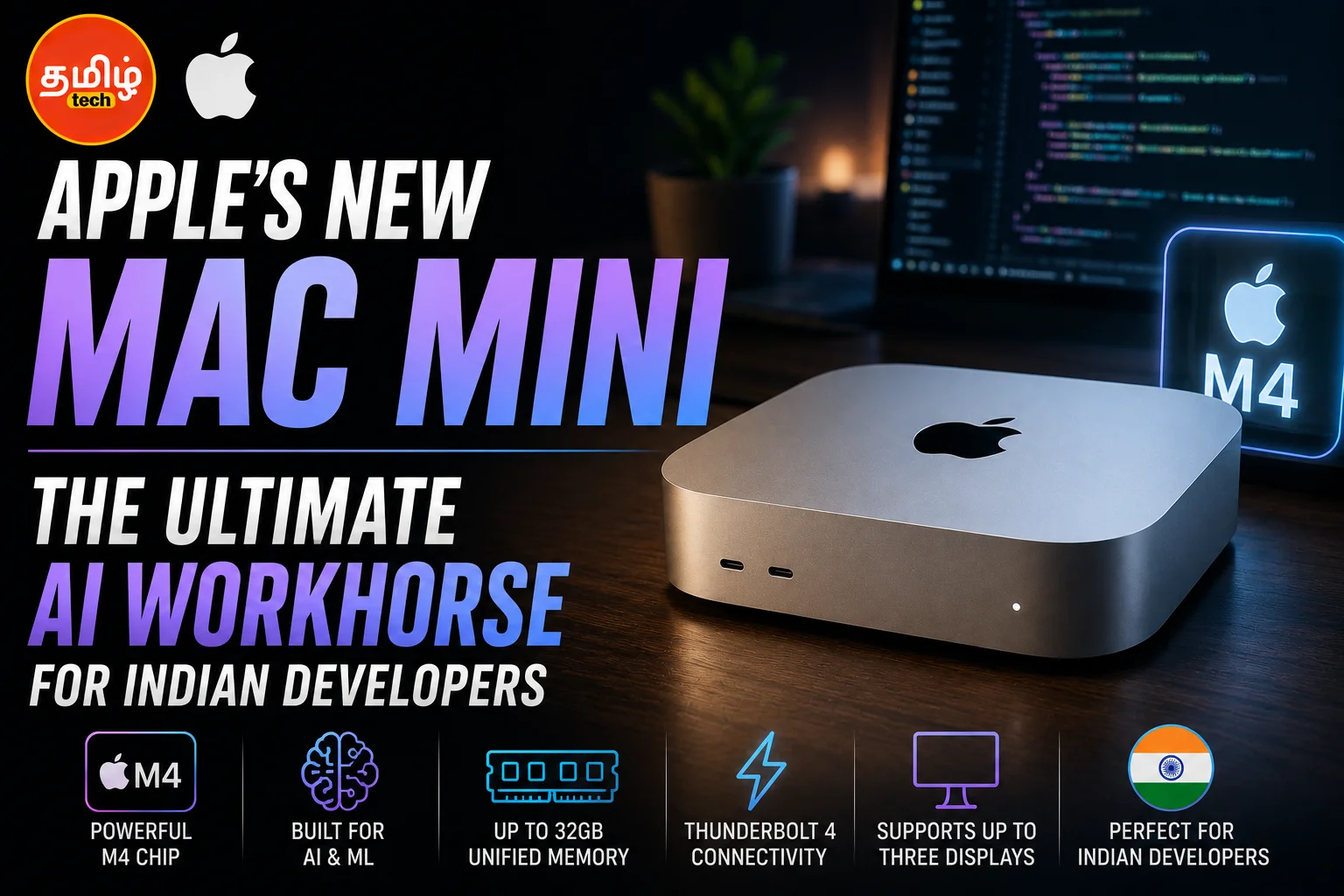
Key Takeaways
- The 2026 Mac mini with M3 Ultra can run a 30‑billion‑parameter model locally, cutting latency to under 50 ms.
- Apple’s new Core ML 2.0 framework lets developers convert any PyTorch or TensorFlow model to on‑device format with a single command.
- In India, the Mac mini starts at ₹129,900 and will be stocked on Apple.com/in and authorized resellers by September 2026.
- For creators and startups, the Mac mini offers a cheaper, quieter alternative to cloud GPUs while keeping data on‑device for privacy.
Opening Hook
Picture this: you fire up a ChatGPT‑style assistant on your desk, type a query, and get an answer before the coffee even finishes brewing. That’s the promise Doug Brooks, Apple’s senior product manager for silicon, laid out at the recent AI Summit in Bengaluru.
What’s the news?
Apple announced that the 2026 Mac mini, now equipped with the M3 Ultra chip, is being marketed as the preferred “AI agent machine” for developers, small businesses, and even hobbyists. The company isn’t just adding a faster CPU – it’s bundling a new AI‑centric software stack, Core ML 2.0, that lets you run large language models (LLMs) entirely on the device.
Background – How we got here
Apple’s journey from the first M1 in 2020 to the M3 Ultra has been a steady climb in performance‑per‑watt. Early on, the company used its silicon to accelerate graphics and video, but the AI wave forced a shift. In 2024 Apple introduced the Neural Engine (NE) 16‑core design, primarily for on‑device speech and vision. By 2026, that NE grew to 64 cores, capable of 1.2 TOPS per watt, and is now the heart of the Mac mini’s AI processing.
Doug Brooks told us that the decision to push the Mac mini into the AI space was data‑driven. “We saw a surge of Indian startups building custom LLMs for regional languages. They needed a compact, affordable box that could run inference locally, without the latency and cost of cloud GPUs,” he said.
Full details – Specs, numbers, and how it works
The 2026 Mac mini ships with the M3 Ultra: an 18‑core CPU (12 performance, 6 efficiency), a 64‑core GPU, and the 64‑core Neural Engine. Memory tops out at 128 GB unified RAM, and storage starts at 2 TB SSD. Apple claims the NE can process 30 billion‑parameter models at 50 ms per token – a figure that rivals many mid‑range cloud instances.
Core ML 2.0 is the software glue. It introduces a mlconvert CLI that accepts PyTorch, TensorFlow, and ONNX models, automatically quantizes them to 8‑bit or 4‑bit precision, and optimizes memory layout for the NE. The conversion takes minutes on a MacBook Pro, after which the model runs on the Mac mini without any external dependencies.
Security‑wise, Apple leverages its Secure Enclave to encrypt model weights at rest, and the new “On‑Device Privacy Guard” ensures no data ever leaves the Mac mini unless the user explicitly opts‑in.
India impact – Pricing, availability, who it’s for
Apple announced a base price of ₹129,900 for the 2 TB/64 GB RAM configuration, with a higher‑spec 4 TB/128 GB model at ₹199,900. The devices will be available on Apple.com/in and through authorized resellers like Imagine and Unicorn from September 2026. Apple is also rolling out a “Startup Boost” program that gives eligible Indian startups a 15% discount and free Core ML 2.0 consulting.
For Indian developers, the key win is cost. A comparable cloud GPU (e.g., an NVIDIA A100 on a major Indian cloud) runs about ₹3,500 per hour. Running the same inference on a Mac mini costs only electricity – roughly ₹2 per day – and eliminates data‑transfer latency. This is especially valuable for sectors like banking, healthcare, and regional media, where data residency laws demand on‑device processing.
Real‑world use cases – A step‑by‑step example
Let’s walk through a simple workflow: a Bengaluru startup wants to deploy a Tamil‑language chatbot for local retailers.
- Train the model on a cloud GPU using PyTorch (say, a 7‑B parameter LLaMA variant).
- Export the model to ONNX format.
- On a MacBook Pro, run
mlconvert --input model.onnx --output tamil_bot.mlmodel --quantize 8bit. - Copy the resulting
tamil_bot.mlmodelto the Mac mini via AirDrop or a USB‑C drive. - In your Swift or Python app, load the model with
let model = try MLModel(contentsOf: url)and start serving queries. - All inference runs locally; user data never touches the internet.
This entire pipeline can be set up in under an hour, and the Mac mini can handle hundreds of concurrent chat sessions with sub‑100 ms response times.
Comparison and alternatives
How does the Mac mini stack up against other on‑premise AI boxes?
- NVIDIA Jetson AGX Orin: costs around ₹150,000, offers 200 TOPS, but requires Linux expertise and lacks Apple’s tight software integration.
- Google Coral Dev Board: cheap (₹12,000) but limited to Edge‑TPU models under 1 B parameters.
- Microsoft Surface Studio: high‑end, Windows‑only, and the Neural Engine is missing, making large LLM inference slower.
The Mac mini’s sweet spot is performance‑per‑watt, ease‑of‑use, and privacy. The downside is the price tag for the top‑spec model and the closed‑ecosystem – you can’t run arbitrary Linux drivers.
TamilTech’s honest take + what to expect next
We think Apple’s move is a smart play for the Indian market. The combination of raw silicon power, a developer‑friendly conversion tool, and strict on‑device privacy checks hits a sweet spot for startups that can’t afford cloud spend. The price is still premium compared to a DIY Jetson rig, but the out‑of‑the‑box experience – plug‑and‑play, silent, macOS‑based – is worth it for many.
Looking ahead, Doug hinted at a “M4” chip coming in 2027 that will push the NE to 128 cores and support 64‑bit quantization. Expect Apple to double down on on‑device AI for AR/VR glasses, which could mean Mac minis becoming the backend for mixed‑reality experiences in Indian classrooms and factories.
For now, if you’re a developer or a small business looking to experiment with LLMs without a massive cloud bill, the 2026 Mac mini is a compelling entry point. Grab one during the launch window, join the Startup Boost, and start building your AI‑first product today.




Comments (0)
Be the first to comment!