


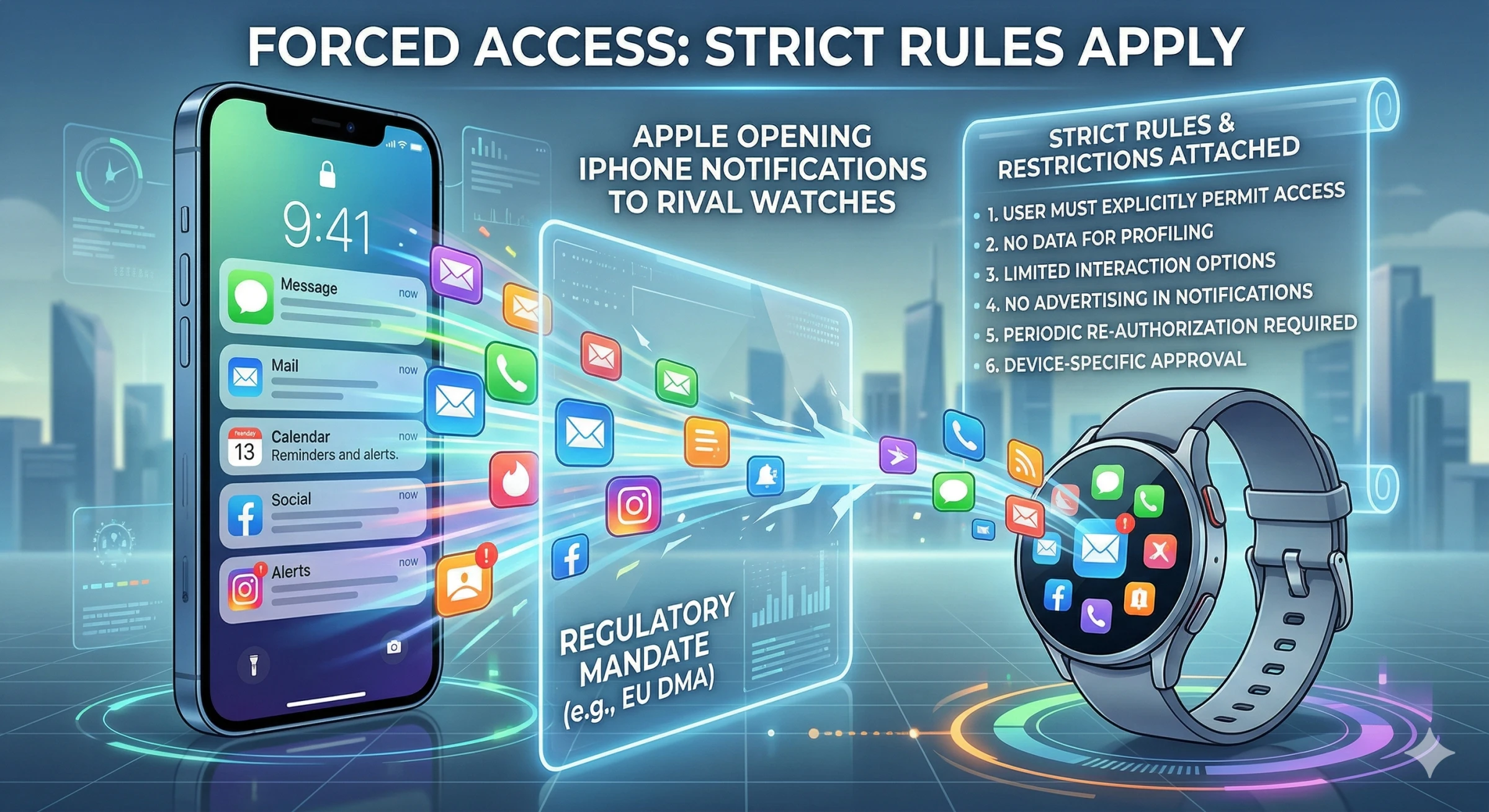
The EU just made Apple do something it really didn't want to do
If you've ever used a Samsung Galaxy Watch or a Garmin with an iPhone, you know the frustration: notifications are limited, Live Activities don't work, and the whole experience feels deliberately crippled. That's not an accident — Apple has historically kept that ecosystem tightly controlled to give Apple Watch a clear advantage.
The European Union's Digital Markets Act (DMA) is changing that. Apple is now legally required to open up iPhone notification and Live Activity access to third-party accessories. And it's complying — but on its own terms, with a strict new rulebook that third-party developers must follow.
What's actually changing?
Apple has updated its Developer Program License Agreement — the legal document developers agree to when building apps and accessories for Apple platforms — with a brand new section: 3.3.3(J), covering something called the Accessory Notifications Framework and Accessory Live Activities Framework.
These are new system-level frameworks that allow third-party accessories to receive forwarded notifications and Live Activities from an iPhone. Live Activities, if you're not familiar, are the real-time updates that appear on your iPhone's lock screen and Dynamic Island — delivery tracking, match scores, flight status, Zomato order progress, Swiggy delivery countdowns. Currently only Apple Watch can display these natively. The new framework will let other wearables do it too — but only in the EU for now, as part of DMA compliance.
The notification forwarding part goes alongside this: third-party accessories will be able to display the actual content of your iPhone notifications. Messages, emails, alerts, reminders — all of it. This is significant because Apple had previously engineered iOS so that even Apple itself cannot read the content of your notifications. Opening this to third parties is a genuinely sensitive thing to do, and Apple knows it.
The strict rules Apple is attaching
Apple isn't opening this up freely. The new licence agreement section contains explicit rules about what third-party developers can and cannot do with the notification and Live Activity data they receive.
No advertising or profiling: Third parties cannot use your forwarded notification content to target you with ads or build a behavioural profile of you. This is the most important rule. Your message content, medical alerts, and purchase notifications cannot become ad-targeting data.
No AI training: The data cannot be used to train AI or machine learning models. A third-party wearable company cannot feed your notification content into its AI to improve its products.
No location monitoring: The forwarded data cannot be used to track your location, even though notification content might sometimes contain location-relevant information.
No sharing beyond the one configured accessory: The data can only go to the specific third-party accessory the user has set up. It cannot be sent to other apps on that device, other devices, or anywhere else.
Encryption keys cannot leave the accessory: The decryption of notification data must happen on the accessory itself, not in the cloud, not on a server, not on the user's own iPhone separately.
No cloud storage: Developers cannot store this data on remote servers or cloud infrastructure, except in cases where it's strictly necessary for delivery (like if the accessory is temporarily out of range).
No altering the content: Third parties can format or display the notification differently, but they cannot change the actual meaning or substance of the content.
Why did Apple fight this so hard?
Apple spent considerable effort arguing against this change. The company published a public statement arguing that the DMA's interoperability requirements create real security and privacy risks that don't exist in Apple's controlled ecosystem.
Their specific argument about notifications was pointed: Apple deliberately designed iOS so that Apple itself cannot read notification content. Even Apple doesn't have access to the full text of your iMessages or your medical alerts from the Health app. The DMA would force Apple to create a pathway that gives third-party companies access to data that Apple itself can't see — which means the privacy guarantee that has been a key selling point of the iPhone would be weakened at the operating system level.
That argument didn't win with EU regulators. The DMA's interoperability requirements stand, and Apple is now complying. The strict rules in the new licence agreement are Apple's way of trying to maintain as much control over how this data is handled as legally possible, even though it lost the argument about whether to open it up at all.
What does this mean for iPhone users outside the EU — including India?
For now, this is EU-only. Apple has been implementing DMA compliance features as region-specific additions — they don't roll out globally. If you're in India using an iPhone with a Samsung Galaxy Watch or a Garmin, you won't see this change immediately.
That said, this matters for India for a few reasons. First, it sets a precedent. Once Apple builds these frameworks and demonstrates they can work safely, the pressure to expand them globally increases — from competitors, from Indian regulators, and from users. India's own digital competition regulations are evolving, and what the EU forces today often becomes an industry standard later.
Second, it signals a genuine shift in Apple's ecosystem strategy. The tight integration between iPhone and Apple Watch has been a major reason people stay in the Apple ecosystem. If third-party wearables get comparable notification access, that advantage weakens. For Indian users considering whether a ₹40,000 Apple Watch is worth it versus a ₹20,000 Samsung Galaxy Watch or a ₹15,000 Garmin, the notification gap has always been a deciding factor. That gap is now officially closing, at least in one region.
How will users actually experience this?
Apple is building user-facing permission prompts into this system. When you configure a third-party accessory to receive notifications, iOS will show you a prompt explaining what you're allowing — with a specific warning that the data may contain personal information including health data, location data, and purchasing history.
Users will also get granularity: you can choose which specific apps can share Live Activities or notifications with the accessory, or grant full access. If you grant full access, that applies to all current and future apps — the prompt will make this clear.
Only one device can receive forwarded notifications at a time. If you enable notification forwarding to a third-party accessory, Apple Watch stops receiving those same notifications. It's a deliberate design choice to prevent data leakage across multiple destinations simultaneously.
TamilTech's take
Apple's position here is genuinely complicated. On one hand, they're right that opening up notification content to third parties is a real privacy risk — the new rules are strict precisely because Apple knows what's at stake if a wearable company abuses this access. On the other hand, the status quo was also a competitive moat dressed up as a privacy feature. The DMA forcing this open is producing a reasonable outcome: third-party accessories get the access they need to compete, but with guardrails that at least attempt to prevent the worst abuses. For iPhone users who prefer non-Apple wearables — and in India, that's a lot of people who can't justify Apple Watch pricing — this is ultimately good news. Even if India doesn't get it immediately, the pressure to expand this globally is now built in.

Comments (0)
Be the first to comment!