


Key Takeaways
- Delhi police now operate a system capable of tracking up to 50 million faces.
- The facial recognition engine promises to match a face against its database in roughly five seconds.
- The deployment raises serious questions about data storage, consent, and oversight.
- Authorities say the tool will help solve crimes and manage large public gatherings.
- Activists warn of mission creep and demand a transparent legal framework.
What's the news
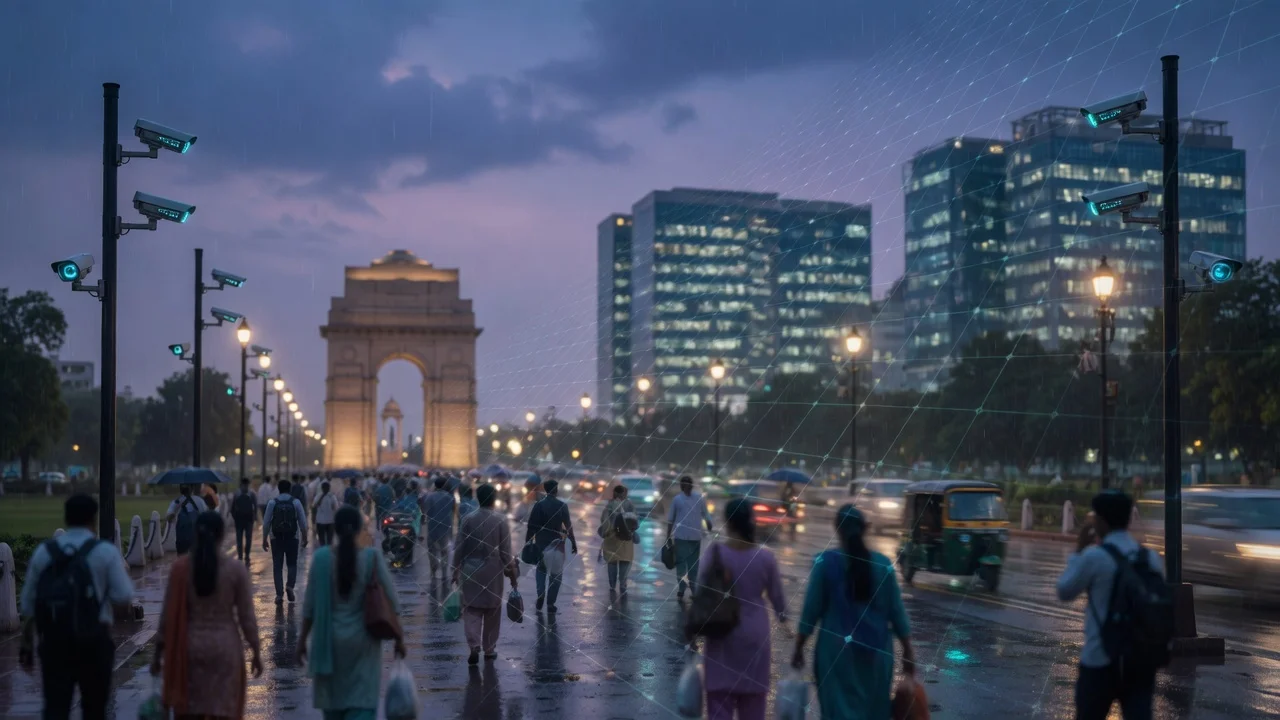
According to recent reporting, Delhi’s surveillance apparatus has been upgraded with a nationwide facial recognition backend. Cameras installed at metro stations, major markets, and busy intersections now feed live video to centralized servers. The system is said to hold templates for up to fifty million individuals, a figure that roughly matches the city’s resident population plus a floating workforce. When a face is detected, the algorithm compares it against the stored templates and returns a potential match within five seconds. Authorities have presented the upgrade as a force multiplier for policing, especially during events that draw huge crowds.
Details
The technical backbone relies on high‑definition CCTV feeds that are compressed and streamed over a mix of fiber and 5G links. Jio’s 5G network has been cited in industry circles as providing the low‑latency pipes needed for real‑time video analytics. On the server side, the platform uses convolutional neural networks trained on a diverse set of Indian facial features to reduce bias. The matching pipeline is designed to run on GPU clusters that can process thousands of frames per second, enabling the five‑second response time claimed by the project.
Data retention policies are still being framed. Officials say that raw video is kept for a limited period, while biometric templates are stored longer for investigative purposes. Access logs are supposed to be monitored by an internal audit team, though independent oversight mechanisms have not yet been detailed publicly.
India impact
The scale of the deployment touches on several nerve points in India’s ongoing debate about privacy and state power. Unlike the UPI ecosystem, which grew through voluntary participation and clear user consent, facial recognition systems often operate in public spaces where individuals cannot easily opt out. This creates a tension between the promise of faster crime detection and the risk of constant, low‑level monitoring.
Legal scholars point out that India still lacks a comprehensive data protection law that specifically addresses biometric information. While the Personal Data Protection Bill has undergone multiple revisions, its final shape and enforcement timeline remain uncertain. In the absence of clear rules, there is a concern that function creep could see the technology used for purposes beyond its original mandate, such as tracking political dissent or monitoring marginalized communities.
On the flip side, proponents argue that India’s experience with large‑scale digital ID programmes like Aadhaar shows that the country can build and manage massive identity infrastructures when proper safeguards are in place. They suggest that the same rigor applied to Aadhaar’s data access protocols could be adapted for facial recognition, provided there is transparency, periodic audits, and avenues for redress.
Use cases
Police officials have outlined several scenarios where the system could prove useful. In criminal investigations, a suspect caught on camera near a crime scene could be identified quickly, potentially shortening the time between offense and arrest. For missing persons, especially children lost in crowded markets or festivals, the technology could help reunite families by matching a live feed against a database of reported missing individuals.
Traffic management is another cited use. Cameras at intersections could detect riders without helmets or drivers jumping red lights, automatically generating challans without needing a human operator to review each clip. During large public gatherings — such as Independence Day celebrations at India Gate or religious processions — the system could flag individuals with outstanding warrants or those deemed a security risk, allowing personnel to intervene before an incident escalates.
Retail spaces have also shown interest. Some mall operators have piloted similar tools to spot known shoplifters entering their premises, though these deployments remain limited and are usually governed by private‑sector policies rather than public law.
Honest take
The technology itself is not inherently good or bad; its impact hinges on the governance framework that surrounds it. Delhi’s rollout demonstrates that India can field a surveillance system of continental scale, but it also highlights the urgency of establishing clear, enforceable limits on how biometric data is collected, stored, and used.
A robust framework would include: a statutory definition of biometric data as sensitive personal information; mandatory impact assessments before any expansion; independent oversight boards with representation from civil liberties groups; sunset clauses that require periodic re‑authorization; and accessible redress mechanisms for individuals who believe they have been misidentified or unfairly targeted.
Without such safeguards, the risk is that the system becomes a tool for pervasive monitoring rather than targeted law enforcement. Given India’s vibrant democratic culture and its recent strides in digital empowerment, striking the right balance will be crucial to ensure that advances in AI serve public safety without eroding the freedoms they are meant to protect.





Comments (0)
Be the first to comment!