


Key Takeaways
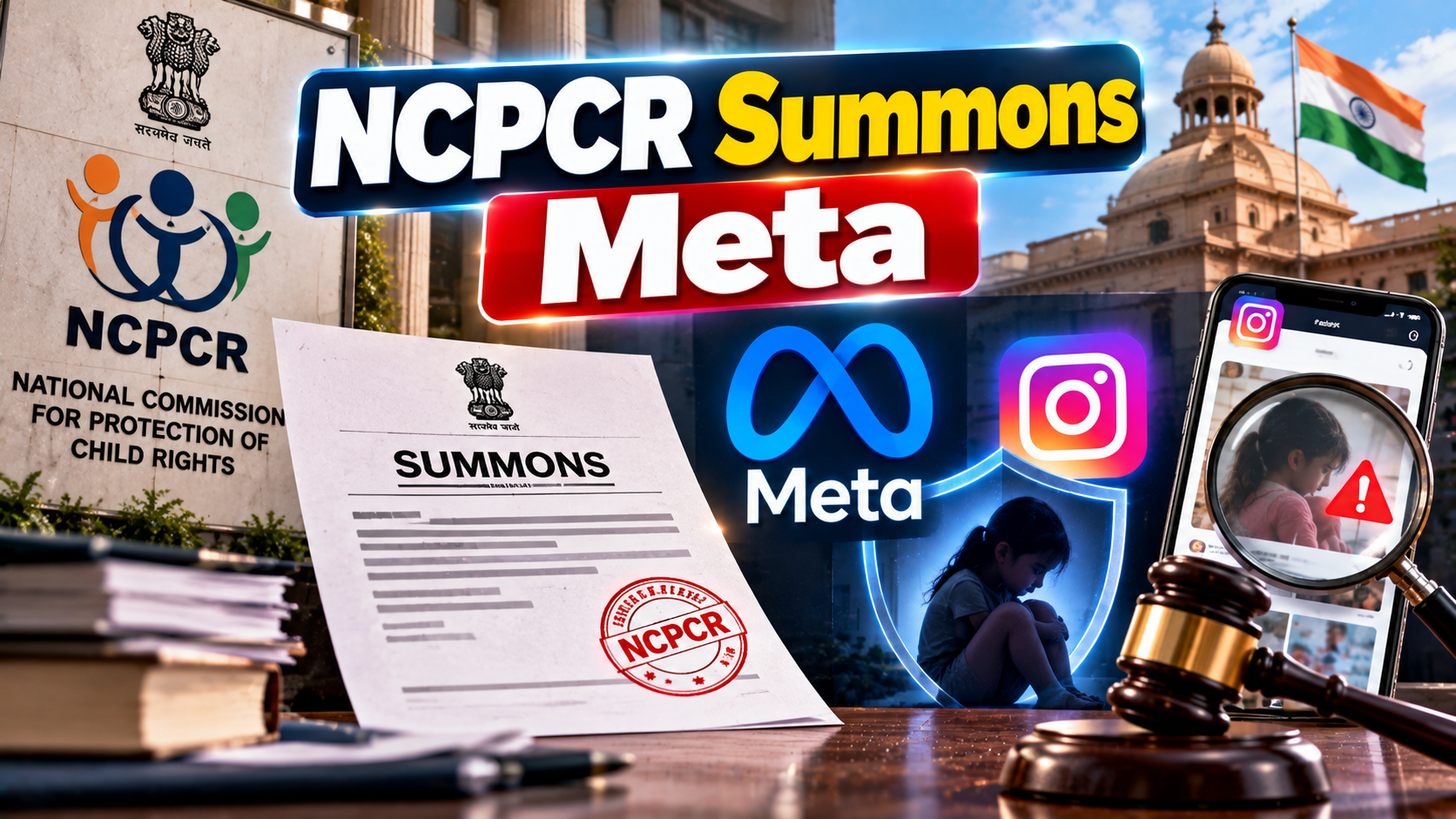
- NCPCR has summoned the Meta India head to appear before the commission on 9 September 2026 to answer for child abuse advertisements on Instagram.
- The formal inquiry was launched roughly one month ago after reports that minors were shown ads linked to harmful or exploitative content.
- India's tighter digital rules under the Digital Personal Data Protection Act and updated IT Rules are forcing global platforms to show stronger local accountability.
- The outcome could set a precedent for future Big Tech investigations, potentially forcing platforms to redesign ad-revenue models in India.
- Indian advertisers and users are watching closely, as any API or targeting overhaul could reshape how small businesses reach their audience online.
What's the news
India's child rights watchdog has summoned Meta's local head to appear on 9 September 2026. The National Commission for Protection of Child Rights (NCPCR) opened a formal inquiry roughly one month ago into targeted child abuse advertisements on Instagram.
The core charge is not that Meta hosts adult content, but that its ad-targeting system allowed advertisers to reach minors with harmful categories. In India, where over 800 million people are online and millions of teenagers use Instagram daily, the implications are immediate. Every scroll feeds an ad ledger that algorithms monetize. If that ledger includes underage viewers for sensitive categories, the platform becomes both the venue and the gatekeeper.
Details
The probe began in early August 2026 after complaints surfaced on social media and through formal channels. NCPCR has not released full complainant details in public posts, but the suspicion is that ads with imagery or copy tied to child abuse reached users under the legal age.
Meta's Indian operations have long been under regulatory glare. Past issues include privacy investigations, data-localisation questions, and misinformation during election cycles. This case, however, zeroes in on Instagram's ad-review machinery rather than organic content moderation. Instagram's advertising relies on automated classifiers and some human review. Critics say multilingual content, slang, and regional dialects break these models.
Indian law is unforgiving. The POCSO Act and the IT Act impose strict penalties for content exploiting minors. The Digital Personal Data Protection Act also requires platforms to conduct data protection impact assessments and appoint a local Data Protection Officer. If algorithmic filtering failed to exclude minors from sensitive ad categories, Meta could face dual liability.
Third-party advertisers complicate the picture. Many small and medium Indian businesses use Meta's self-serve portal, often without dedicated legal review teams. If interest-based targeting let audiences include minors, liability could extend to advertisers, though platforms are typically the primary target for regulators.
Meta has rolled out global safety upgrades, including stricter ad policies and age-gating. Indian officials have asked whether these are truly localized or engineered outside India. The 9 September hearing offers a chance to surface those operational gaps.
India impact
Instagram's economic footprint in India is massive. With over 200 million active users and growing Shoppable post volumes, the platform is woven into e-commerce workflows. Brands using UPI payment flows via Instagram Checkout and sellers on Flipkart and Meesho rely on granular ad targeting.
If NCPCR finds Meta's ad infrastructure inadequate for minors, the fallout could stretch beyond reputation. The commission may recommend changing Meta's ad-targeting APIs locally. That could dent the fine segmentation small advertisers use, making it harder for regional boutiques to compete with national players.
There is a regulatory ripple effect. India's Data Protection Board and MeitY have shown appetite for extraterritorial jurisdiction over platforms serving Indian users. A landmark finding could push other countries to demand localized engineering and real-time audits.
For regulators, the goal is safety without another TikTok-style ban. The playbook favors technical persuasion: keep the platform, force structural changes to India's ad stack.
Use cases
Here are some concrete areas where regulators, platforms, and civil society could turn the probe into durable infrastructure upgrades:
- Multilingual classifiers: Safe ad detection must handle Hindi, Tamil, Telugu, Bengali, and regional dialects. English-only models will miss harmful consistency in localized ad copy.
- Age-verification gating: Using India's Aadhaar or bank-KYC stacks in privacy-preserving ways could let platforms probabilistically confirm age bands without storing raw identity data.
- Real-time audit APIs: A restricted, on-premise API for regulators to query anonymized ad-impression logs and flag timelines would cut investigation latency from weeks to hours.
- Sandbox testing for NGOs: Accredited child-rights groups could run controlled experiments on Meta's ad-review simulation environment to uncover bias that automated metrics miss.
- Locally empowered compliance engineers: Meta could empower Indian engineering managers to hot-patch ad algorithms locally rather than routing every policy change through global hubs.
Honest take
Let us be blunt. This is not new. Platforms have been dodging this for over a decade. Instagram will likely issue a statement, promise more reviewers, and commission an "independent audit." That script repeats.
What is different is the volume of Indian user activity and the government's stated preference for technical fixes over bans. The real question is whether the summons carries teeth or is another PR beat.
The slim upside is that India has digital talent to help. Domestic AI startups and security labs could offer third-party auditing. If Meta India is forced to publish false-positive rates for ad-flagging, a new market might emerge for India-built moderation tools.
The darker truth is that monetizing attention and protecting children are structurally misaligned. Instagram makes money from eyeballs, and algorithms optimize for engagement, not moral guardrails. Until child safety is a first-class metric, every summons remains a temporary band-aid.
For parents and educators, the short-term shield is not to wait for Meta. It is to enable supervised accounts, teach children to spot sponsored content, and use OS-level restrictions where possible. The regulatory hammer will only land where corporate incentives fail, and in India the push to grow user bases in tier-2 and tier-3 cities remains too strong to ignore.
FAQs
Q: What is NCPCR and why is it involved? A: The National Commission for Protection of Child Rights is India's statutory child rights watchdog. It opened the probe after concerns that Instagram's ad-targeting exposed minors to harmful material, and it is using its powers to summon Meta representatives for testimony.
Q: Has Meta's head been found guilty? A: Nothing has been proven. The summons is an investigatory step. The Meta India head is expected to explain ad-review policies, algorithmic targeting decisions, and measures taken to block age-restricted ads from reaching minors.
Q: Could Meta face a TikTok-style ban in India? A: Unlikely. While heavy fines or API changes are plausible, India's current regulatory playbook favors restriction and reform over wholesale bans. The focus is on forcing structural changes to ad safety systems rather than removing the platform.
Q: How does this affect regular Instagram users in India? A: If the commission imposes tighter ad rules, users might see fewer personalized ads for certain categories like dating, gambling-adjacent content, or financial services. It could also increase ad load if Meta strips away granular targeting precision to remain compliant.
Q: What should businesses using Instagram ads do right now? A: They should review audience-targeting settings to ensure they are not broadly targeting users under eighteen. They should also implement pre-flight checks for ad creatives that could be misclassified by Indian-language algorithmic filters, and stay tuned to any new integration requirements that might emerge from the hearing.



Comments (0)
Be the first to comment!