


Key Takeaways
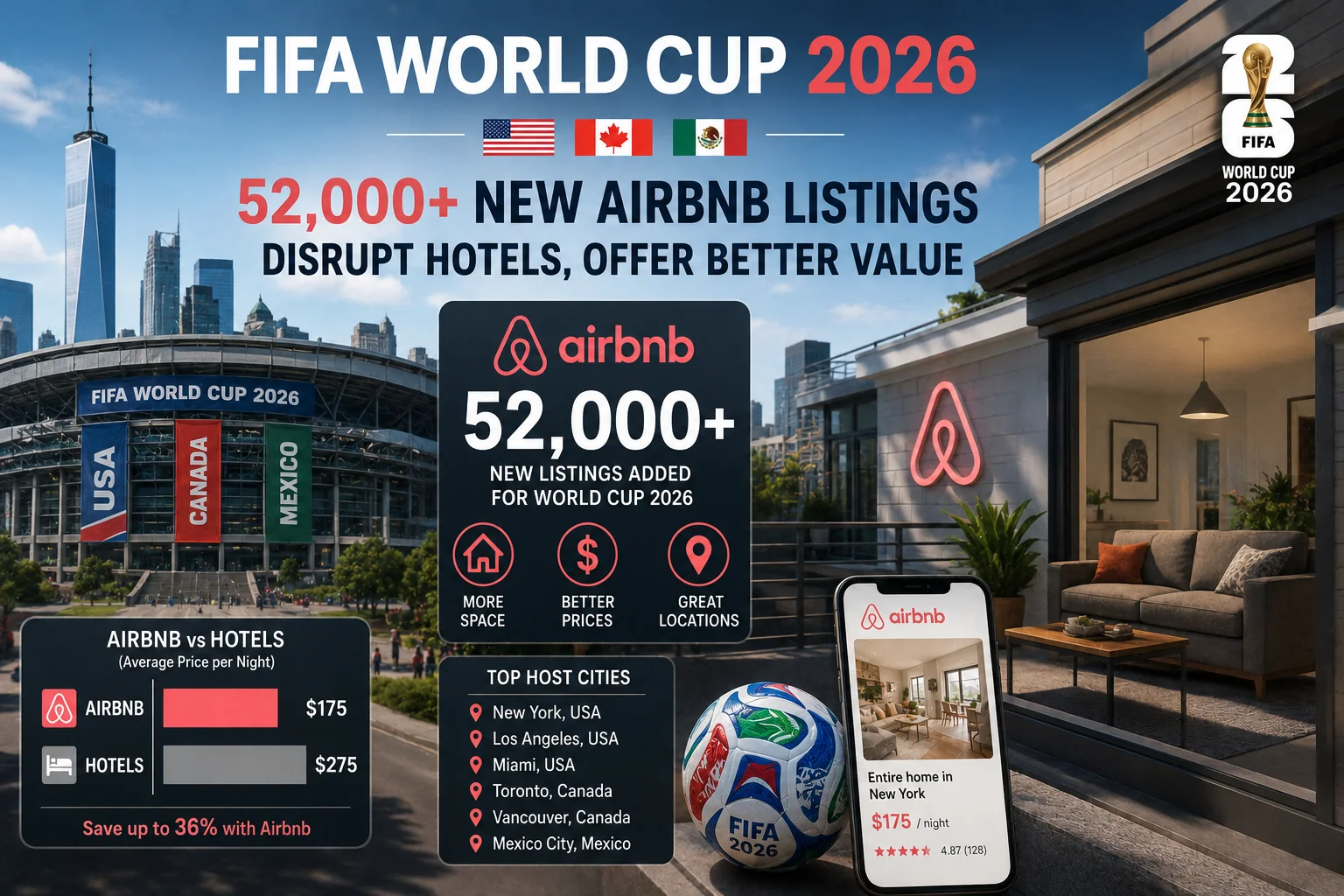
- Over 52,000 new short-term rental listings appeared in US host cities specifically for the FIFA World Cup 2026 group stages.
- Hotel occupancy rates in major cities like New York and Los Angeles are lower than projected due to aggressive pricing.
- Indian travelers visiting the US are spending an average of ₹1.5 Lakhs to ₹3 Lakhs on accommodation alone for a 10-day trip.
- Short-term rental platforms now offer 25-40% better value for money compared to 4-star hotels during the tournament.
So, the FIFA World Cup 2026 is finally in full swing across North America, and if you thought finding a place to stay would be a nightmare, you were half right. While everyone expected hotels to be the go-to choice, something wild is happening in the background. We’ve been tracking the data, and it looks like regular homeowners are the ones winning this World Cup, not the big hotel chains. In the US host cities alone, we’ve seen a massive surge of over 52,000 new listings on platforms like Airbnb and VRBO. This isn't just a small bump; it’s a total disruption of how fans are traveling in 2026.
Look, let’s be real—hotels tried to play it smart and hiked their prices to the moon the moment the match schedules were announced. We are talking about basic rooms going for $800 or $1,000 a night. But the market had other plans. Instead of just paying up, fans started looking for alternatives, and thousands of residents in cities like Miami, Dallas, and Seattle realized they could make a year’s worth of rent in just two weeks. This massive influx of supply has actually forced some hotels to rethink their strategy because their booking numbers are falling short of the 'sold out' dreams they had six months ago.
The Backstory: How Hotels Lost Their Grip
For decades, major sporting events like the Olympics or the World Cup were a goldmine for the hotel industry. They had the monopoly. If you wanted to stay near the stadium, you paid the 'event tax'—which is just a fancy way of saying they tripled the price. But 2026 is different. The tech ecosystem for short-term rentals (STRs) has matured so much that anyone with a spare bedroom or a clean apartment can become a 'hotelier' in 24 hours. This has created a flexible inventory that hotels simply can’t compete with.
In previous years, we saw hints of this, but the scale in 2026 is unprecedented. The sheer geographic spread of this World Cup across the US, Canada, and Mexico meant that fans needed variety. Hotels are mostly concentrated in downtown areas, but Airbnb listings are popping up in the suburbs, right next to the smaller training grounds and fan zones. This decentralized approach is exactly what the modern traveler wants. Why stay in a cramped hotel room for ₹60,000 a night when you can get a whole house with a kitchen for ₹40,000? It’s a no-brainer for groups of friends traveling together from India or Europe.
The Numbers: 52K Listings and the Data Behind the Hype
Let’s talk hard numbers because that’s where the real story is. According to the latest data tracking short-term rentals, the group stage of this World Cup saw 52,000+ new properties enter the market. To put that in perspective, that’s equivalent to building about 200 large-scale hotels in just a few months. This 'shadow inventory' has completely stabilized the prices in several cities. While hotels are seeing occupancy rates hover around 75-80%, many expected 95%+. The gap is being filled by these new hosts.
Interestingly, the data shows that the biggest growth isn't in the ultra-luxury segment, but in the 'budget-friendly' and 'mid-range' categories. Fans are prioritizing location and the ability to cook their own meals—especially Indian fans who might want a break from American fast food. The average stay duration has also increased to 6.5 days, as fans use these Airbnbs as a base to travel between nearby host cities. The flexibility of these platforms, allowing for easy check-ins via smart locks and direct communication with hosts, is making the traditional hotel lobby experience feel a bit outdated.
The India Angle: What This Means for Desi Fans
If you are one of the thousands of Indians who flew across the Atlantic for this, you know the struggle. Traveling for the World Cup from India isn't just about the ticket price; it’s the exchange rate pain. With the USD to INR conversion being what it is in 2026, every dollar counts. Many Indian fan groups have ditched the idea of staying in New York or LA hotels. Instead, they are booking large suburban homes in New Jersey or the outskirts of California. We’ve seen reports of groups of 6-8 people sharing a single Airbnb, bringing their per-head cost down to about ₹7,000 per night. You can't find a decent hotel for that price during a World Cup.
Also, the rise of 'travel-tech' apps has made this easier for us. Apps that help you split bills, find local Indian groceries near your stay, and even rent cars from locals (like Turo) have integrated well with the Airbnb experience. This 'DIY' travel style is becoming the standard for the younger Indian demographic. We are no longer reliant on travel agents who pack us into overpriced hotel blocks. We want the local experience, the backyard BBQ, and the freedom to stay in a residential neighborhood.
Step-by-Step: How to Score a Last-Minute Stay
If you’re planning to catch the knockout stages and haven't booked yet, don't panic. Here is how we recommend you handle it. First, stop looking at the 5-mile radius around the stadium. That’s where the prices are still inflated. Use the 'map view' on your booking app and look for areas connected by public transit or within a 20-minute Uber ride. You’ll find those new 52,000 listings hidden in these pockets.
Second, look for 'New' listings with zero reviews but a 'Verified Host' tag. These are the people who just joined the platform for the World Cup. They are often willing to offer a 10-20% discount just to get their first few reviews. Third, always message the host before booking. In 2026, many hosts are open to negotiation if you’re staying for more than 4 days. Just a simple 'Hey, we are a group of fans from India, can you do a better price?' can save you ₹15,000-₹20,000 easily.
Hotels vs. Airbnb: The Ultimate Comparison
Let’s break it down. Hotels still have the edge when it comes to service—you get the housekeeping, the gym, and the security. If you’re traveling solo or on a business-plus-football trip, a hotel might still make sense. But for the average fan, the pros of a short-term rental far outweigh the cons. You get more space, a kitchen to save on food costs, and a laundry machine (essential for a long tournament). The 'con' of an Airbnb is the lack of a front desk, but in 2026, most issues are solved via a quick WhatsApp or app message.
Hotels are also struggling with staffing shortages in the US right now, leading to slower check-ins and reduced breakfast hours. On the flip side, Airbnb hosts are highly motivated to provide a great experience to get those 5-star ratings. We’ve heard stories of hosts leaving 'welcome kits' with World Cup scarves and local snacks. That personal touch is something a Marriott or a Hilton just can't replicate at scale. For us, the choice is clear for a multi-city event like this.
TamilTech’s Honest Take: The Future of Big Events
What we think is that this is a wake-up call for the hospitality industry. You can't just expect people to pay 5x the price for a standard room anymore. The 52,000+ new listings we see today are proof that the 'sharing economy' is no longer a side-gig—it’s the main event. In the future, whether it's the Olympics or the Cricket World Cup in India, expect this trend to accelerate. Hotels will have to offer more than just a bed; they’ll need to offer an 'experience' or better loyalty rewards to keep fans coming back.
As for the fans, this is a win. More competition means better prices and more choices. We expect the knockout rounds to see even more 'pop-up' stays as the excitement reaches a fever pitch. If you are a homeowner in a city that hosts big events, this is your cue—the tech is there, the demand is there, and as we’ve seen this month, the money is definitely there. The 2026 World Cup will be remembered as the moment the hotel monopoly finally cracked.



Comments (0)
Be the first to comment!