


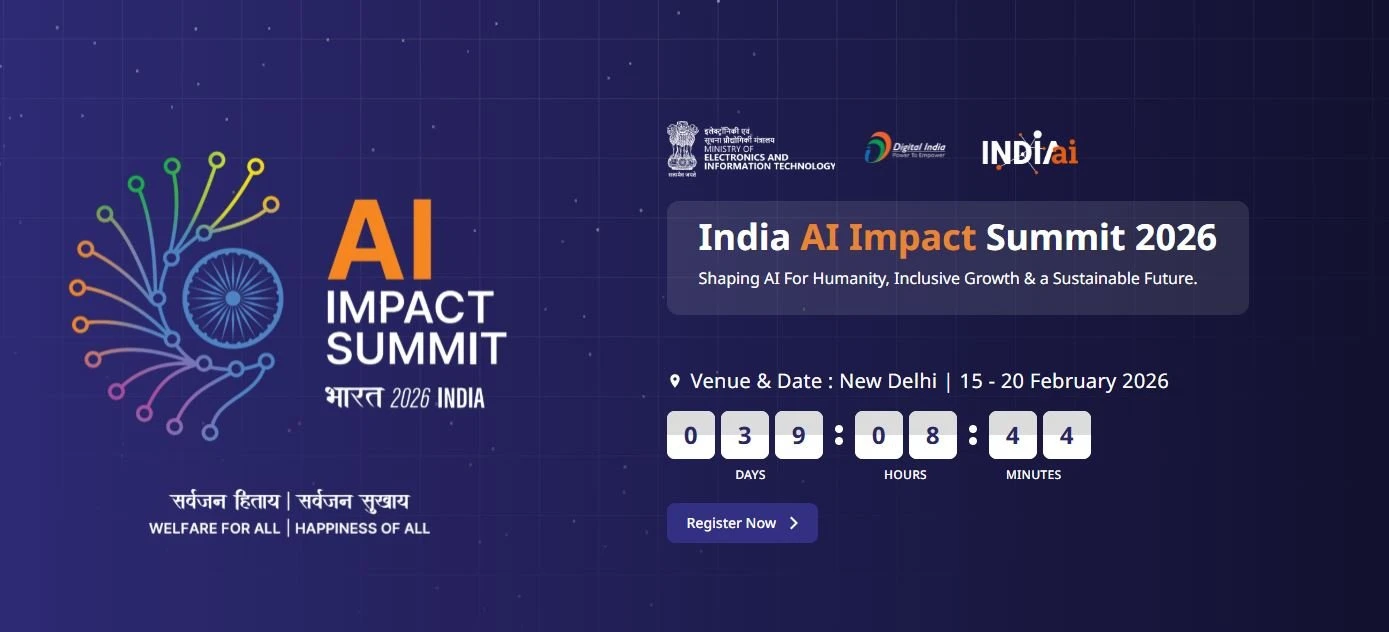
India Hosts AI Impact Summit 2026: The Global South's Defining AI Moment
On February 16, 2026, India will make history. The AI Impact Summit 2026, scheduled to run from February 16 to 20 at the iconic Bharat Mandapam in New Delhi, represents the first time a major global AI summit is being hosted in the Global South. This is not merely a conference — it is a geopolitical statement. By hosting the world's most influential AI leaders, researchers, and policymakers on Indian soil, India is asserting its position as a co-architect of the global AI order, not merely a consumer of technology developed elsewhere.
With 35,000+ registrations from over 100 countries, 500+ sessions, and a speaker list that reads like a who's who of global technology — Sundar Pichai, Sam Altman, Bill Gates, Jensen Huang, Dario Amodei — the AI Impact Summit is the most significant technology event India has ever hosted. It comes at a moment when India's AI ambitions are being backed by unprecedented government investment and Big Tech commitments totaling tens of billions of dollars.
Event Overview: The Essentials
| Detail | Information |
|---|---|
| Event Name | AI Impact Summit 2026 |
| Dates | February 16-20, 2026 |
| Venue | Bharat Mandapam, Pragati Maidan, New Delhi |
| Registrations | 35,000+ from 100+ countries |
| Sessions | 500+ |
| Theme | "Seven Chakras" Framework — People, Planet, Progress |
| Significance | First major global AI summit hosted in the Global South |
| Organizer | Government of India (Ministry of Electronics and IT) |
The Speaker List: A Global Technology Powerhouse
The caliber of speakers committed to the AI Impact Summit is unprecedented for any technology event hosted in India. These are not mid-level executives or regional heads — they are the CEOs and founders who are directly building the AI systems that will shape the next decade:
| Speaker | Role | Company | Why Their Presence Matters |
|---|---|---|---|
| Sundar Pichai | CEO | Alphabet / Google | Leads Gemini AI development; Google investing $15B in India AI |
| Sam Altman | CEO | OpenAI | Creator of ChatGPT/GPT-5; exploring India partnerships |
| Bill Gates | Co-Chair | Gates Foundation | AI for development, healthcare, and education in Global South |
| Jensen Huang | CEO | NVIDIA | Controls global AI chip supply; India GPU infrastructure plans |
| Dario Amodei | CEO | Anthropic | Claude AI; Bengaluru office opening; AI safety advocate |
| Satya Nadella | CEO | Microsoft | Microsoft investing $17.5B in India; Azure AI expansion |
| Arvind Krishna | CEO | IBM | Enterprise AI and watsonx platform for India market |
The fact that the CEOs of Alphabet, OpenAI, NVIDIA, Anthropic, and Microsoft are all attending the same event in India — rather than at Davos, CES, or their own developer conferences — is itself a statement about India's strategic importance to the global AI industry.
The "Seven Chakras" Framework
The summit is organized around what the Indian government has called the "Seven Chakras" framework — a distinctly Indian conceptual structure that maps AI's impact across seven domains. The three overarching pillars are People, Planet, and Progress, which are further divided into specific focus areas:
- People: AI in healthcare, education, skilling, and workforce transformation
- Planet: AI for climate action, sustainable agriculture, water management, and disaster prediction
- Progress: AI-driven economic growth, infrastructure, governance, and innovation ecosystems
This framework explicitly positions AI not merely as a commercial technology but as a tool for addressing the challenges most relevant to developing nations — healthcare access, agricultural productivity, climate resilience, and inclusive economic growth. It is a deliberate counter-narrative to the Silicon Valley-centric view of AI as primarily a productivity tool for knowledge workers in wealthy countries.
India's AI Announcements: BharatGen and Indigenous Models
The summit is expected to serve as the platform for several landmark AI announcements by the Indian government:
BharatGen: India's First Multimodal LLM
BharatGen is India's first indigenous multimodal large language model, developed under the IndiaAI Mission. What makes BharatGen unique is its design specification: it is built to support all 22 officially recognized languages of India — from Hindi and Tamil to Bodo and Dogri. This is fundamentally different from models like GPT, Gemini, or Claude, which are primarily English-centric with varying quality of multilingual support.
For a country where only about 10% of the population is fluent in English, a truly multilingual AI model is not a luxury — it is a necessity. BharatGen aims to enable AI-powered services — voice assistants, document processing, customer service, educational tools — in languages that current commercial models serve poorly or not at all.
12 Indigenous Foundation Models
Beyond BharatGen, India has announced the development of 12 indigenous foundation models across different domains — healthcare, agriculture, legal, education, and scientific research. These models are being developed by a combination of IITs, IISc, and private sector partners under government funding. The objective is to ensure that India is not entirely dependent on American AI companies for critical AI infrastructure.
38,000 GPUs for AI Compute
AI model training requires enormous compute power, and India has historically lagged behind the US and China in GPU infrastructure. The government has committed to deploying 38,000 GPUs across government-affiliated AI compute centers. While this is still a fraction of what companies like OpenAI or Google individually deploy (OpenAI alone is reported to have access to over 100,000 H100 GPUs), it represents a significant starting point for sovereign AI compute capacity.
Big Tech Investment Commitments to India
The AI Impact Summit is also serving as the occasion for massive investment pledges from global technology companies. The numbers are staggering:
| Company | Investment Pledge | Focus Area | Timeline |
|---|---|---|---|
| Amazon (AWS) | $35 Billion | Data centers, cloud infrastructure, AI services | By 2030 |
| Microsoft | $17.5 Billion | Azure cloud, AI compute, Copilot ecosystem | 2025-2028 |
| $15 Billion | AI research, cloud infrastructure, Gemini services | 2025-2029 | |
| NVIDIA | Not disclosed (GPU supply) | GPU supply partnerships for IndiaAI compute centers | Ongoing |
| Total Major Commitments | $67.5 Billion+ | Combined AI and cloud infrastructure | 2025-2030 |
These are not speculative numbers. $67.5 billion in combined commitments from just three companies (Amazon, Microsoft, Google) represents approximately Rs 5.74 lakh crore — more than the annual budget of most Indian states. These investments will fund data center construction, AI research centers, GPU clusters, and talent development programs across India.
IndiaAI Mission: Rs 10,372 Crore Government Investment
Complementing the private sector investments, the Indian government's IndiaAI Mission provides a structured framework for building AI capacity:
| Component | Budget | Objective |
|---|---|---|
| Total IndiaAI Mission | Rs 10,372 Crore (~$1.25B) | Build sovereign AI infrastructure and ecosystem |
| AI Compute | Rs 4,564 Crore | 38,000 GPUs across government AI compute centers |
| AI Innovation | Rs 2,000 Crore | 12 indigenous foundation models, R&D grants |
| AI Skilling | Rs 1,500 Crore | AI training for 1 million+ students and professionals |
| AI Datasets | Rs 1,000 Crore | Curated Indian-language datasets for model training |
| AI Startups | Rs 1,308 Crore | Funding and incubation for AI startups |
The Rs 4,564 crore allocation for AI compute alone makes this one of the largest government AI infrastructure investments outside the US and China.
India's AI Talent Advantage
One of the most compelling data points in India's favor is its position in global AI talent. According to multiple industry reports, India ranks #1 globally in AI skill penetration — meaning a higher percentage of its professional workforce has AI-related skills than any other country. This is driven by:
- Engineering Education Pipeline: India produces approximately 1.5 million engineering graduates annually — the largest in the world.
- IT Services Workforce: Companies like TCS, Infosys, and Wipro employ millions of technology professionals who are rapidly upskilling in AI.
- Startup Ecosystem: India's AI startup ecosystem has produced over 3,000 AI-focused companies, with clusters in Bengaluru, Hyderabad, and Chennai.
- Global Workforce: Indian-origin leaders helm the world's largest technology companies — Sundar Pichai (Google), Satya Nadella (Microsoft), Arvind Krishna (IBM) — demonstrating the depth of Indian technical talent at the highest levels.
Tamil Nadu's AI Ecosystem: A Regional Spotlight
For Tamil-speaking readers, Tamil Nadu's AI initiatives deserve special attention:
| Initiative | Details | Status |
|---|---|---|
| IIT Madras CeRAI | Centre for Responsible AI — research and policy | Operational |
| Deeptech Startup Policy | Rs 100 Crore fund for AI/deeptech startups | Active — accepting applications |
| AI in Schools | AI curriculum integration in government schools | Pilot phase in select districts |
| Chennai AI Hub | Startup incubators and AI research centers | Growing ecosystem with 200+ AI startups |
IIT Madras CeRAI (Centre for Responsible AI) is particularly significant. It is one of the few academic institutions in India focused specifically on AI ethics, fairness, and accountability — the kinds of issues that the AI Impact Summit's "Seven Chakras" framework explicitly addresses. Tamil Nadu's Deeptech Startup Policy, with its Rs 100 crore allocation, positions the state as a competitive destination for AI entrepreneurs alongside Karnataka (Bengaluru) and Telangana (Hyderabad).
Why This Summit Matters for India's Future
The AI Impact Summit 2026 is significant for several interconnected reasons:
- Geopolitical Positioning: By hosting this summit, India positions itself as the voice of the Global South in AI governance — advocating for inclusive AI that serves 8 billion people, not just the 1 billion in wealthy nations.
- Investment Catalyst: The $67.5 billion+ in Big Tech commitments, combined with Rs 10,372 crore in government funding, represent the largest coordinated AI investment push India has ever seen.
- Sovereign AI: BharatGen and the 12 indigenous foundation models signal India's intent to build AI capabilities in-house, reducing dependence on American AI providers for critical applications.
- Talent Retention: India's AI talent frequently migrates to the US for better opportunities. Having major AI companies invest in India directly creates opportunities that keep talent within the country.
- Standards Setting: India's participation in global AI governance discussions — alongside the EU AI Act and potential US regulations — gives it influence over the rules that will govern AI deployment worldwide.
What to Watch During the Summit
Several developments during the February 16-20 event could have lasting implications:
- Sam Altman and India: OpenAI's India strategy has been ambiguous. Will Altman announce an India office, Hindi/Tamil GPT models, or partnerships with Indian companies?
- Jensen Huang and GPU Access: NVIDIA controls the global AI chip supply. Any announcements about prioritized GPU allocation for India would be significant.
- BharatGen Demo: A live demonstration of BharatGen's multilingual capabilities — particularly in Tamil and other South Indian languages — could be a landmark moment.
- Regulatory Framework: Will India announce a formal AI regulation framework, or continue with its current light-touch approach?
- Bilateral Agreements: AI partnerships between India and other Global South nations (Brazil, Indonesia, South Africa) could establish new multilateral AI cooperation frameworks.
Key Takeaways
- India is hosting the most significant AI event ever held in the Global South. The AI Impact Summit 2026 brings the CEOs of Google, OpenAI, NVIDIA, Microsoft, and Anthropic to New Delhi.
- BharatGen is India's first multimodal LLM supporting 22 languages. This is a genuine sovereign AI initiative that addresses India's unique multilingual reality.
- Big Tech is investing $67.5B+ in India's AI infrastructure. Amazon ($35B), Microsoft ($17.5B), and Google ($15B) are building data centers, cloud capacity, and AI services in India.
- The IndiaAI Mission commits Rs 10,372 crore to sovereign AI development. This includes 38,000 GPUs, 12 foundation models, and AI skilling for 1M+ people.
- Tamil Nadu is building a competitive AI ecosystem. IIT Madras CeRAI, Rs 100 crore Deeptech Startup Policy, and AI-in-schools programs position the state as an AI hub.
Conclusion
The AI Impact Summit 2026 represents a pivotal moment in India's technology history. For the first time, India is not just participating in the global AI conversation — it is hosting and shaping it. The combination of unprecedented government investment, massive Big Tech commitments, a world-leading AI talent pool, and indigenous AI capabilities like BharatGen creates the conditions for India to become a genuine AI power, not merely an AI consumer.
The summit's "Seven Chakras" framework — with its emphasis on People, Planet, and Progress — is a deliberate articulation of an AI vision that serves developing nations, not just wealthy ones. Whether this vision translates into reality will depend on execution: building the compute infrastructure, training the multilingual models, skilling the workforce, and creating the regulatory framework that enables innovation while protecting citizens. The next five days in New Delhi will set the trajectory. The world will be watching.




Comments (0)
Be the first to comment!