


Key Takeaways
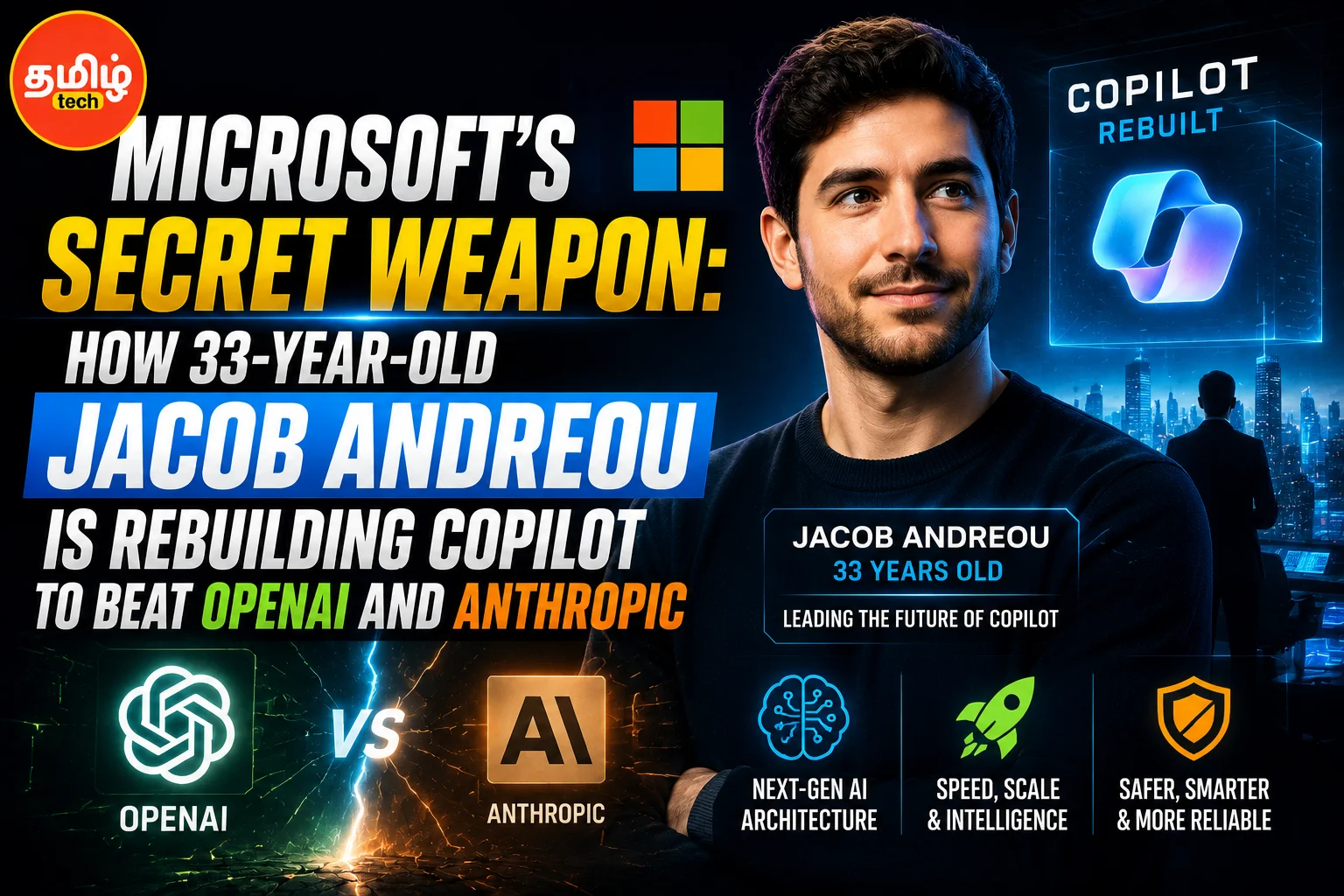
- Jacob Andreou, a 33-year-old former Snap VP, is now leading Microsoft's unified Copilot division as of 2026.
- Microsoft has consolidated all AI efforts—Windows, Bing, and Office—under one team to speed up product shipping.
- The strategy shifts from 'pure research' to 'product growth,' borrowing tactics from social media to increase daily usage.
- In India, Copilot Pro is priced at ₹1,650 per month, aiming to capture the massive developer and student market.
- Microsoft's main goal is to reduce dependency on OpenAI while competing directly with Anthropic's Claude.
The New Face of Microsoft AI
It’s June 2026, and if you’ve noticed that your Windows PC or your smartphone feels a lot more 'talkative' lately, there’s one person largely responsible for it. Jacob Andreou, just 33 years old, has become one of the most powerful figures at Microsoft. Coming from a background that isn't typical for enterprise software—he was the VP of Product at Snap (the company behind Snapchat)—Jacob was brought in for a very specific reason: Microsoft didn't just need better AI; they needed people to actually use it every single day. For a long time, Microsoft's AI features were scattered everywhere. You had Bing Chat here, Windows Copilot there, and Office AI somewhere else. It was messy. Jacob's mission was to take these fragments and turn them into a singular, cohesive powerhouse called the 'Consolidated Copilot Team.'
Why does this matter to you? Because for the last two years, we’ve seen OpenAI and Anthropic moving at lightning speed. While Microsoft was the biggest investor in OpenAI, they realized they couldn't just ride on Sam Altman’s coattails forever. They needed their own 'product DNA.' Jacob Andreou represents that shift. He isn't a research scientist focusing on LLM parameters; he’s a product guy who understands how to make an app addictive and useful. At TamilTech, we’ve been watching this transition closely, and it’s clear that Microsoft is no longer playing nice—they want to own the AI interface on every screen you own.
From Snap to Satya: The Strategy Shift
Jacob’s journey from the world of disappearing messages and AR filters to the world of enterprise AI is fascinating. At Snap, he learned how to build for the mobile-first generation. Microsoft, historically, has been a 'desktop-first' company. By putting Jacob in charge, Satya Nadella sent a clear signal: Copilot needs to be a mobile-first, consumer-friendly experience. The consolidated team under Jacob has broken down the old silos. Previously, the team building AI for Excel didn't talk much to the team building AI for Windows. Now, it's one unified roadmap. This allows Microsoft to ship features in weeks rather than months, which is the only way to keep up with the rapid-fire releases from Anthropic’s Claude 4 and 5 models in 2026.
We think this is a brilliant move. The tech industry is moving away from 'who has the biggest model' to 'who has the best user experience.' Jacob is implementing what we call 'Growth Loops' inside Copilot. If you use it once to draft an email, the system now intelligently suggests how it can help you with your calendar or your next PowerPoint presentation. It’s that 'stickiness' that Microsoft was lacking. They had the brains (GPT-4 and beyond), but they didn't have the personality. Jacob is changing that by making Copilot feel less like a search engine and more like a proactive personal assistant that actually knows you.
The Battle for India: Pricing and Localization
In the Indian context, this strategy is hitting the ground running. As of mid-2026, Microsoft has localized Copilot heavily for the Indian market. We’re seeing deep integration with Indian languages including Tamil, Telugu, and Hindi, not just as a translation layer, but with cultural context. The pricing of Copilot Pro at ₹1,650 per month is a bold move. It’s positioned right against ChatGPT Plus and Claude Pro. For Indian professionals and the millions of students using Windows laptops, Microsoft is banking on the fact that you’d rather pay for an AI that is already built into your Word document and your Taskbar rather than a separate app like ChatGPT.
However, it’s not all smooth sailing. Google Gemini is still the king of Android in India, and since most Indians use Android phones, Jacob Andreou’s team has a massive challenge: how do you get someone to install the Copilot app when Gemini is already there? Their answer seems to be 'PC-to-Phone' continuity. If you use Copilot on your Windows laptop for work, it syncs everything to your phone perfectly. We’ve tested this, and the hand-off is smoother than what we’ve seen from the competition lately. For a student in Chennai or a developer in Bengaluru, this ecosystem play is a huge value addition.
TamilTech’s Take: Can He Actually Catch Up?
So, what do we think? Is a 33-year-old 'product guy' enough to beat the world’s best AI researchers? In our opinion, yes—because the 'research phase' of AI is slowly becoming the 'utility phase.' Everyone has a good chatbot now. What people don't have is a chatbot that actually does their work for them without being asked. Jacob Andreou is pushing Copilot to be 'agentic'—meaning it doesn't just answer questions, it takes actions. Whether it's booking a flight on an Indian travel site or organizing your chaotic desktop files, this is where the battle will be won.
The real risk for Microsoft is 'bloatware.' We’ve seen Microsoft ruin good products before by stuffing too many features into them. If Jacob can keep Copilot lean, fast, and actually helpful, Microsoft might just pull off one of the greatest pivots in tech history. For now, if you are a power user in India, we recommend keeping an eye on the Windows 11/12 updates coming later this year. The 'Jacob effect' is real, and the AI on your PC is about to get a lot smarter—and perhaps a bit more like a social media app in how it keeps you coming back for more.





Comments (0)
Be the first to comment!