

முக்கிய விஷயங்கள்
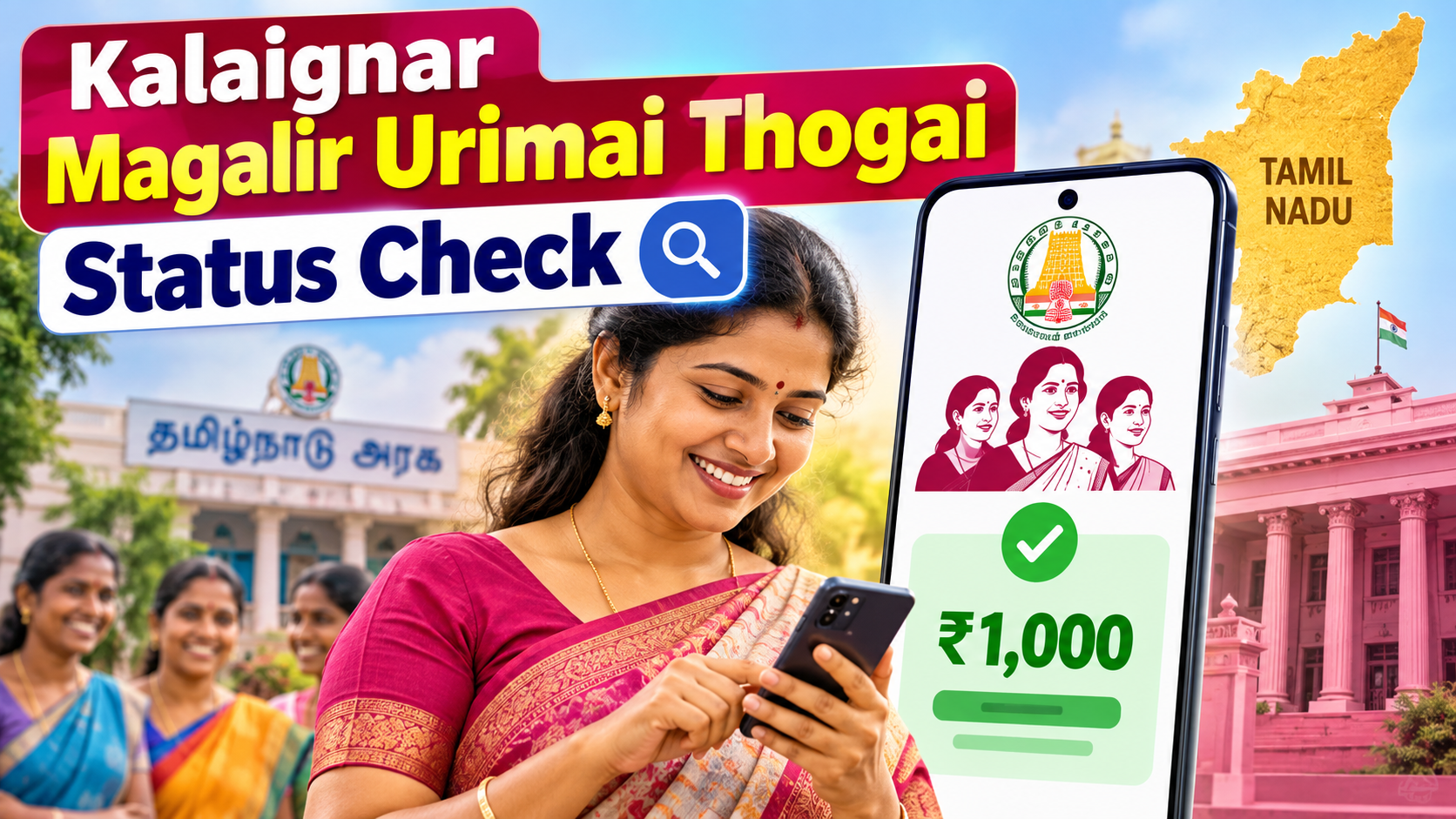
- Kalaignar Magalir Urimai Thogai is the Tamil Nadu government's monthly financial assistance scheme for eligible women heads of households.
- Status check needs either your application/acknowledgement number or your Aadhaar-linked registered mobile number — no shortcuts around that.
- Most 'not showing' cases are simple: wrong bank IFSC, Aadhaar not seeded to the bank account, or the application is still in verification queue.
- e-Sevai centres and the ration shop staff can help offline if the online portal is slow or down.
- Nothing here requires paying anyone a single rupee — if someone asks for money to 'speed up' your status, that's a scam, full stop.
What just happened? Why is everyone searching for this status check?
To check your Kalaignar Magalir Urimai Thogai status, head to the official Tamil Nadu scheme portal and log in with your application number or Aadhaar-linked registered mobile number — that's the only real shortcut there is. This guide walks through every status-check method, from the online portal to e-Sevai centres, explains the most common reasons payments get stuck, and tells you exactly what to do (and who not to trust) when your money hasn't landed yet.
Kalaignar Magalir Urimai Thogai is the Tamil Nadu government's scheme that gives direct monthly financial help to women who head their households and meet the state's income and family criteria. It was rolled out by the DMK government under Chief Minister M.K. Stalin as part of a broader push to put cash directly into women's hands, not routed through anyone else in the family.
The idea itself isn't new for Tamil Nadu — the state has a long history of welfare schemes targeted at women, from free bus travel to nutrition kits. This one is simply the latest, and because the amount is credited monthly, people naturally want to track it the way they'd track a UPI payment or a courier package.
How does this actually work — what do you actually check?
The status check tells you one of three things: your application is approved and payment is processing, it's still under verification at the district level, or it's rejected because something in your documents didn't match.
To check, you typically need your application reference number — the one you got as an SMS or printed slip when you first applied, either online or at an e-Sevai centre. If you've lost that number, your Aadhaar number linked to your registered mobile is usually the backup option.
Here's the thing most people miss: the status portal isn't checking your bank balance, it's checking your application record. So even after it says 'approved', the actual credit into your account depends on your bank processing the batch transfer, which can take a few extra days — especially around month-end when lakhs of transactions hit the system at once.
If the portal is slow (and during peak days, it genuinely is), don't keep refreshing every two minutes. Try early morning before 9 AM or late evening — traffic is lower and pages load faster.
| Status Check Method | What You Need | Best For |
|---|---|---|
| Official scheme portal (online) | Application number or Aadhaar + registered mobile OTP | Anyone with a smartphone and decent network |
| e-Sevai Maiyam (common service centre) | Aadhaar card, acknowledgement slip | Those without smartphones or in rural areas |
| Ration shop / Anganwadi worker enquiry | Ration card number | Older applicants comfortable asking locally |
| Toll-free helpline (via local administration office) | Application reference number | Quick status confirmation without travel |
What changes for people in India — why does this matter day to day?
For a lot of households, this isn't pocket money — it's grocery money, school fee top-up, or the gas cylinder refill that was being postponed. When the credit is delayed even by a week, that's a real dent in the monthly budget.
This is also part of a bigger shift happening across India: direct benefit transfer, or DBT, straight into bank accounts linked with Aadhaar, instead of cash handed out through middlemen. Tamil Nadu is leaning hard into this model, and schemes like this one are a test of how smoothly that system runs at scale.
For women in joint families where the husband or in-laws control the main bank account, having a scheme that specifically targets the woman as head of household — with her own linked account — is a genuinely different experience, not just a different amount.
What mistakes should you avoid while checking status?
The number one mistake: using an old mobile number that's no longer linked to your Aadhaar. If you changed your SIM after applying, the OTP never arrives, and people assume the system is broken when it's actually their own number that's outdated.
Second mistake: checking status obsessively within the first week of applying. Verification at the taluk or village level takes time — bank accounts get cross-checked, duplicate applications get filtered out, and ration card details get matched. Give it at least two to three weeks before you worry.
Third, and this is important: never share your Aadhaar OTP with anyone claiming to be a 'scheme agent' who can check or fix your status for a fee. Government welfare schemes in Tamil Nadu don't charge for status checks, period. If someone's asking for money, walk away.
Who is this scheme really for?
This scheme is built for women who are the primary earners or heads of their household and fall within the state's defined income bracket — typically lower-income families where this monthly amount genuinely moves the needle. It's not meant for every woman in Tamil Nadu; eligibility criteria around family income, existing government pensions, and ration card category all come into play.
If you're unsure whether you qualify at all, that's a separate check from the status check — eligibility verification happens before the application is even accepted, so if your application went through and got a reference number, you've already cleared that first gate.
What should you do now?
Keep your application number saved somewhere safe — a screenshot, a WhatsApp message to yourself, written down in a notebook, whatever works. Losing that number is the single biggest reason people get stuck re-explaining their case at the e-Sevai centre.
Make sure your Aadhaar is seeded to the exact bank account you gave during application — not an old account, not a joint account that got closed. This single detail causes more payment failures than anything else in DBT schemes across India.
If it's been over a month with no update and no rejection message either, go in person to your nearest e-Sevai centre or the local administrative office with your original documents. Online checks are convenient, but a human at the counter can actually look up what's stuck and why — something a status page often can't explain.

Comments (0)
Be the first to comment!