


Key Takeaways
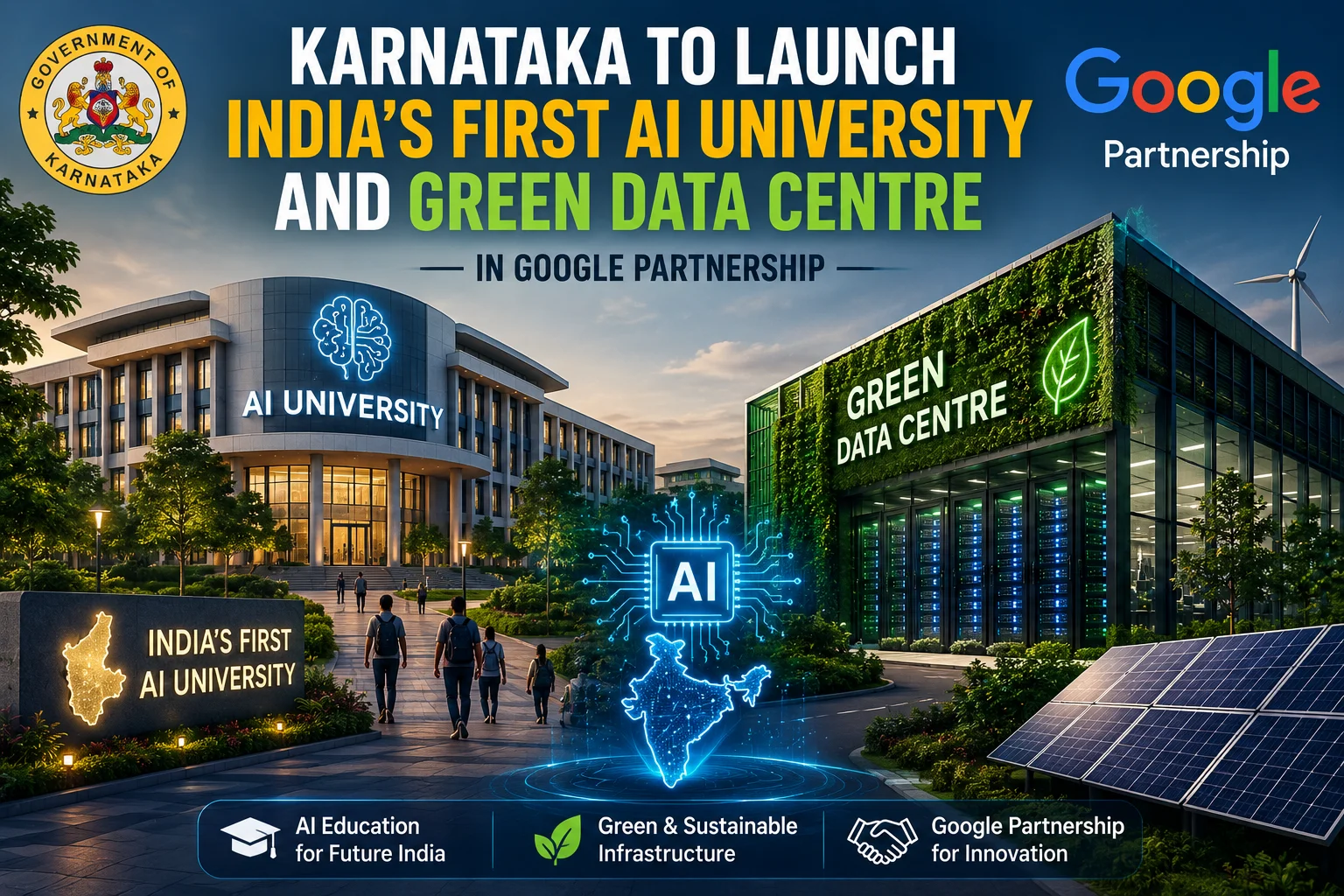
- Karnataka government is establishing India's first dedicated AI University in Bengaluru to train 2 lakh students annually.
- A state-of-the-art 'Green Data Centre' will be built, powered 100% by renewable energy sources like solar and wind.
- Google and the Karnataka government have signed an MoU to integrate AI tools into governance and public service delivery.
- The move aims to generate over 1 lakh high-skilled tech jobs in the state by the end of 2027.
- TamilTech's verdict: This is a massive win for students and techies, shifting the focus from basic IT to high-end AI research.
The Big Announcement at Google I/O Connect 2026
The tech world's eyes were on Bengaluru this week as Google I/O Connect India 2026 kicked off. While we expected new software updates and Gemini improvements, the real showstopper came from the Karnataka state government. Chief Minister Siddaramaiah took the stage to announce a series of groundbreaking initiatives that could redefine India's position in the global AI race. The headline? Karnataka is getting its own dedicated AI University and a massive Green Data Centre. This isn't just another government promise; it's a strategic partnership with Google that aims to turn Bengaluru from the 'Silicon Valley of India' into the 'AI Capital of the World'.
We at TamilTech have been tracking these developments for months, and seeing it finally take shape is exciting. The collaboration between a tech giant like Google and a state government is the kind of synergy we need to move beyond just being a service hub. The focus here is clearly on infrastructure and education—the two pillars that will determine who wins the AI era. With the 2026 landscape being dominated by Generative AI and localized LLMs, Karnataka's move to build physical and intellectual infrastructure is a masterstroke that other states will likely try to emulate soon.
India’s First Dedicated AI University: What’s the Plan?
The most ambitious part of the announcement is the establishment of a dedicated AI University. Unlike traditional engineering colleges where AI is just a subject or a specialization, this institution will be built from the ground up for Artificial Intelligence, Machine Learning, and Robotics. The curriculum is being designed in consultation with Google’s top engineers and academic experts. The goal is to produce 'AI-ready' graduates who don't need months of corporate training before they start contributing. CM Siddaramaiah mentioned that the university will focus on practical applications—think AI for healthcare, agriculture, and urban planning—rather than just theoretical coding.
From what we've gathered, the university will offer undergraduate, postgraduate, and doctoral programs. But here is the kicker: there will also be short-term 'bridge courses' for existing IT professionals who want to pivot to AI. In 2026, where job roles are evolving faster than ever, this kind of upskilling center is a goldmine. Google will provide the cloud infrastructure and access to their Vertex AI platform for students, ensuring they work on the same tools used by Silicon Valley startups. This is a huge deal for students in South India who want world-class education without moving to the US or Europe.
The Green Data Centre: Sustainable Tech for the Future
You might be wondering, why do we need a 'Green' data centre? Well, AI models require massive amounts of computing power, which in turn consumes a lot of electricity. Traditional data centres are notorious for their carbon footprint. Karnataka’s proposed Green Data Centre aims to solve this by running entirely on renewable energy. By leveraging the state’s existing lead in solar and wind power, this facility will provide the 'compute' needed for local AI startups at a fraction of the environmental cost. This is a forward-thinking move, especially as global regulations on 'Green Tech' are becoming stricter in 2026.
This data centre won't just be for private companies. It will host the state’s own localized AI models. Imagine a government AI that can process land records, health data, and transport logistics in real-time, all while being powered by the sun. For the tech-savvy crowd, this means lower latency for local apps and potentially cheaper cloud credits for homegrown startups. It’s about building a sovereign AI capability so that we aren't entirely dependent on foreign servers for our data processing needs. This is exactly the kind of infrastructure we've been advocating for at TamilTech.
The Google-Karnataka Partnership: Beyond Just Infrastructure
The MoU signed between Google and the Karnataka government isn't just about buildings; it's about people. Google has committed to training 2 lakh students across the state in AI literacy. This isn't just for computer science students—the program aims to teach AI basics to students in arts, commerce, and science streams too. In 2026, AI is a tool like Excel or Word was in the 2000s; everyone needs to know how to use it. This mass-scale training program could create a massive pool of talent that will attract even more global tech companies to India.
Furthermore, Google will be working with the state to implement AI in governance. We are talking about AI-driven traffic management in Bengaluru (which God knows we need!), automated grievance redressal systems, and precision agriculture tools for farmers. By integrating Google’s AI stack into public services, the government aims to make bureaucracy more efficient and transparent. For the common man, this could mean faster passport processing, quicker hospital admissions, and better-managed city resources. It's a win-win for both the tech ecosystem and the general public.
India Impact: Jobs, Economy, and Competition
What does this mean for the rest of India? Firstly, the job market is going to see a massive shift. While traditional software testing and maintenance roles are shrinking, the demand for AI prompt engineers, data scientists, and AI ethicists is skyrocketing. This university and data centre will make Bengaluru the primary destination for these high-paying roles. We expect to see a surge in AI-based startups coming out of Karnataka, which will boost the state's GDP and contribute significantly to India’s $5 trillion economy goal.
However, this also sets up a healthy competition between states. Tamil Nadu has been pushing its Fintech City and Global Strategy Centre initiatives, while Telangana is building its 'AI City' near Hyderabad. Karnataka’s partnership with Google gives it a significant 'first-mover' advantage in the AI university space. For you, the user, this competition is great because it means better infrastructure, more job opportunities, and better education across the country. If you are a student or a professional in 2026, the message is clear: learn AI or get left behind.
TamilTech’s Honest Take: Is it All Hype?
Look, we've seen many MoUs signed at big events that never see the light of day. But this one feels different. Why? Because the involvement of Google brings a level of technical accountability that government-only projects often lack. Plus, the physical need for data centres is real—companies are desperate for local compute power in 2026. The AI University is a brilliant move, but its success will depend on how quickly they can build the campus and hire quality faculty. It shouldn't just become another building with old computers; it needs to be a living lab.
Our advice? If you are a student in South India, keep a close watch on the admission notifications for this AI University. If you are a developer, start looking into how you can leverage the Green Data Centre's API when it goes live. This is a rare moment where government policy and tech trends align perfectly. While there will be challenges—like land acquisition for the data centre and setting the right curriculum—the intent is solid. We think this is a game-changer for the Indian tech scene, and we can't wait to see the first batch of AI graduates come out of Bengaluru.
What to Expect Next?
The construction of the Green Data Centre is expected to begin by late 2026, with the first phase becoming operational by mid-2027. As for the AI University, the government plans to start the first batch in a temporary campus as early as next academic year. Google is expected to roll out the first set of AI training modules for colleges by December 2026. Stay tuned to TamilTech, as we will be bringing you a step-by-step guide on how to apply for these courses and how startups can apply for data centre grants as soon as the official portals open.




Comments (0)
Be the first to comment!