


Key Takeaways
- Electricity costs represent only 7% of the total expenditure for AI data centers, debunking the idea that cheap space-based solar power is a primary driver for orbital migration.
- The race for Artificial Super Intelligence (ASI) is expected to reach its climax by 2028-2029, making the long lead times of space infrastructure impractical.
- Hardware depreciation and the high cost of NVIDIA's 2026-era Rubin chips make up the bulk of the investment, not the utility bills.
- In India, terrestrial data center investments from Adani and Reliance are reaching ₹1.5 lakh crore, focusing on local liquid-cooling and renewable energy rather than space.
The Battle of the Billionaires: Earth vs. Space
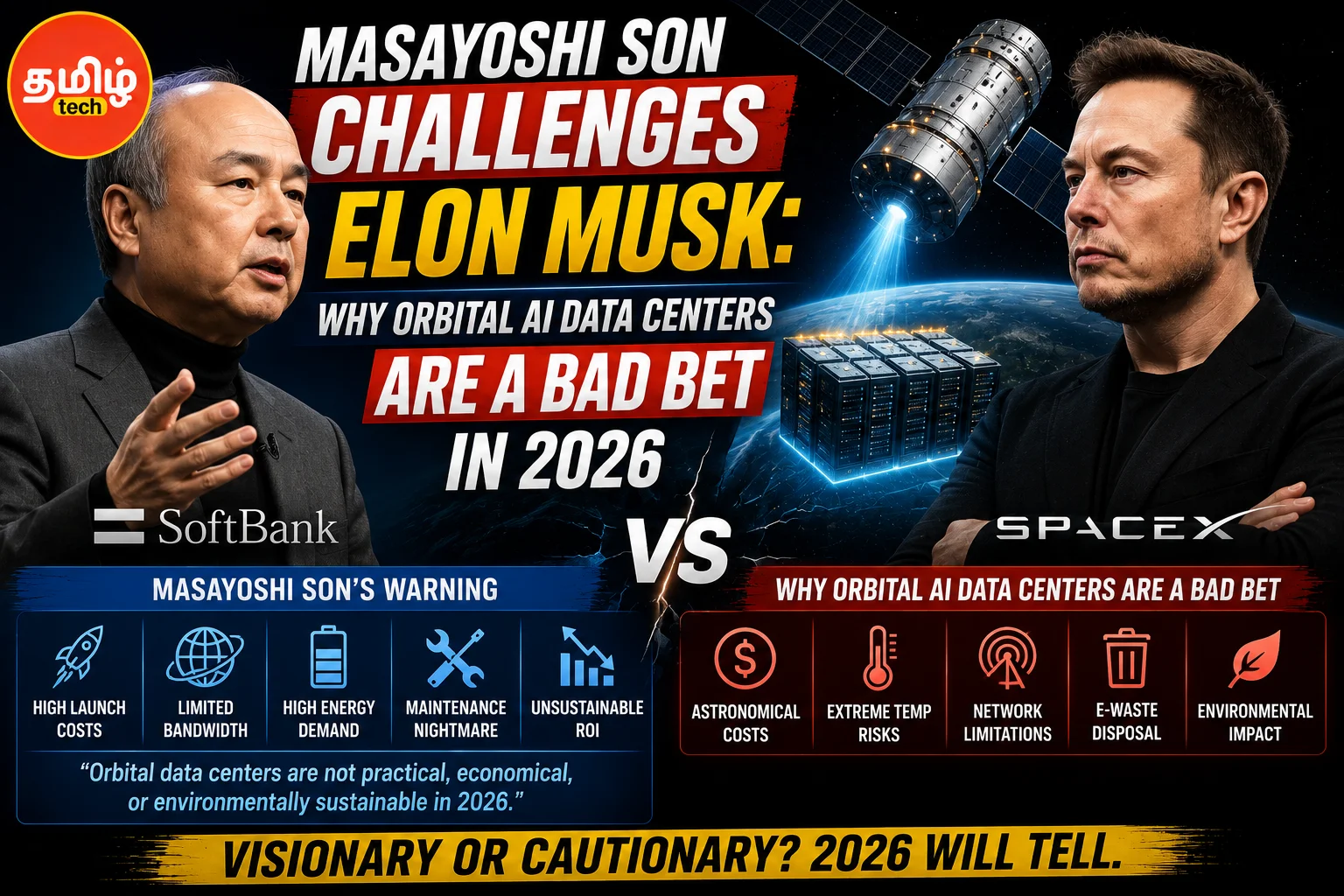
It is June 2026, and the AI wars have reached a fever pitch. While Elon Musk has been advocating for the ultimate 'off-world' backup for humanity, including moving massive compute clusters into orbit to leverage the cold vacuum of space for cooling and 24/7 solar energy, SoftBank's Masayoshi Son has a very different perspective. During a recent high-level strategy session, Son didn't hold back. He questioned the fundamental logic of sending AI into space, arguing that the math simply doesn't add up for the current trajectory of Artificial Super Intelligence development. For those of us following the tech scene in India, where we are seeing a massive boom in land-based data centers, this debate is more than just billionaire banter—it defines where the next trillion dollars will be spent.
Son’s argument is rooted in a cold, hard financial reality that many space enthusiasts tend to ignore. When you look at the multi-billion dollar price tag of a modern AI cluster—filled with the latest NVIDIA Rubin GPUs—the electricity bill, while massive in absolute terms, is actually a small slice of the overall pie. We are talking about a world where a single high-end AI server rack can cost more than a luxury apartment in Mumbai. Son pointed out that electricity accounts for roughly 7% of the total cost of ownership over the lifecycle of these machines. If the power bill is that low relative to the hardware cost, why would anyone take the massive risk of launching that delicate hardware into a high-radiation, hard-to-service environment like Earth's orbit?
The 7% Reality Check and Hardware Depreciation
Let's break down the numbers because this is where Son's logic becomes undeniable. In 2026, the cost of AI is dominated by 'CAPEX'—the initial capital expenditure. A single AI data center today can require an investment of $10 billion to $50 billion. The vast majority of that money goes into the silicon. The chips we are using now are so powerful and so expensive that they become the primary asset. When you factor in the rapid pace of innovation, these chips have a 'shelf life' of maybe three to four years before they are replaced by something twice as fast. This means the hardware is depreciating at an incredible rate. If you send these chips into space, you are essentially launching a depreciating asset that you cannot easily upgrade or repair.
Furthermore, the 'cooling' advantage of space is often overstated. While space is cold, it is also a vacuum. In a vacuum, you can't use traditional fans or liquid cooling as easily because there is no air to carry the heat away. You have to rely on thermal radiation through massive radiators, which adds weight and complexity to the satellite. On Earth, we have perfected liquid-to-chip cooling systems that are incredibly efficient. Son believes that the engineering challenges of managing heat in orbit far outweigh the benefits of 'free' space cooling. In his view, it is much cheaper to build a massive radiator on a plot of land in Rajasthan or Tamil Nadu than it is to fold one into a Falcon 9 or Starship fairing.
The AGI Timeline: No Time for Space Logistics
One of the most striking points Son made was about the timeline of AI development. He has been very vocal about his belief that Artificial General Intelligence (AGI) and even Artificial Super Intelligence (ASI) will be achieved within this decade—likely by 2028 or 2029. We are currently in the middle of 2026. If the 'finish line' for the most important technology in human history is only two or three years away, we don't have time to wait for the logistics of orbital data centers to mature. Building a constellation of satellites capable of handling the Petaflops required for training a GPT-6 or GPT-7 level model would take years of launches, testing, and orbital assembly.
The AI race is a sprint, not a marathon. The companies that win will be the ones that can scale the fastest right now. Terrestrial data centers can be built in 12 to 18 months. We are seeing massive 'gigawatt-scale' campuses popping up globally. Son’s strategy for SoftBank and its various arms, including ARM, is to dominate the energy and compute infrastructure on the ground. He believes that by the time an orbital data center is fully operational and bug-free, the AI race will already have been won by a model trained in a warehouse in North Dakota or a specialized facility in Hyderabad. The latency involved in sending petabytes of data back and forth from orbit also creates a bottleneck that Earth-based fiber optics simply don't have.
India’s Role in the Terrestrial AI Boom
Why does this matter for us in India? Because we are currently becoming the data center capital of the world. With the government's push for data localization and the massive investments from the Adani Group, Reliance, and international players like Google and Microsoft, India is betting big on the 'Earth-first' approach. We are seeing data centers being built with direct links to solar farms and green hydrogen plants. This aligns perfectly with Son's view: solve the 7% power problem on the ground using renewable energy rather than trying to solve it in orbit. The cost of land and construction in India, while rising, is still a fraction of the cost of a single rocket launch.
Moreover, the Indian context requires low latency for services like UPI, real-time AI translation for our diverse languages, and autonomous driving in our chaotic traffic. These applications require edge computing and localized data centers. An AI model sitting in a satellite 500 kilometers above the Earth might be great for some niche tasks, but for the day-to-day digital life of 1.4 billion people, we need the servers to be as close to the users as possible. Son’s skepticism about Musk’s space-AI vision validates the massive infrastructure projects currently underway in states like Maharashtra and Telangana.
TamilTech’s Take: Is Musk Wrong?
So, is Elon Musk wrong? Not necessarily in the long term, but Masayoshi Son is right for the 'Now'. Musk's vision is often about the multi-planetary future—if we are living on Mars, we definitely need orbital AI. But for the immediate goal of achieving ASI and transforming the global economy by 2030, Earth is the only viable platform. At TamilTech, we think the '7% rule' is a massive eye-opener. Most people think electricity is the biggest problem for AI, but it's actually the sheer cost of the chips and the speed at which they become obsolete. If you can't swap out a GPU in 15 minutes, your data center is going to fail in the AI era.
Expect to see a massive shift in how we talk about AI sustainability. Instead of looking to the stars, the industry will focus on better liquid cooling, more efficient chip architectures (like what ARM is doing), and hyper-local renewable energy grids. The space-AI dream might happen in the 2030s, but for the next few years, the real action is happening right here on the ground. Keep an eye on the massive data center parks coming up near you—that is where the future of intelligence is being built, not in a satellite orbiting the Earth.






Comments (0)
Be the first to comment!