


Key Takeaways
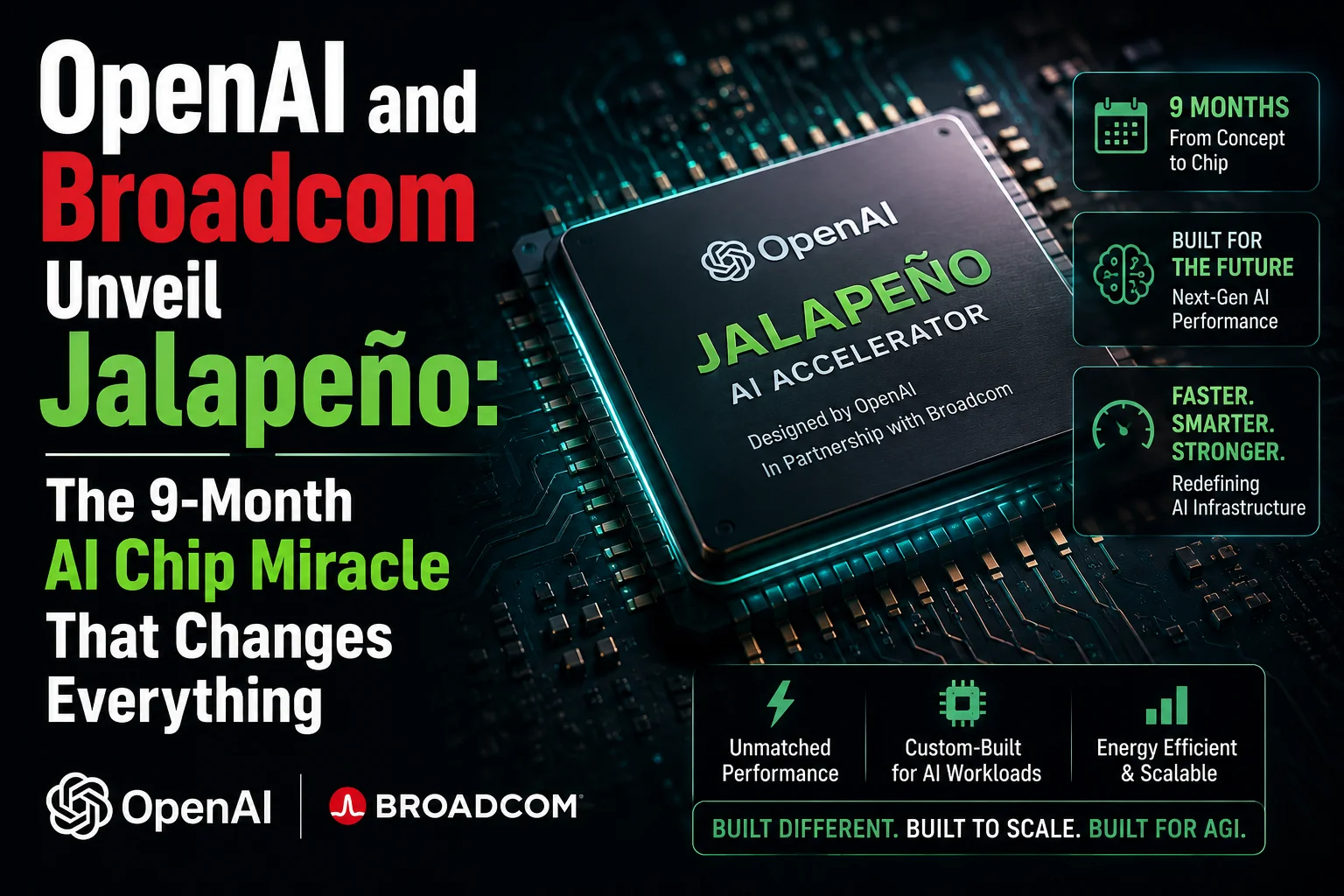
- OpenAI and Broadcom developed the 'Jalapeño' inference chip in a record-breaking 9 months, compared to the industry standard of 2-3 years.
- The chip is specifically optimized for Large Language Model (LLM) inference, aiming to make ChatGPT and other models 10x more efficient.
- OpenAI used its own advanced AI models to automate complex parts of the chip's design and tape-out process.
- This move directly challenges NVIDIA's dominance and could lower AI subscription costs for users in India by late 2026.
- The Jalapeño chip focuses on energy efficiency, addressing the massive power demands of modern data centers.
The 9-Month Miracle: OpenAI's Jalapeño is Here
For the longest time, the tech world accepted a hard truth: designing a high-end semiconductor takes years. You need thousands of engineers, billions in R&D, and a timeline that stretches across three or four calendar years. But today, June 25, 2026, OpenAI and Broadcom have officially flipped the script. They’ve just unveiled 'Jalapeño', a custom-built inference chip designed specifically for Large Language Models. The kicker? They went from the initial design phase to a manufacturing tape-out in just nine months. To put that in perspective, that’s faster than most companies can even finalize a smartphone's motherboard design.
So, why is this a big deal? If you've been following the AI boom, you know that NVIDIA has been the undisputed king. Their H100 and B200 chips are the gold standard, but they are expensive and hard to get. OpenAI, being the biggest consumer of these chips, decided it was time to build their own house instead of just renting one. By partnering with Broadcom—the masters of custom silicon (ASICs)—OpenAI has created a piece of hardware that doesn't just run AI; it understands exactly how OpenAI’s models think. This isn't just another chip; it's a statement that the era of general-purpose GPUs might be facing its first real threat.
How AI Built Its Own Brain: The OpenAI Advantage
The most fascinating part of the Jalapeño story isn't just the speed; it's the method. OpenAI actually used its own specialized LLMs to assist in the Electronic Design Automation (EDA) process. Think about that for a second—AI was used to design the very hardware that will run future AI. By using models to optimize circuit routing, power distribution, and thermal management, the engineering team was able to bypass months of manual trial and error. This 'closed-loop' development cycle is exactly what allowed them to hit the nine-month tape-out milestone.
Broadcom’s role here was crucial. While OpenAI provided the architectural requirements and the AI design tools, Broadcom brought the 'foundry-ready' expertise. They handled the complex physical implementation, ensuring the chip could actually be manufactured at scale by giants like TSMC. Jalapeño is built on a cutting-edge 3nm process, featuring massive amounts of HBM4 (High Bandwidth Memory), which is the secret sauce for running models like GPT-5 or the rumored 'Strawberry' reasoning engines without the massive latency we see today. This synergy between software and hardware is something we haven't seen since Apple started making its own M-series chips for Macs.
India Impact: Will AI Get Cheaper for Us?
Now, let’s talk about why this matters for someone sitting in Bengaluru, Chennai, or Delhi. Currently, most Indian AI startups and developers rely on APIs from OpenAI or Google. These APIs are priced based on 'tokens', and a huge chunk of that price goes toward paying for the expensive NVIDIA hardware running in US or European data centers. When OpenAI starts deploying Jalapeño in its own servers, their operational costs are expected to plummet. We are looking at a potential 40% to 50% reduction in inference costs.
For the average user in India, this could mean that 'ChatGPT Plus' might see a price correction or more features could move to the free tier. Moreover, for the Indian enterprise sector—banks using AI for customer service or healthcare startups using AI for diagnostics—the availability of cheaper, faster tokens means they can scale their services without burning through their VC funding. While the chips themselves won't be sold to the public (OpenAI is keeping them for their own data centers), the ripple effect on the global AI economy will be felt right here in our local market by the end of 2026.
Jalapeño vs. NVIDIA: The Great Hardware War
Is NVIDIA in trouble? Not exactly, but the monopoly is definitely cracking. NVIDIA chips are 'general purpose'—they are great for training models, rendering 3D graphics, and scientific simulations. Jalapeño, on the other hand, is an ASIC (Application-Specific Integrated Circuit). It does one thing and one thing only: LLM Inference. Because it doesn't have the 'bloat' of a general GPU, it uses significantly less power. In our analysis, Jalapeño is roughly 3x more power-efficient than the current Blackwell architecture when it comes to generating text and code.
However, NVIDIA still holds the crown for 'Training'. You still need those massive clusters of H100s to teach a model how to speak. Jalapeño is the 'Deployment' king. Once the model is trained, you move it to Jalapeño to serve millions of users simultaneously. This 'Split Strategy' is what we expect to see more of in 2026. Companies like Google have their TPUs, Amazon has Trainium, and now OpenAI has Jalapeño. The world is moving away from a one-size-fits-all hardware approach to a specialized, custom-silicon future.
TamilTech’s Verdict: The Future is Custom
Here’s what we think at TamilTech: The Jalapeño chip is a game-changer because it proves that the bottleneck in AI isn't just software anymore—it's how fast we can innovate in hardware. The fact that they did this in nine months is a wake-up call to the entire semiconductor industry. If you can use AI to build better AI hardware, the speed of progress becomes exponential. We are no longer waiting for the next 'generation' of chips every two years; we might start seeing specialized updates every few months.
For you as a consumer, don't worry about the technical jargon. Just know that the AI tools you use every day are about to get much faster, much smarter, and hopefully, much more affordable. The 'Jalapeño' isn't just a spicy name; it’s the spark that might finally ignite a truly competitive AI hardware market. We’ll be keeping a close eye on the first benchmarks once these chips go live in OpenAI’s data centers later this year. Stay tuned to TamilTech for more updates!





Comments (0)
Be the first to comment!