


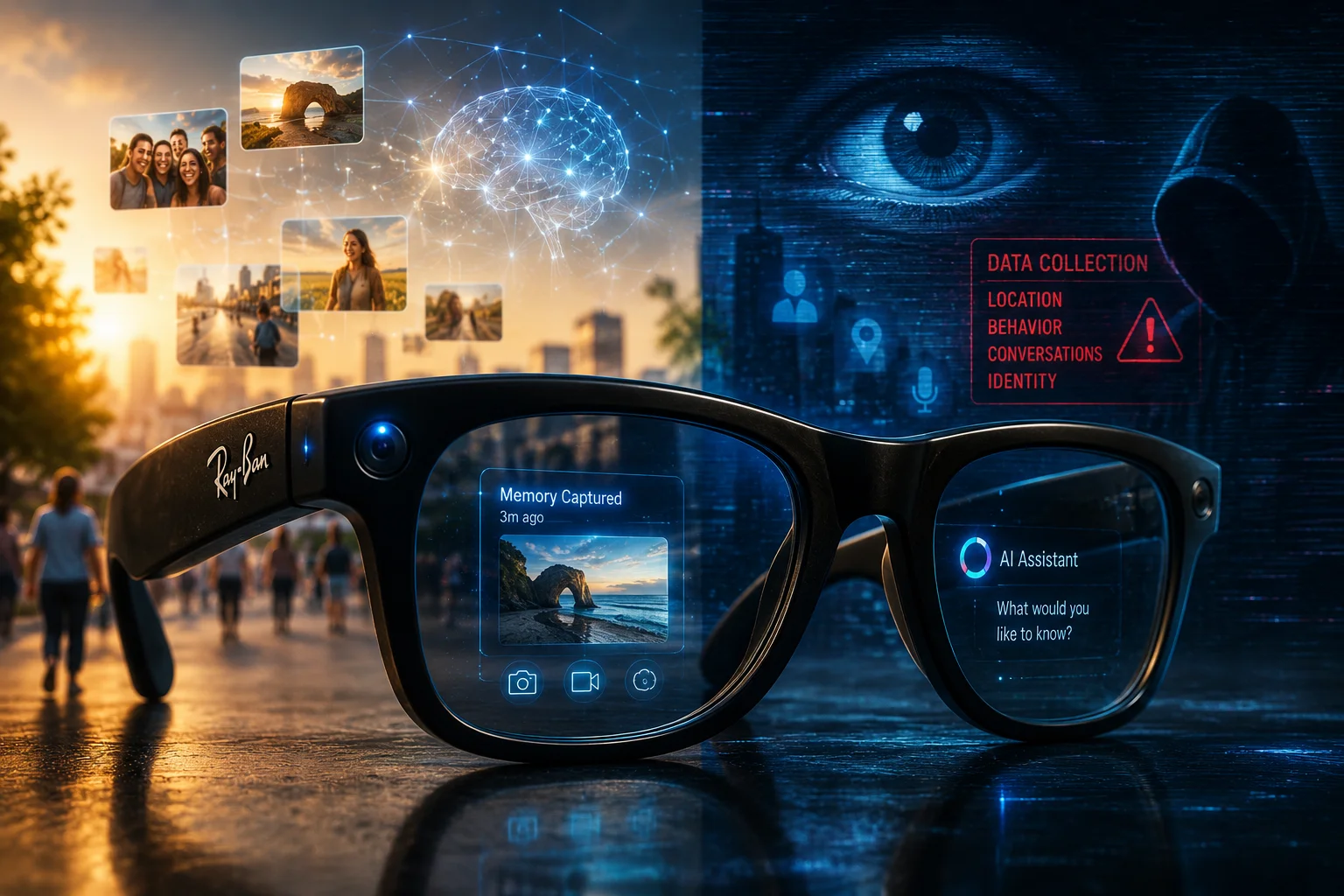
Key Takeaways
- Meta is testing a 'Continuous AI' feature that takes photos every 2 to 5 seconds and records audio in the background without manual triggers.
- The new system allows users to query their glasses about things they saw hours ago, such as "Where did I leave my car keys?" or "What was the price of that shirt I saw?"
- The glasses are expected to hit the Indian market by late 2026 with a projected price tag of ₹38,000 to ₹45,000.
- TamilTech Verdict: While the productivity boost is massive, the privacy implications of a 'walking surveillance camera' are a major concern for Indian users.
The Future of Wearables is Getting Real (and a Bit Creepy)
Imagine you are walking through a busy market in T. Nagar, Chennai. You see a dozen different things, talk to three shopkeepers, and check out various prices. Two hours later, you're back home and you can't remember which shop had that specific blue kurta you liked. Now, imagine asking your glasses, "Hey Meta, which shop had the blue kurta for ₹1,200?" and getting an instant answer. This isn't a Black Mirror episode anymore; it's exactly what Meta is testing right now in July 2026. The tech giant is pushing the boundaries of what smart glasses can do by moving away from 'on-demand' AI to 'continuous' AI. This means the glasses are no longer waiting for you to tap a button; they are silently watching and listening to help you remember your life.
So, here is the deal—Meta is internally testing a version of the Ray-Ban Meta glasses that captures images every few seconds and maintains a rolling buffer of audio. This data is processed by their latest Llama 4 model (which is significantly faster and more contextual than last year's version). The goal is to create a 'perpetual memory' assistant. It’s not just about taking a photo; it’s about the AI understanding the context of your entire day. We at TamilTech have been following this development closely, and honestly, the implications for productivity are wild. But let’s be real, the idea of a camera that never stops clicking is going to make a lot of people very uncomfortable.
How This 'Continuous AI' Actually Works
In the previous 2024 and 2025 models, you had to say "Hey Meta, look and tell me..." for the glasses to activate the camera. It was a conscious action. In this new 2026 testing phase, the glasses operate in a low-power 'passive' mode. Every few seconds—depending on the motion sensors—the camera snaps a low-resolution thumbnail. These aren't high-quality photos meant for your Instagram feed; they are 'data points' for the AI. The audio works similarly, keeping a temporary log of conversations and ambient sounds. All of this is then indexed locally or in an encrypted cloud silo, allowing you to perform a natural language search on your own life experiences.
The hardware required for this is quite sophisticated. To prevent the glasses from melting on your face due to heat, Meta is using a new 4nm chipset that handles most of the image processing in a specialized low-power enclave. Battery life has always been the Achilles' heel for smart glasses. In our analysis, running a camera every 5 seconds would usually kill a battery in 45 minutes. However, Meta's new 'snapshot' tech only wakes up the sensor for a fraction of a second, aiming for at least 4 to 6 hours of continuous 'memory' tracking. It’s a massive engineering feat, but it raises the question: just because we can record everything, should we?
The India Impact: Privacy, Laws, and Social Etiquette
When this tech lands in India—likely through official Ray-Ban stores and platforms like Flipkart or Amazon—it's going to hit a wall of social and legal scrutiny. India's Digital Personal Data Protection (DPDP) Act is now in full swing in 2026, and a device that records people in public without explicit consent every 5 seconds is a legal gray area. Think about it: if you're wearing these in a metro or a private office meeting in Bengaluru, you are technically recording everyone around you. Meta is trying to mitigate this with a more prominent LED light that pulses when the 'continuous' mode is active, but in a bright Indian outdoor setting, who is really going to notice a tiny white light?
From a pricing perspective, we expect these glasses to be positioned as a premium lifestyle gadget. With the current exchange rates and import duties, a price point of around ₹42,000 seems realistic. For the tech-savvy Indian professional, this is a productivity beast. Imagine being a medical student or an engineer who can 'search' back through a three-hour workshop just by asking questions. But for the average person on the street, it might feel like being followed by a drone. We think the adoption in India will be divided—the Gen-Z and tech crowd will love it for the 'cool factor,' while the older generation might see it as a massive privacy risk.
Real-World Use Cases: Why Would You Want This?
Let's talk about the 'Why'. Why would you want your glasses to record everything? The most obvious use case is 'Recall'. We all have those moments where we forget where we put our wallet, or the name of the person we just met at a wedding. With continuous recording, the AI can pinpoint the exact second you put your wallet on the fridge or when that person introduced themselves. It's like having a searchable transcript and photo album of your entire day. For people with memory issues or even just busy professionals, this is a literal lifesaver. You could ask, "What was the name of the restaurant I walked past in Indiranagar?" and the AI would pull up the image and give you the menu.
Another huge use case is real-time assistance. Since the AI is always 'seeing', it can provide proactive help. If you are in a supermarket and you pick up a product, the AI could instantly whisper in your ear that the same item is 20% cheaper on BigBasket or Blinkit. It turns your vision into an interactive shopping layer. However, the downside is the 'creep factor'. How would you feel if your friend was wearing these while you were sharing a personal secret? The social etiquette for 2026 is going to have to evolve very quickly to keep up with this hardware.
TamilTech’s Honest Take: Is it Worth It?
Look, we love new tech, but this one feels like a double-edged sword. On one hand, the convenience of never forgetting anything is incredible. It’s the closest thing we’ve seen to a brain-computer interface without actually putting a chip in your head. On the other hand, the 'Always-On' nature of this device is a privacy nightmare. Meta doesn't have the best track record with data, and even if they promise everything is encrypted, the idea of their servers having a low-res map of your entire life is a hard pill to swallow. We think this will be a niche product for the first year, mostly used by creators and 'power users'.
Our advice? If you are a student or someone who deals with a lot of visual information, this could be your best tool yet. But if you value your privacy—and the privacy of those around you—you might want to wait and see how the regulations handle this. One thing is for sure: the way we interact with the world is changing. We’re moving from 'using' tech to 'wearing' it, and Meta is leading that charge, for better or worse. Stay tuned to TamilTech for more updates as we get our hands on a testing unit later this year!




Comments (0)
Be the first to comment!