


Key Takeaways
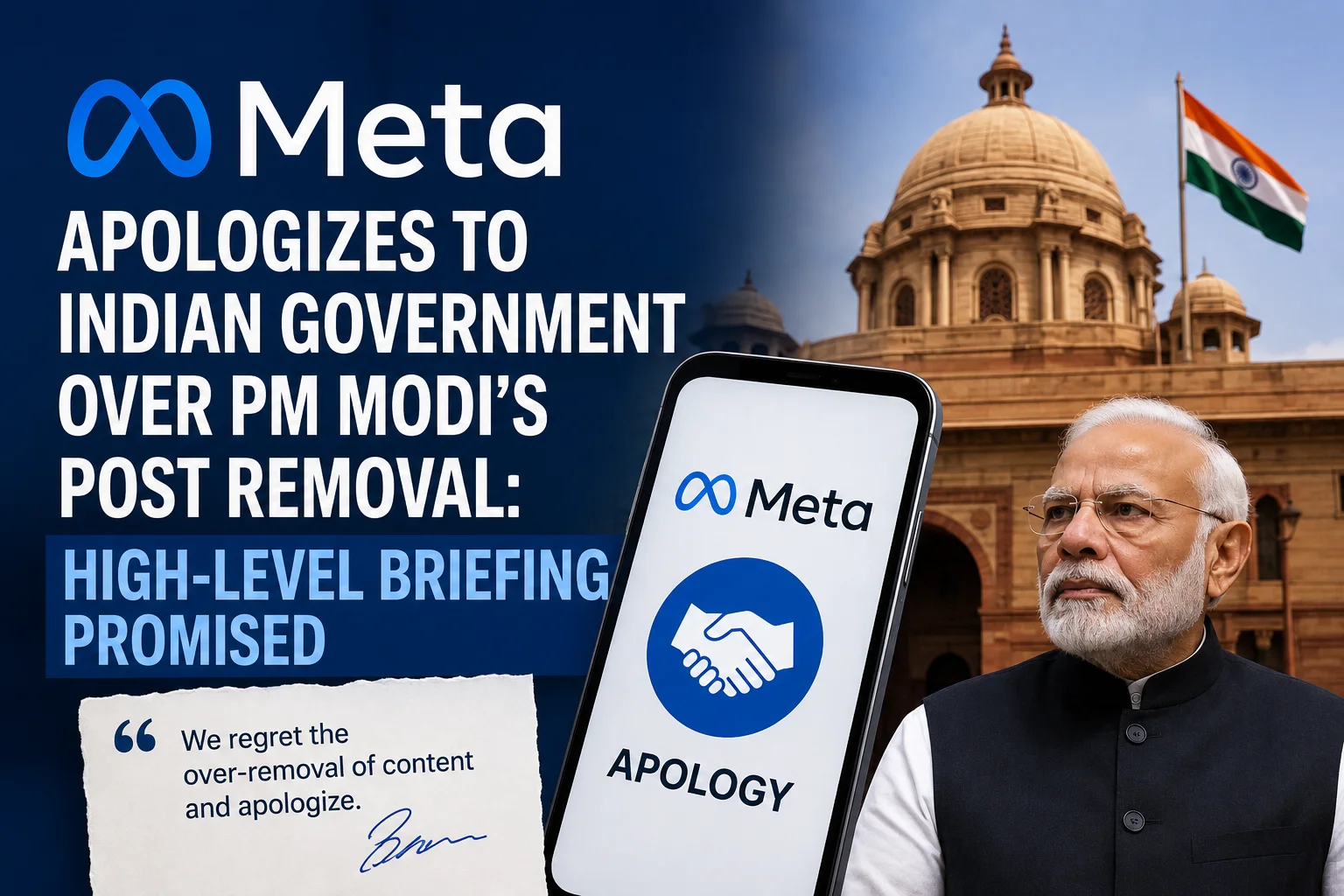
- Meta officially expressed regret to the Indian government for the accidental removal of a post from PM Narendra Modi's official account.
- IT Secretary S Krishnan confirmed that Meta will provide a detailed explanation at the highest leadership level regarding why their automated systems failed.
- The incident was attributed to an 'automated moderation error' where AI systems wrongly flagged content as violating community standards.
- This event highlights the ongoing friction between the Indian government's IT rules and the algorithmic transparency of Big Tech platforms in 2026.
- Users whose posts are wrongly removed can use the 'Request Review' feature, but the government is pushing for faster human intervention in high-profile cases.
The 'Oops' Moment That Shook Social Media
Imagine being the most followed leader on a platform and having your content suddenly vanished by an AI bot. That is exactly what happened recently when Meta's automated systems decided to flag and remove a post from Prime Minister Narendra Modi's profile. While the post was eventually restored, the ripple effects in the Ministry of Electronics and Information Technology (MeitY) were immediate. It is not every day that a global tech giant has to answer for 'silencing' a head of state, especially in its largest market, India. We have seen glitches before, but when it happens at this level, it raises massive questions about who really controls the narrative on social media.
The Indian government did not take this lightly. IT Secretary S Krishnan has been vocal about the incident, stating that the government expects more than just a standard 'system error' excuse. For a long time, we at TamilTech have discussed how AI moderation is a double-edged sword. On one hand, it cleans up millions of spam posts every second. On the other hand, it lacks the nuance to understand political context or the significance of an official government communication. This incident is a wake-up call for Meta to refine its Indian context-specific algorithms, which clearly still have significant blind spots even in 2026.
MeitY Steps In: S Krishnan Demands Accountability
Following the incident, the IT Secretary, S Krishnan, held discussions with Meta's India leadership. According to the latest updates, Meta has officially expressed its regret. But the Indian government wants to dig deeper. They aren't just looking for an apology; they want to know the 'why' and the 'how.' Meta has promised to provide a comprehensive briefing at the highest level—meaning global executives might have to explain the technical failure to Indian officials. This isn't just about one post; it's about the sovereignty of digital communication in India and how much power these platforms should hold over public discourse.
The government's stance is clear: if an algorithm can accidentally censor the Prime Minister, what is happening to the average 'Digital Nagrik' (Digital Citizen)? S Krishnan emphasized that platforms must ensure their automated tools are calibrated to handle sensitive and high-profile accounts with a layer of human oversight. The Ministry is looking into whether this was a genuine technical glitch or a flaw in the policy logic that the AI follows. In 2026, with the Digital India Act in full force, the stakes for non-compliance or repeated 'errors' are higher than ever for companies like Meta, Google, and X.
The Technical Glitch Excuse: How AI Moderation Actually Fails
Meta often hides behind the term 'technical glitch,' but let us break down what that actually means. Meta uses a massive neural network to scan billions of images, videos, and text strings. These systems are trained on datasets to recognize 'harmful content.' However, these AI models can suffer from 'false positives.' For example, a perfectly legal political statement might contain keywords that the AI associates with restricted topics. When the AI hits a high confidence score for a violation, it automatically hides or deletes the post before a human even sees it.
The problem in this specific case was likely a failure in the 'whitelisting' or 'priority queue' system. Usually, high-profile accounts like those of world leaders have a protection layer where automated removals are supposed to be reviewed by a human moderator first. If this layer failed, it suggests a deeper bug in Meta's 2026 code architecture. We believe Meta needs to be more transparent about these 'safeguards.' If the system can't distinguish between a Prime Minister's official update and a violation of community standards, the AI is clearly not as 'smart' as the marketing suggests.
India Impact: Why Meta Cannot Afford to Mess Up Here
India is Meta's biggest playground. Between Facebook, Instagram, and WhatsApp, Meta has over 800 million users in India. Any friction with the Indian government is bad for business. Recently, we have seen stricter rules regarding 'Fact Checking' and 'Grievance Redressal.' If Meta is perceived as being biased or technically incompetent in handling Indian content, it risks facing heavy fines or even service restrictions under the current IT laws. For the average Indian user, this means the platform you use every day is under constant scrutiny.
From an investment perspective, Meta has poured billions into India, including partnerships with Jio and various digital literacy programs. They cannot afford a 'trust deficit.' When the IT Secretary says they are waiting for a high-level explanation, it means Meta is currently in the 'penalty box.' For you and me, this might lead to more human moderators being hired for Indian languages and a potential change in how our own posts are flagged. We might see a more 'cautious' AI that asks for human confirmation more often, which could slow down moderation but increase accuracy.
What to Do if Your Post is Wrongly Removed
While you might not have the IT Secretary fighting your case, you still have rights. If Meta's AI wrongly removes your post, here is the standard procedure to follow in 2026. First, do not panic. Go to your 'Account Status' in the settings menu. You will see the specific post that was flagged and the reason (e.g., 'Community Standards violation'). Click on 'Request Review' or 'I Disagree with This Decision.' This usually pushes the content to a human moderator, though it can take anywhere from 24 hours to a week.
If the internal appeal fails and you are sure you haven't broken any laws, you can escalate this to the Government's Grievance Appellate Committee (GAC). This is a portal where Indian citizens can complain against the decisions of social media platforms. The GAC has the power to overrule the platform's decision. This is a powerful tool that many users ignore. Remember, in the Digital India era, you are not just a user; you are a stakeholder with legal protections against arbitrary automated decisions.
TamilTech's Take: Accountability Over Apology
We think Meta's 'regret' is a good first step, but it is not enough. Big Tech has been using the 'automated error' excuse for nearly a decade now. It is time for real accountability. If an algorithm is powerful enough to delete content, it must be transparent enough to be audited. We want to see Meta release a detailed report on why their 'high-profile protection' failed in this instance. Was it a server-side update gone wrong? Or was it a training data bias? The Indian public deserves to know.
Looking ahead, we expect the relationship between the Indian government and social media giants to remain 'complicated.' While these platforms are essential for communication and business, the 'black box' nature of their AI is a major concern. We predict that by the end of 2026, we might see new regulations that mandate 'Human-in-the-loop' moderation for any content involving public figures or national interests. For now, stay tuned to TamilTech for more updates on this developing story. Don't forget to check your own account status regularly—you never know when the AI might have an 'oops' moment with your profile too!




Comments (0)
Be the first to comment!