


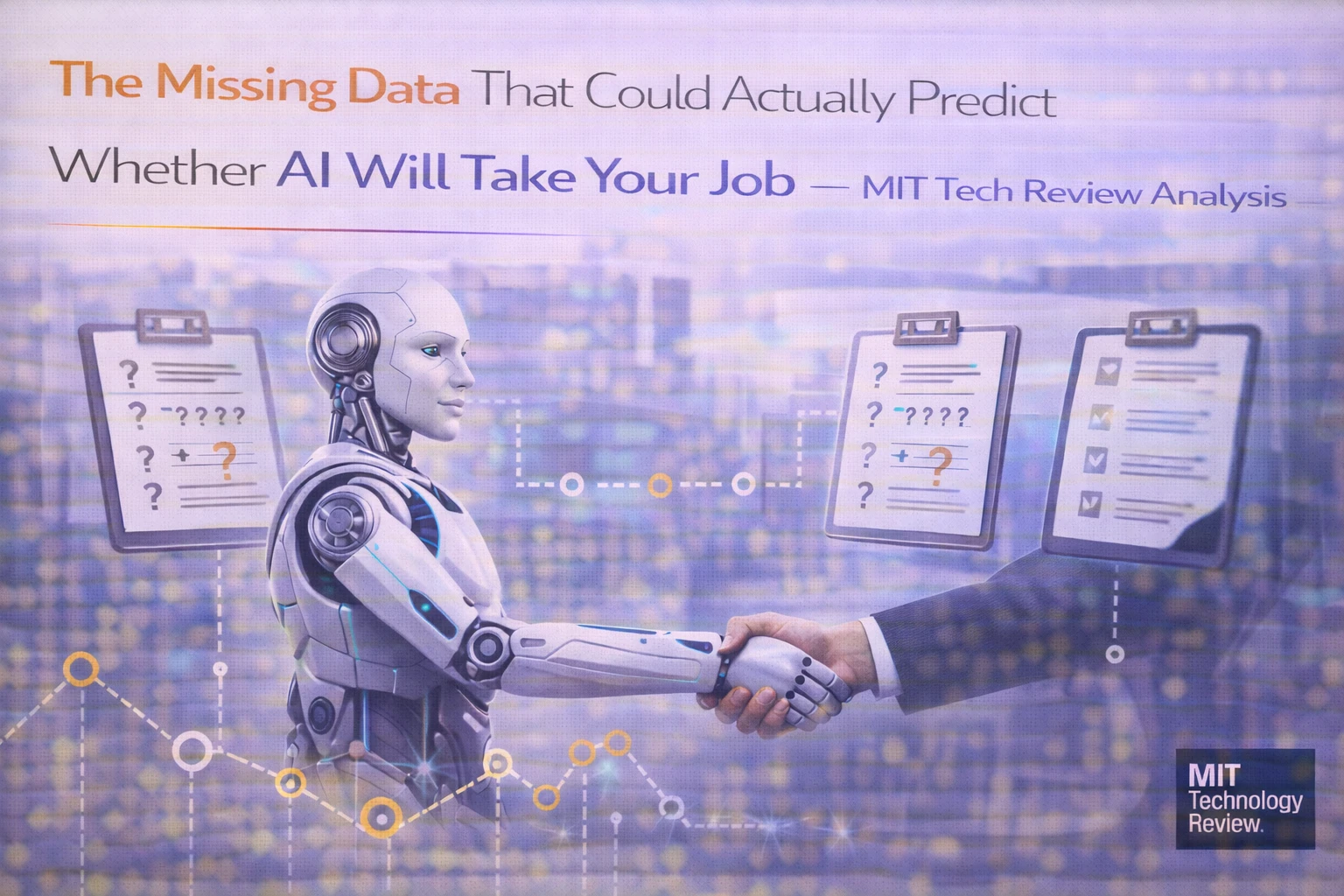
Why Nobody Can Actually Predict AI's Impact on Jobs — The Missing Variable
Will AI take your job? Everyone has an opinion, but nobody has the data. A provocative article from MIT Technology Review (April 6, 2026) argues that the entire discourse around AI and employment is built on incomplete data — and identifies the one piece of missing information that could actually answer the question.
Economist Alex Imas from the University of Chicago puts it bluntly: current tools for predicting AI's impact on jobs are "pretty abysmal" and issues a "call to arms" for economists to collect the missing data.
The Missing Price Elasticity of Demand
The one piece of data that nobody has is price elasticity of demand — the measure of how demand for a service changes when its cost drops due to AI automation.
Here's why it matters with a simple example:
If AI makes tutoring 10x cheaper, do people buy 10x more tutoring? If yes, tutors may actually see MORE work despite AI automation. If demand doesn't increase proportionally, tutors get displaced.
Universities like the University of Chicago have price elasticity figures for grocery items (cereal, milk) from supermarket partnerships. But no comparable data exists for job categories like tutors, web developers, dietitians, or accountants.
Imas states: "We need, like, a Manhattan Project to collect this" data across the entire economy.
Why "AI Exposure" Alone Is Meaningless
Most AI-and-jobs research measures "task exposure" — how many of a job's tasks can AI perform. OpenAI's research (December 2025) used the O*NET task catalogue to estimate that 36% of occupations use AI for at least a quarter of tasks. This sounds scary, but Imas argues: "Exposure alone is a completely meaningless tool for predicting displacement."
Why? Because displacement depends on two variables that exposure doesn't capture:
Variable 1: Elasticity of Consumer Demand
If a service gets cheaper, do people buy more of it?
- High elasticity (demand increases a lot when price drops): Tutoring, content creation, legal advice for small businesses — more people would use these if they were 10x cheaper
- Low elasticity (demand stays flat): Tax preparation, certain accounting tasks — you don't do your taxes twice just because it's cheap
High-elasticity jobs could actually grow with AI automation. Low-elasticity jobs are more at risk.
Variable 2: Job Dimensionality
How many tasks make up the job?
- Low-dimensional jobs (few tasks): If a job has one core task and AI automates it, the job is gone. Example: a data entry operator
- High-dimensional jobs (many tasks): AI may automate some tasks but not others. Example: a doctor diagnoses, counsels, performs procedures, manages a team — AI can help with diagnosis but not the rest
What Data Exists Today?
OpenAI Research (December 2025)
- Used O*NET (US government task catalogue, launched 1998) to measure AI "exposure"
- About 36% of occupations use AI for at least a quarter of tasks
- Only 4% show AI used for three-quarters or more of tasks
Anthropic Research (February-March 2026)
- Analyzed nearly 2 million Claude conversations to measure "observed exposure"
- Theoretical AI coverage (what AI COULD do): Computer/math 94.3%, Business/finance 94.3%, Management 91.3%
- Observed AI coverage (what AI IS actually doing): Computer/math 37.2%, Business/finance 7.6%, Management 4.9%
- The gap between theoretical and observed is massive — AI CAN do a lot more than it currently IS doing
What This Means for India
India's tech workforce is particularly exposed to this uncertainty:
- IT Services (TCS, Infosys, Wipro, HCL) — These companies employ millions of workers doing tasks with high AI exposure. But the key question is: will cheaper AI-powered IT services create MORE demand from global clients?
- BPO Industry — India's massive call center and back-office industry is a classic low-dimensional job risk. If AI can handle 80% of customer queries, do companies hire fewer agents or handle more queries?
- Freelancers — India has the world's second-largest freelancer base. Content writing, web development, graphic design — all highly AI-exposed. Elasticity determines whether these freelancers thrive or struggle
- Education — India's ed-tech boom (Byju's, Unacademy, PhysicsWallah) could go either way. If AI tutoring is 10x cheaper, does demand explode (good for the sector) or does it eliminate the need for human tutors?
The Framework for Thinking About Your Job
| High Elasticity (demand grows with price drop) | Low Elasticity (demand stays flat) | |
|---|---|---|
| High Dimensional (many tasks) | SAFEST — job grows, AI handles routine parts | MIXED — some tasks automated, job evolves |
| Low Dimensional (few tasks) | GROWING — more demand, but AI does the work differently | MOST AT RISK — limited tasks, limited new demand |
What Needs to Happen
Imas's "Manhattan Project" call is for:
- Systematic price elasticity measurement across hundreds of service categories
- Real-time tracking of how AI adoption changes demand patterns
- Policy preparation — governments can't prepare for displacement they can't predict
- Worker education — helping people understand which dimensions of their job are AI-resistant
Until this data exists, every prediction about AI and jobs — whether optimistic or pessimistic — is essentially guesswork dressed up in research methodology. India, with its massive tech workforce and rapidly growing AI adoption, has perhaps the most at stake in getting this right.




Comments (0)
Be the first to comment!