


Key Takeaways
- Microsoft plans to offer low-cost AI models, directly challenging the dominance of a few major AI labs and making advanced AI accessible for Indian startups and developers.
- Nadella's stance on AI democratization aligns with India's 'Digital India' vision, potentially accelerating AI adoption in local languages and regional applications across the country.
- This move could significantly lower the barrier to entry for AI innovation in India, fostering a new wave of homegrown AI solutions tailored for the Indian market.
What's the News
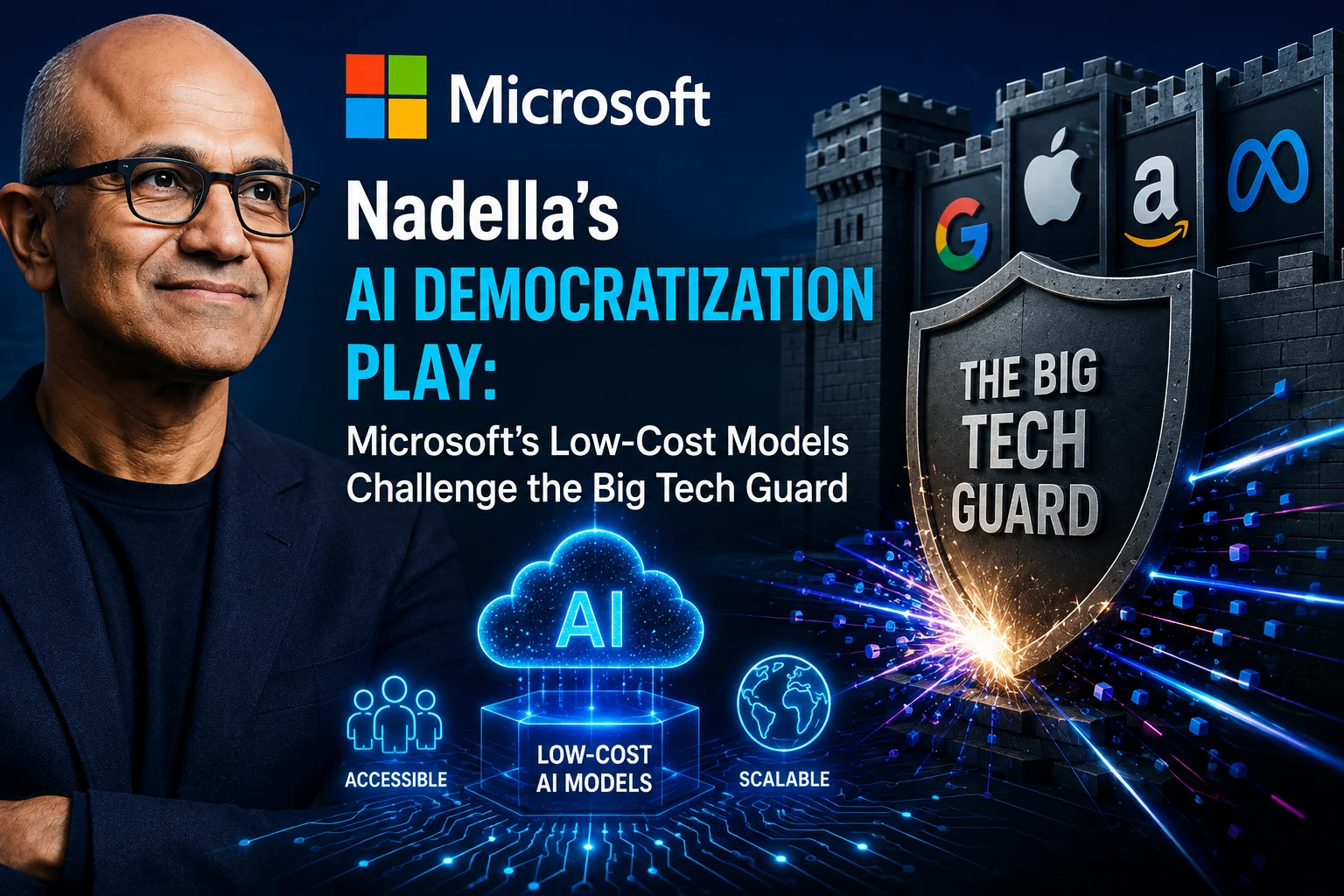
Microsoft CEO Satya Nadella has thrown down the gauntlet in the global AI race, stating that the public and markets will not tolerate a future where only a handful of labs control the world's AI learning. In a strategic pivot, Microsoft is gearing up to release a suite of low-cost AI models and tools, aiming to democratize access to artificial intelligence. This announcement comes as a direct challenge to the closed ecosystems of tech giants and signals a significant shift towards more open and affordable AI infrastructure.
Details
Speaking at a recent tech summit, Nadella emphasized the need for a more distributed AI ecosystem. He argued that concentrating AI's learning and power in the hands of a few is not only unsustainable but also goes against the principles of innovation and progress. Microsoft's response is to build and offer a range of AI models that are not only powerful but also significantly cheaper to run and integrate. This includes smaller, more efficient models that can be fine-tuned for specific tasks, reducing the computational costs that have been a major barrier for many businesses and developers. The company is also enhancing its Azure AI platform with new tools designed to make building and deploying AI applications easier and more cost-effective. This strategy is a clear move to capture the next wave of AI adoption, especially in emerging markets where cost is a critical factor.
India Impact
For India, this news is a potential game-changer. The country has been making significant strides in technology, but the high cost of AI has been a bottleneck for widespread adoption. Nadella's vision directly addresses this pain point. By providing low-cost AI models, Microsoft is empowering Indian startups, MSMEs, and educational institutions to leverage AI without breaking the bank. This could lead to a surge in AI-powered solutions tailored for Indian languages, local contexts, and specific challenges in sectors like agriculture, healthcare, and finance. Imagine an AI model that can understand and process multiple Indian languages flawlessly, or a tool that helps farmers predict crop yields with high accuracy. Microsoft's move could make these scenarios a reality, aligning perfectly with initiatives like Digital India and the push for 'Aatmanirbhar Bharat' in the tech sector.
Use Cases
The implications of these low-cost AI models are vast and varied. For Indian startups, it means the ability to build sophisticated AI products without needing massive funding for compute resources. A fintech startup in Bengaluru could use these models to build a more accurate credit scoring system, while a health-tech company in Hyderabad could develop AI-driven diagnostic tools. In the education sector, schools and colleges could integrate AI tutors that support regional languages, making quality education more accessible. Even individual developers and students can experiment with advanced AI, fostering a culture of innovation and learning. The focus on smaller, more efficient models also opens up possibilities for on-device AI, which could be crucial for applications in areas with limited internet connectivity.
Honest Take
While Nadella's call for AI democratization sounds noble and is certainly good news for the Indian ecosystem, it's important to be realistic. Microsoft is still a tech giant with its own commercial interests. This move is as much about expanding its market share as it is about altruism. However, that doesn't diminish the positive impact it could have. The real test will be in the execution. Are these models truly affordable? Are they open enough to foster genuine innovation, or will they still lock users into the Microsoft ecosystem? For now, this is a welcome disruption in an AI landscape that has been looking increasingly like a walled garden. If Microsoft can deliver on its promise, it could accelerate AI adoption in India by years, creating a more inclusive and diverse tech ecosystem. It's a bold move, and one that could redefine the power dynamics in the AI world.






Comments (0)
Be the first to comment!