


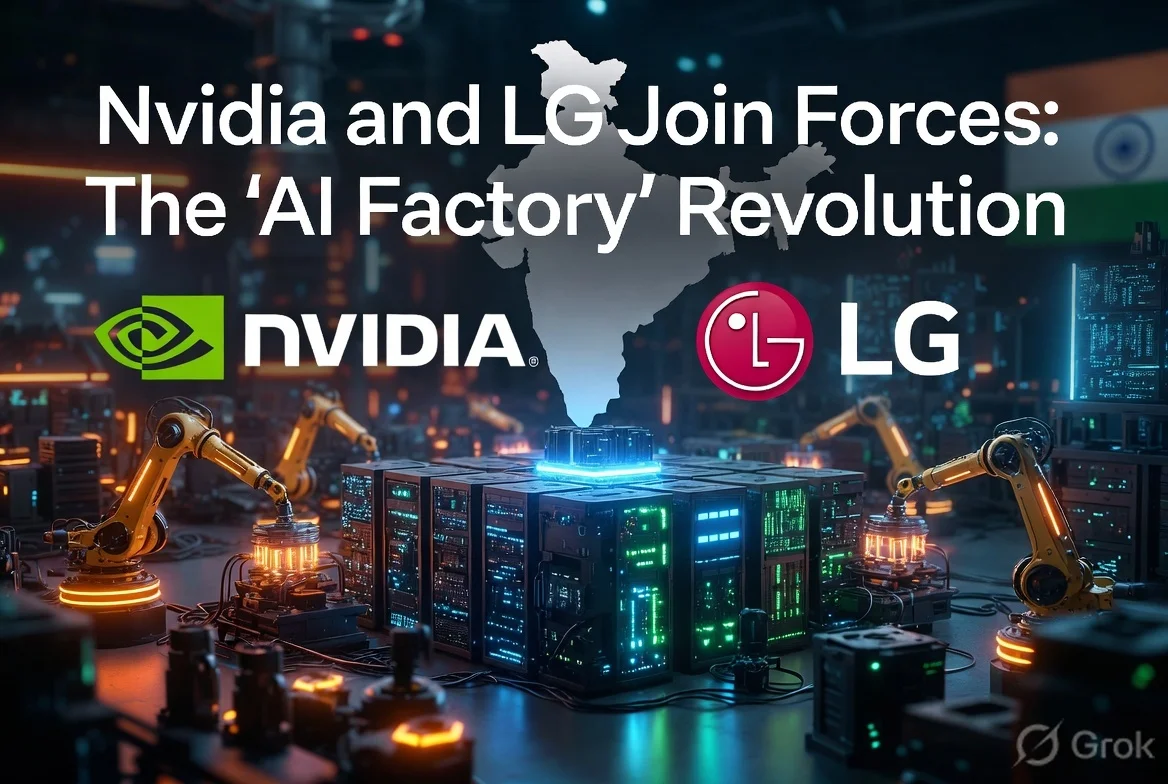
Key Takeaways
- Nvidia and LG are co-developing 'AI Factories' to accelerate the production of generative AI models for consumer electronics.
- The partnership includes co-designing next-gen data center architectures specifically optimized for Nvidia's 2026-era GPU clusters.
- LG will integrate Nvidia DRIVE and Isaac platforms into their upcoming electric vehicle components and autonomous factory robots.
- For India, this could lead to more advanced 'Made in India' LG products and local AI infrastructure development in LG's Pune and Noida plants.
- The bottom line: This isn't just a chip deal; it's a complete overhaul of how LG builds everything from washing machines to smart cars.
The Big Move: Nvidia and LG are Rethinking Everything
Look, we all know Nvidia is the king of AI right now. In 2026, you can't even talk about technology without mentioning Jensen Huang and his team. But the latest news is a massive level-up. Nvidia and LG have officially expanded their partnership into something way bigger than just buying chips. They are talking about building 'AI Factories' and co-designing the very architecture of future data centers. This isn't just a corporate handshake; it’s a blueprint for the next decade of smart devices and mobility tech.
So, what exactly is an AI Factory? Think of it as a massive power plant, but instead of electricity, it pumps out intelligence. LG wants to use Nvidia's massive computing power to train AI models that will live inside your next fridge, your next TV, and even the electric car you might buy in a few years. They are moving away from simple 'smart' features to 'agentic' AI—devices that can actually think, plan, and execute tasks without you having to click ten buttons on an app. We at TamilTech have been tracking this shift, and this Nvidia-LG combo is probably the most serious attempt we've seen at making AI truly physical.
How We Got Here: From TVs to Total AI Integration
If you look back at the last couple of years, LG has been quietly transforming itself. They aren't just a 'home appliance' company anymore; they’ve been calling themselves a 'Smart Life Solution Company.' To do that, you need serious horsepower. Nvidia, on the other hand, is looking for partners who can actually put their AI chips to work in the real world, not just in a cloud server somewhere in Silicon Valley. This partnership bridges that gap perfectly.
Previously, LG was using Nvidia's tech in smaller doses—mostly for their infotainment systems in cars. But now, they are going deep into the backend. By co-designing data centers, LG is ensuring that their software runs perfectly on Nvidia’s hardware from day one. This kind of 'vertical integration' is what made Apple so successful, and now LG is trying to do the same for the home and mobility ecosystem. It's a smart play because, in 2026, hardware is only as good as the AI running on it.
The 'AI Factory' and Data Center Architecture
Let's get into the technical weeds for a second. When they talk about co-designing data center architectures, they are talking about liquid cooling, high-speed interconnects, and massive GPU clusters. LG needs this because they are collecting petabytes of data from millions of connected devices worldwide. To turn that data into useful features, you need an AI Factory that doesn't melt under the heat of 2026-level processing requirements.
These data centers will likely use Nvidia's latest Blackwell-successor architecture (perhaps the Rubin platform we've been hearing about). By working together, LG can tell Nvidia exactly what kind of workloads their home appliances and robots need. This means the chips and the servers are being built specifically to handle things like computer vision for vacuum cleaners or real-time sensor fusion for autonomous cars. It’s a custom-tailored approach that gives LG a massive edge over competitors who are just buying off-the-shelf parts.
India Impact: What's in it for us?
Now, let's talk about India. LG has a massive manufacturing footprint here, with major plants in Pune and Noida. As LG upgrades its global manufacturing using Nvidia’s 'Digital Twins' and robotics tech (the Isaac platform), we expect these Indian factories to get a massive tech boost. This could mean more high-tech jobs in India and more advanced products being 'Made in India' rather than just assembled here. If LG starts building these AI-ready components locally, it could significantly drop the price of high-end smart tech for Indian consumers.
Moreover, Nvidia has been very aggressive about the Indian market lately, partnering with big names like Tata and Reliance. The LG partnership adds another layer to this. Imagine an LG smart car, powered by Nvidia, built in a factory in Maharashtra that uses AI to ensure zero defects. That’s the level of impact we are looking at. While we might not see the full results by the end of 2026, the foundation is being laid right now. Expect LG’s premium 'Signature' line of products in India to get significantly smarter—and potentially more expensive—in the coming months.
Robotics and Mobility: The Future is Autonomous
One of the coolest parts of this deal is the focus on robotics. LG has been showing off various robots for years—delivery bots, lawnmowers, and even hospital assistants. By using Nvidia’s Isaac platform, these robots are going to get a massive brain transplant. They will be able to navigate complex environments (like a crowded Indian apartment or a busy hospital corridor) with much higher precision. They are moving from 'following a set path' to 'understanding the room.'
On the mobility side, LG is a huge supplier of car parts to other brands. By co-designing with Nvidia, LG’s 'cockpit' systems will become the gold standard. We are talking about AR (Augmented Reality) windshields that highlight potholes in real-time or AI assistants that can tell if the driver is feeling unwell and automatically pull the car over. This isn't sci-fi anymore; with Nvidia’s DRIVE platform and LG’s hardware, this is the 2027-2028 roadmap being built today.
TamilTech’s Honest Take: Is it all Hype?
Look, we see these 'strategic partnerships' all the time. Often, it's just a way to pump up stock prices. But this feels different. Why? Because LG actually has the hardware (fridges, cars, robots) and Nvidia actually has the brains (GPUs, CUDA, AI platforms). They need each other. LG can't build AI chips as well as Nvidia, and Nvidia doesn't want to build washing machines. It’s a perfect marriage of convenience.
The only downside? Privacy. If everything in your house is connected to an 'AI Factory,' where is that data going? LG and Nvidia will need to be very transparent about how they handle user data, especially in markets like India where data protection laws are still evolving. If they get the privacy part right, this could be the most significant tech alliance of the decade. If they don't, it might just be another way for big tech to peek into our living rooms.
What to Expect Next
Expect to see the first 'Nvidia-Optimized' LG products hitting the market by late 2026 or early 2027. We will probably see a major showcase at CES next year. For now, if you are planning to buy a high-end LG appliance or looking at their EV tech, just know that there is a massive Nvidia-powered brain being built behind the scenes to make those devices stay relevant for years to come. Stay tuned to TamilTech, we'll be the first to tear these devices down when they arrive!




Comments (0)
Be the first to comment!