


Key Takeaways
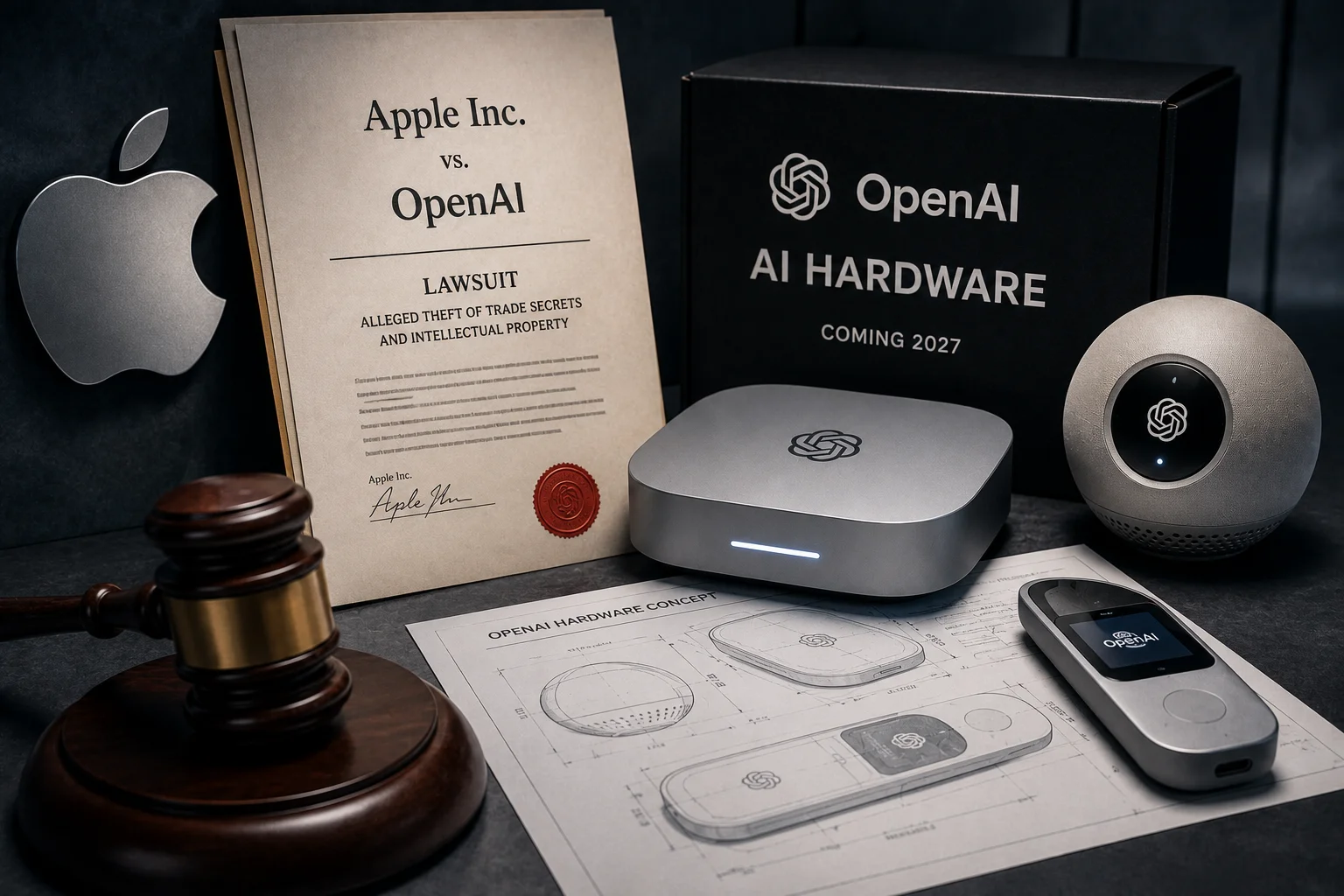
- OpenAI is officially on track to unveil its first AI-powered hardware device in late 2026, with a global consumer launch scheduled for 2027.
- Apple has filed a strategic lawsuit targeting OpenAI’s hiring practices, claiming they are poaching top-tier hardware engineers from the iPhone team.
- The device is expected to be a 'screenless' AI companion, potentially priced between ₹60,000 and ₹85,000 in the Indian market.
- Supply chain issues are mounting as Apple reportedly pressures component manufacturers to prioritize their upcoming 'Apple Intelligence' hardware over OpenAI’s orders.
So, here is the big news that everyone in the tech world has been whispering about. For the past year, we’ve heard rumors that OpenAI wants to move beyond just being a software company. They don’t just want to be the app on your phone; they want to be the phone itself—or at least the device that replaces it. As of July 2026, the internal word from OpenAI is clear: they are sticking to their timeline. We are looking at a grand reveal in late 2026 and a full-scale market release in 2027. But there is a massive elephant in the room, and that elephant is wearing an Apple logo.
The Sam Altman and Jony Ive Collaboration: What Are They Building?
Before we get into the drama, let’s talk about what this thing actually is. This isn't just another startup trying to make a 'cool' gadget like the failed Humane Pin or the Rabbit R1 from a couple of years ago. This is a collaboration between OpenAI CEO Sam Altman and the legendary Jony Ive—the man who basically designed the iPhone, iMac, and MacBook. When Jony Ive builds something, the world watches. The goal here is to create a device that uses 'Natural Interaction.' Think of it as a device that doesn't require you to stare at a glowing rectangle all day. It’s expected to be voice-first, gesture-heavy, and deeply integrated with GPT-5 (or whatever massive model they have by 2027).
Reports suggest the device will feel more like a high-end fashion accessory than a piece of tech. Imagine a device that understands your context—it knows who you are talking to, what you are looking at, and what you need to do next without you ever having to unlock an app. For us in India, this could be a game-changer for accessibility. Imagine a device that can live-translate a conversation in a local market or help a student study for exams using just voice. But building this hardware is proving to be much harder than writing code.
The Apple Lawsuit: A War for Talent
Now, let’s talk about the friction. Apple isn't sitting quietly while its former design chief builds a 'potential iPhone killer.' Apple has recently intensified a legal battle against OpenAI, focusing on 'talent poaching.' Over the last 18 months, OpenAI has successfully hired dozens of top-tier hardware engineers, many of whom were instrumental in developing Apple’s proprietary chips and camera systems. Apple’s lawsuit claims that these hires are a violation of non-compete agreements and, more importantly, that trade secrets regarding power management and battery efficiency are being leaked.
This isn't just about lawyers in a courtroom. This lawsuit is actively slowing down OpenAI’s progress. When a company is under this much legal scrutiny, hiring becomes a nightmare. New recruits are hesitant to join if they think they’ll be sued on day one. Furthermore, Apple is reportedly using its massive influence over supply chains in Taiwan and China to ensure that OpenAI doesn't get the 'first pick' of sensors and processors. If you want the best AI chips, you usually have to go through the same factories Apple uses. If Apple says 'it’s us or them,' most suppliers will choose the company that orders 200 million units a year.
India Impact: Price, Connectivity, and Local Languages
If OpenAI manages to push through these hurdles, what does it mean for the Indian consumer? First, let’s talk about the price. Given that Jony Ive is involved and they are using premium materials, this won't be a budget device. We expect a price tag around $800 to $1,000, which translates to roughly ₹70,000 to ₹90,000 after import duties. In India, this puts it directly in competition with the iPhone 17 and the Samsung S27 series. To succeed here, OpenAI will need to partner with someone like Jio or Airtel to bundle high-speed 5G data, because an AI device is useless without a constant, low-latency connection.
Another huge factor is language. For an AI device to work in India, it can't just speak English. It needs to master Hindi, Tamil, Telugu, and Marathi. OpenAI has been working on 'Project Bhasha' internally to improve its regional language models. If this device can effectively communicate in Tamil as naturally as it does in English, it will find a massive audience in the enterprise and education sectors in India. However, the lack of a physical screen might be a hard sell for the 'YouTube and Instagram' obsessed Indian youth.
TamilTech’s Take: Is OpenAI Biting Off More Than It Can Chew?
Honestly, we’ve seen this story before. Many companies have tried to build 'AI hardware' and most of them have ended up in the tech graveyard. But OpenAI is different because they own the 'brain' (ChatGPT). The problem is that hardware is a different beast entirely. You have to deal with batteries that explode, screens that crack, and supply chains that fail. Apple has spent 40 years perfecting this. OpenAI is trying to do it in three. While we are excited about the 2026 reveal, the Apple lawsuit is a serious threat. Apple doesn't need to win the lawsuit; they just need to delay OpenAI long enough so that 'Apple Intelligence' becomes the default for everyone.
Our advice? Don't throw away your smartphone just yet. The 2027 launch is still a way off, and by then, the iPhone might have evolved enough to make a standalone AI device feel redundant. But if anyone can disrupt the smartphone market, it’s the combination of Altman’s AI and Ive’s design. We’ll be tracking the supply chain movements in Chennai and Noida very closely to see if OpenAI looks for local manufacturing partners to bypass some of these hurdles.




Comments (0)
Be the first to comment!