


Key Takeaways
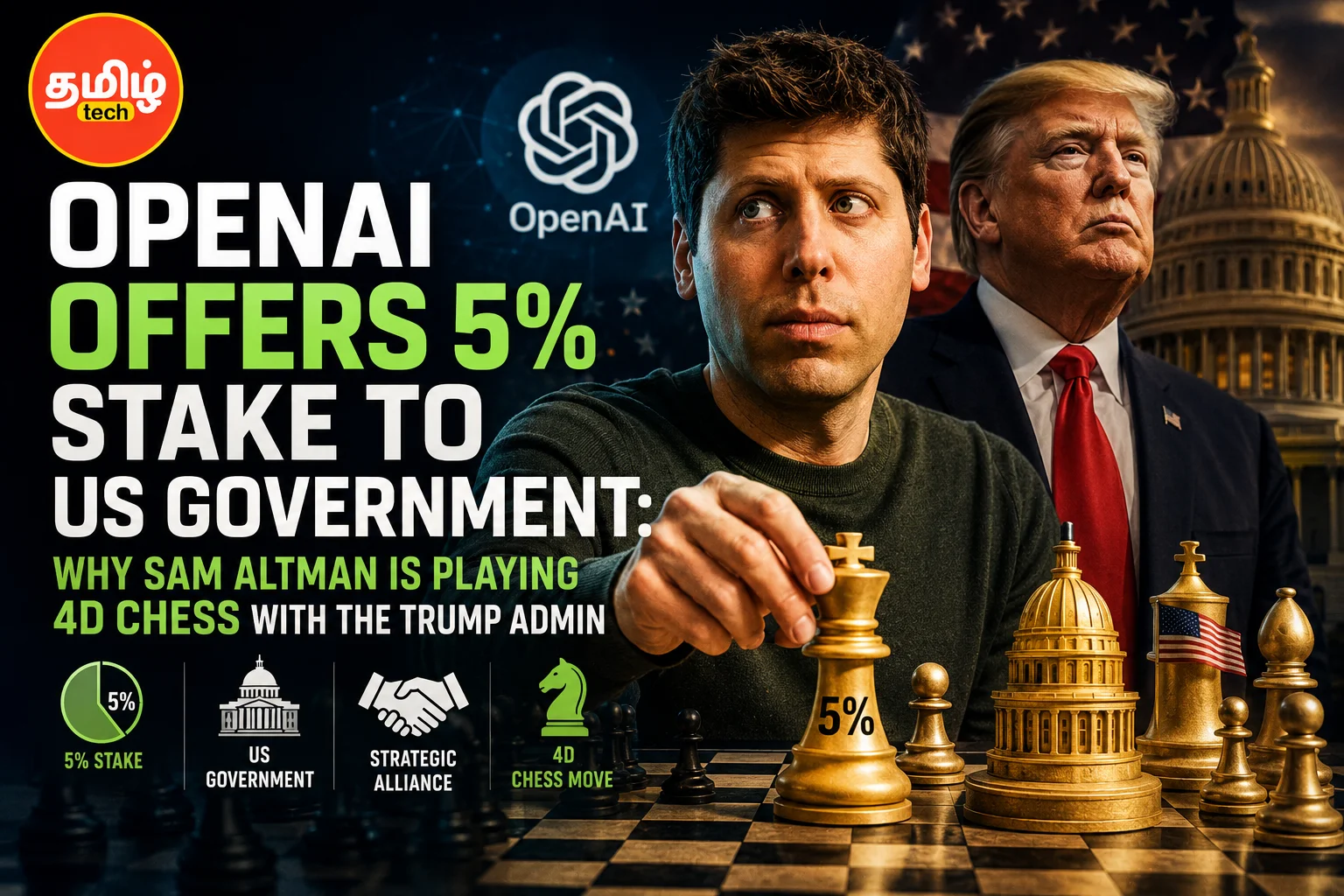
- OpenAI is discussing a proposal to give a 5% equity stake to the US government to secure political and regulatory buy-in.
- The move aims to align OpenAI with US national security interests and bypass potential antitrust or regulatory blocks under the Trump administration.
- This 5% stake could be worth billions, given OpenAI's current valuation, making the US government a direct stakeholder in AI's future.
- For users in India, this raises questions about AI neutrality and whether the US government will have a say in ChatGPT’s global policies.
- The bottom line: OpenAI is trading ownership for political protection to ensure it stays ahead of global rivals like China.
The Biggest Power Move in Tech History?
So, here is the thing — OpenAI is no longer just a tech company making cool chatbots. As of July 2026, it has become a geopolitical powerhouse. The latest buzz in the tech world is that Sam Altman and his team are actually discussing giving a 5% stake in the company directly to the US government. Think about that for a second. We are talking about one of the most valuable private companies in the world offering a piece of the pie to Uncle Sam. But why now? And why such a drastic move?
If you have been following the news this year, you know that the Trump administration has been very vocal about 'America First' in the AI race. They want to make sure that the US doesn't just lead in AI, but dominates it completely, especially against China. OpenAI, which is currently transitioning from its complex non-profit/for-profit hybrid structure to a full-on for-profit 'Public Benefit Corporation,' needs friends in high places. By offering a 5% stake, they aren't just giving away money; they are buying a 'get out of jail free' card for future regulatory headaches. It is a bold, calculated, and honestly, a bit scary move that could change how tech companies operate forever.
How OpenAI Got Here: From Non-Profit to Government Partner
To understand why this is happening in 2026, we have to look back at how much OpenAI has changed. Remember when it started as a small non-profit lab? Those days are long gone. After the massive success of GPT-4 and the recent rollout of GPT-6 models, OpenAI has become a massive commercial entity. However, this growth came with a lot of baggage. Governments around the world started asking tough questions about data privacy, copyright, and the sheer power these AI models hold. In the US, the political climate has shifted towards heavy scrutiny of 'Big Tech,' even if the administration is generally pro-business.
The Trump administration's approach to tech in 2026 has been a mix of deregulation for 'patriotic' companies and heavy pressure on those that don't align with national interests. OpenAI saw the writing on the wall. They realized that to build the massive 'Stargate' supercomputer clusters they have planned — which require billions of dollars in investment and massive amounts of electricity — they need the government's full support. They need land, they need power, and they need to make sure the Department of Justice doesn't come knocking with an antitrust lawsuit every Tuesday. Giving the government a 5% stake is the ultimate way to say, 'We are on your team.'
The Details: What Does a 5% Stake Actually Mean?
Let’s talk numbers. OpenAI’s valuation has skyrocketed this year. A 5% stake isn't just a symbolic gesture; it represents tens of billions of dollars in potential value. But it’s not just about the money. This stake would likely come with certain conditions. It could mean the US government gets a seat on the board or at least an 'observer' status. It means that when OpenAI makes a major decision about who to sell its tech to, or how to develop its next-gen AGI (Artificial General Intelligence), the US government has a direct line of sight into those plans. It’s a level of public-private partnership we haven't seen since the early days of the aerospace or defense industries.
This move is also a strategic play to secure the supply chain. In 2026, the 'AI war' is really a 'chip war' and a 'power war.' By having the government as a shareholder, OpenAI can potentially get fast-tracked access to cutting-edge NVIDIA chips (or whatever specialized AI silicon is topping the charts now) and preferential treatment for energy grid access. In return, the US government gets to ensure that the most powerful AI in the world remains an American asset. It’s a win-win for them, but it leaves competitors like Anthropic or Google in a very weird spot. Do they have to give away stakes too just to compete?
The India Angle: Why Should We Care in Bengaluru or Chennai?
Now, you might be wondering, 'This is all happening in Washington, why does it matter to me in India?' Well, it matters a lot. India is one of the largest user bases for ChatGPT and OpenAI’s API services. If the US government becomes a direct stakeholder in OpenAI, the 'neutrality' of the AI comes into question. Could the US government influence how ChatGPT answers questions about geopolitics, trade, or international relations? In India, where we are already pushing for 'Sovereign AI' and local data storage, this move might make our government even more cautious.
We have seen how the Indian government interacts with platforms like X (formerly Twitter) or Google. If OpenAI is partially 'owned' by the US government, it might face stricter regulations here under the Digital India Act. There is also the pricing factor. If OpenAI’s priorities shift heavily toward US national defense and government projects, will they continue to offer affordable 'Plus' subscriptions or API credits for Indian developers? We might see a push for more 'Made in India' LLMs like Krutrim or Hanooman as a direct response to this American consolidation of AI power. It’s a reminder that in 2026, software is no longer just code; it’s digital territory.
The Risks: Privacy, Monopoly, and the Future of AGI
While this move might be great for OpenAI's stock and Sam Altman's peace of mind, it opens a massive can of worms regarding privacy. If the government owns a piece of the company that processes your daily emails, business strategies, and personal queries, where does the data go? Even with 'Enterprise' grade security, the line between corporate data and national security interests starts to blur. This is a huge red flag for companies in the EU and Asia who use OpenAI’s tools. They might start looking for open-source alternatives like Meta's Llama series just to stay away from US government influence.
Then there is the monopoly issue. If the government is a part-owner of the leading AI company, are they ever going to truly regulate it? It creates a 'too big to fail' scenario. If OpenAI messes up, the government is incentivized to protect its own investment rather than holding the company accountable. This could stifle innovation from smaller startups who don't have the political capital to offer stakes to the White House. We are looking at a future where the barrier to entry in AI isn't just code or compute, but political alignment. That is a massive shift from the 'garage startup' culture that built Silicon Valley.
TamilTech’s Honest Take: Is This a Good Move?
Look, let’s be real — Sam Altman is a genius at survival. He knows that in 2026, you can't run a world-altering technology company without the government's blessing. By offering this 5% stake, he is essentially making OpenAI a 'national champion.' It’s the same model China uses with its tech giants, just with a 'Stars and Stripes' coat of paint. From a business perspective, it is a masterstroke. It secures their future, their funding, and their infrastructure. It makes OpenAI nearly untouchable by competitors who are still playing by the old rules of the free market.
However, from a user perspective, I’m skeptical. We like our tech to be independent. We want our AI to be a tool, not a political instrument. If this deal goes through, it sets a precedent that every major AI lab will eventually have to 'bend the knee' to their respective governments. For us in India, the lesson is clear: we cannot rely solely on foreign AI. We need to double down on our own models and infrastructure. The 'AI Cold War' is officially here, and OpenAI just picked its side. Expect more news on this soon, as other tech giants will definitely have something to say about this unfair advantage!




Comments (0)
Be the first to comment!