


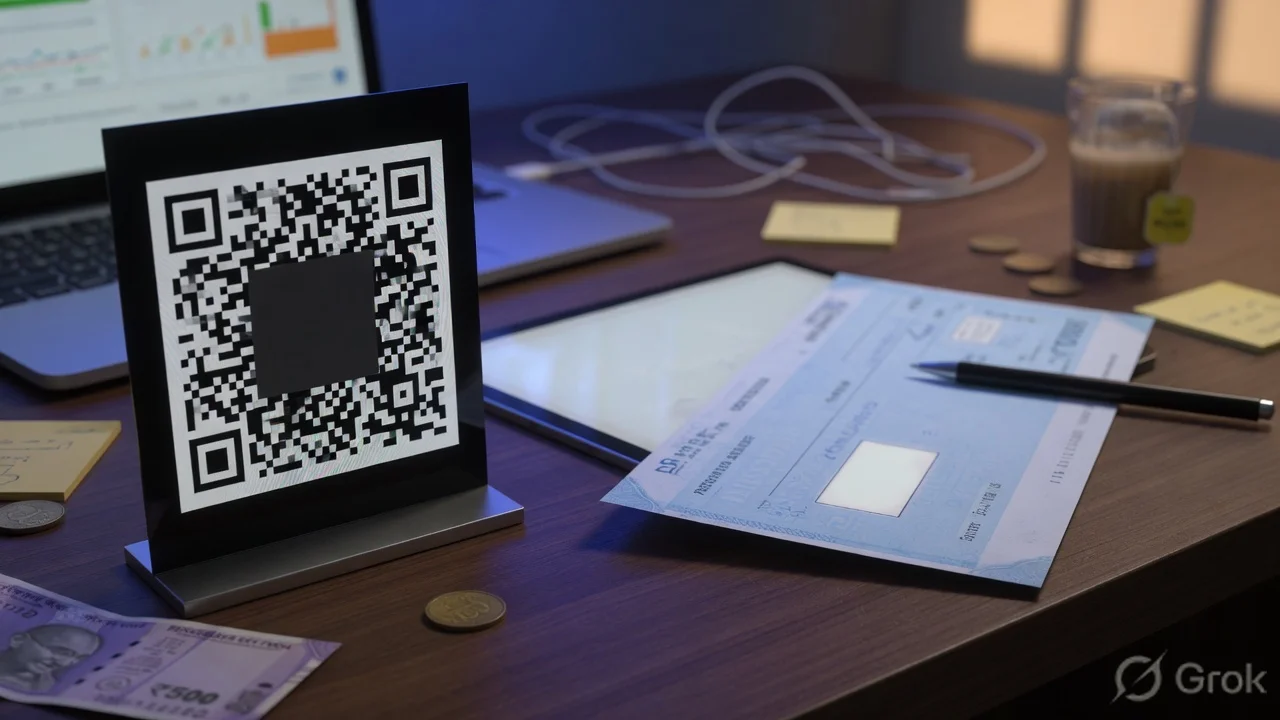
India's digital payments are getting a major upgrade — here's what RBI is planning
India's UPI story is genuinely one of the world's most impressive fintech transformations. From near-zero in 2016 to processing billions of transactions a month, the system changed how an entire country handles money. Now the RBI has released Payments Vision 2028 — a roadmap laying out what the next three years of that story looks like.
The document, titled 'Shaping India's Payment Frontier,' covers a lot of ground. But for regular users — people who use GPay, PhonePe, PayTM, net banking, and occasionally still write cheques — there are specific proposals that will directly affect daily financial life. Here's the breakdown of what actually matters.
E-Cheques — India's oldest payment instrument gets a digital upgrade
Cheques aren't dead. Anyone who has paid rent, made large business payments, or dealt with property transactions knows that paper cheques are still widely used in India despite UPI's dominance. The RBI is now proposing to digitise them.
An e-cheque works like this: instead of writing on paper, filling in the date, amount, and payee name, and physically delivering it — you do all of that digitally. You fill the details online, apply your digital signature, and send it electronically. The receiving bank processes it exactly like a regular cheque, but faster, more securely, and with a complete digital audit trail.
The RBI will also review the design and security features of all existing cheque instruments to standardise them. Currently, banks have added their own security features on top of the CTS-2010 standards (the baseline specifications for cheques in India), creating inconsistency across the banking system. That's getting unified.
For businesses — particularly those in construction, manufacturing, wholesale trade, and real estate, where cheques remain common for high-value transactions — this is a meaningful improvement. E-cheques can't be lost in transit, can't be physically altered, are harder to forge, and process faster than their paper equivalents. The fraud prevention angle is significant: post-dated cheque fraud, signature forgery, and cheque tampering are ongoing problems in India that e-cheques structurally prevent.
Cross-border payments — cheaper and faster for exporters, remitters, and MSMEs
This is the section of the Vision 2028 document that matters most for India's export community and the massive diaspora remittance market. Cross-border transfers from India — and to India from NRIs and overseas workers — remain expensive and slow compared to domestic UPI transfers. The RBI wants to fix that.
The proposed framework aims to streamline the regulatory authorisation process for cross-border payments under both the Payment and Settlement Systems Act and FEMA (Foreign Exchange Management Act). Currently, companies and individuals navigating international transfers deal with multiple regulatory layers — the proposal would create cleaner pathways through what the RBI describes as working toward a unified, more streamlined approach.
Smaller payment system providers will get a more flexible regulatory treatment — a perpetual regulatory sandbox structure for Small Payment System Providers. This is specifically aimed at fintech startups building in the cross-border remittance and international trade payments space, making it easier for innovative companies to operate without the same compliance burden as large banks.
The RBI will also publish dedicated reports on cross-border transaction volumes, costs, speed, and transparency benchmarks — essentially creating public accountability data for how well India's cross-border payment infrastructure is performing. This matters because it creates pressure to actually improve metrics rather than just announce intentions.
For Tamil Nadu specifically, where Gulf remittances from migrant workers in UAE, Saudi Arabia, Qatar, and Kuwait are a significant part of household income for millions of families, cheaper and faster cross-border transfers have very direct financial consequences. Even a 1-2% reduction in transfer fees on a monthly remittance of ₹50,000 saves ₹500-₹1,000 per month — real money that stays in the family.
Switch on/off for all digital payment modes — not just cards
This feature already exists for debit and credit cards. You can log into your bank app and toggle off international card transactions, online transactions, or contactless payments. It's a useful fraud prevention tool — if you're not travelling, why would your card need to work internationally?
The RBI is proposing to extend this same control to all digital payment modes. Not just cards — but UPI, net banking, IMPS, NEFT. You'd be able to disable specific modes from your bank's app or the issuer's portal, and re-enable them when needed.
The practical benefit: if your phone is stolen, you can immediately disable all UPI transactions from the compromised number without waiting for a bank representative. If you notice suspicious activity on one payment channel, you can isolate it without disrupting everything else. It's the kind of granular control that makes digital payments meaningfully safer to use.
TReDS interoperability — this one's for SME business owners
TReDS stands for Trade Receivables Discounting System — a platform that lets small businesses (MSMEs) get paid faster by selling their unpaid invoices to financial institutions at a discount. Currently, the various TReDS platforms in India don't talk to each other — a business registered on one platform can't easily interact with buyers and financiers on another.
The RBI's Vision 2028 proposes a framework for interoperability between these platforms. For a small manufacturer or service provider in Tamil Nadu supplying to a large corporation and waiting 60-90 days to get paid, TReDS interoperability means more financing options, more competitive discounting rates, and easier access to working capital. It directly addresses one of the biggest cash flow problems in Indian SME business.
Shared fraud liability — banks can't just blame the customer anymore
One of the most consumer-friendly proposals in Vision 2028 is the shared responsibility framework for digital payment fraud. Currently, if you're defrauded in a UPI or net banking transaction, getting your money back from the bank is often a drawn-out, frustrating process where the bank's default position is that the customer was negligent.
The proposed shared responsibility framework changes this: both the issuing bank (your bank) and the beneficiary bank (where the money went) would jointly bear liability for fraudulent transactions. This creates real financial incentives for both sides to build better fraud detection rather than just blaming the victim. For millions of Indians who've lost money to online fraud and been told there's nothing the bank can do, this is a fundamental shift in how the system treats them.
Domestic Legal Entity Identifier — better business payment tracking
For individuals, this doesn't directly affect daily life. But for businesses, the proposed Domestic Legal Entity Identifier (DLEI) for non-individual entities — companies, trusts, NGOs — means a unique, verifiable digital identity for every business entity in the payments ecosystem. It improves transparency, reduces fraud in B2B transactions, and makes regulatory oversight more effective. Banks and payment processors can better verify who they're dealing with before processing large transactions.
TamilTech's take
Vision 2028 is a genuinely substantive document rather than aspirational window dressing. The e-cheque proposal addresses a real gap — paper cheques are impractical but still necessary for many use cases, and digitising them properly is overdue. The cross-border payment improvements are the most immediately impactful for a large number of Tamil families receiving remittances from the Gulf. And the shared fraud liability framework, if implemented as described, would materially change the experience of millions of people who have been left without recourse after payment fraud.
The timeline is December 2028 — three years away. Some of these proposals will arrive sooner, some later, and some may be modified or dropped as implementation gets complex. But the direction is clear: India's payment system is moving toward more interoperability, more user control, lower costs, and better fraud protection. That's the right direction.




Comments (0)
Be the first to comment!