


Key Takeaways
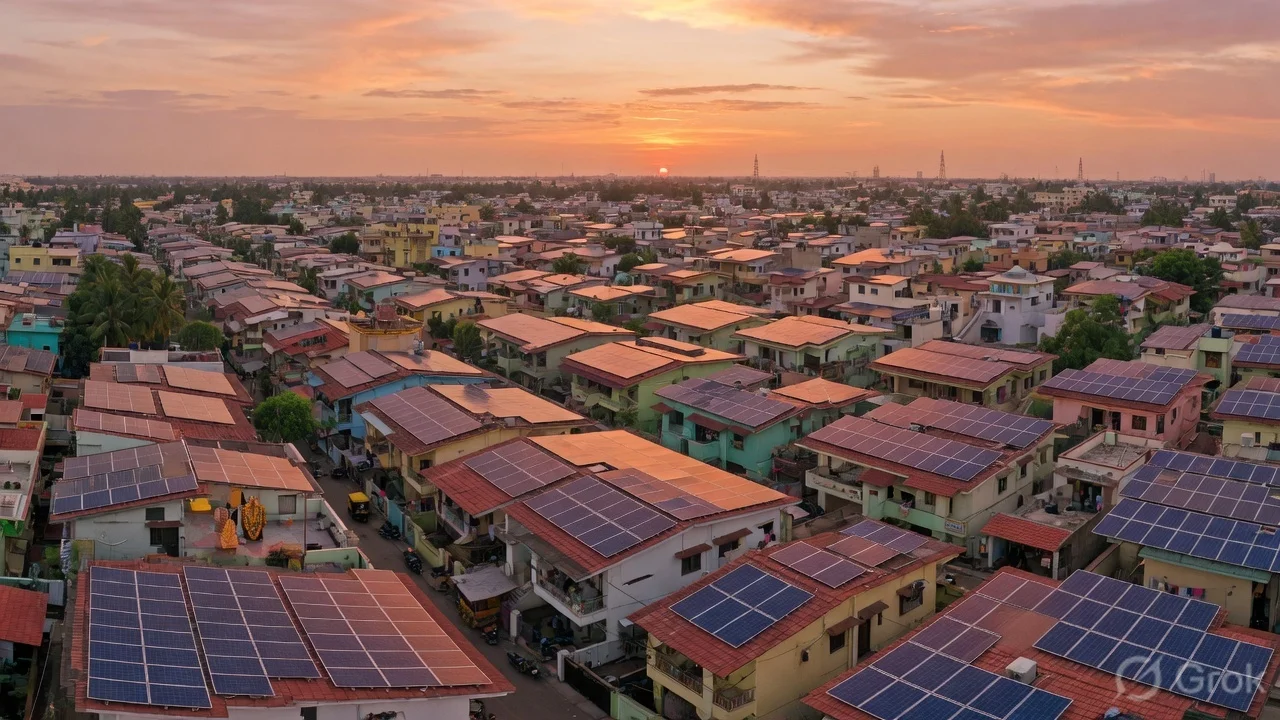
- PM Surya Ghar program has helped India cross 50 lakh rooftop solar installations in just over two years
- Installation pace has tripled since initial launch, showing strong market adoption
- Average household saves ₹1,500-2,000 monthly on electricity bills with rooftop solar
- Government subsidies reduced upfront costs by up to 60% for eligible families
- India's renewable energy targets gaining momentum with rooftop solar contributing 15% of total capacity
What's the News
India's rooftop solar revolution has hit a massive milestone, crossing the 50 lakh (5 million) home installation mark in just over two years. The PM Surya Ghar: Muft Bijli Yojana program has dramatically accelerated adoption, tripling its installation pace since the initial launch. This achievement marks a significant shift in how Indian households approach energy consumption, with solar panels becoming as common as water tanks on terraces.
The program's success comes at a crucial time when India faces both rising electricity demand and increasing environmental concerns. What started as a modest initiative has transformed into one of the fastest-growing renewable energy adoption programs globally, outpacing many developed nations in per-capita rooftop solar installations.
Details
The PM Surya Ghar scheme, launched in early 2024, operates on a simple premise: make solar energy accessible to every Indian household. The program offers substantial subsidies based on income levels, with families earning up to ₹3 lakh annually receiving 60% subsidy on installation costs. Those earning between ₹3-10 lakh get 40% subsidy, while higher-income households receive 20% support.
Installation costs typically range from ₹1.5-3 lakh for a 3kW system, but after subsidies, many families pay as little as ₹60,000-1.2 lakh. The payback period has shortened to 3-4 years in most states, compared to 6-8 years before the subsidy program. Major solar companies like Tata Power Solar, Adani Solar, and Vikram Solar have expanded their installation networks to meet the surge in demand.
State governments have played a crucial role, with Gujarat, Rajasthan, Maharashtra, and Karnataka leading in implementation. These states have streamlined approval processes and provided additional incentives, creating a conducive environment for rapid adoption.
India Impact
This rooftop solar boom is reshaping India's energy landscape in multiple ways. First, it's reducing the burden on the national grid, especially during peak summer months when air conditioning demand surges. Second, it's creating thousands of jobs in installation, maintenance, and manufacturing sectors.
The economic impact is substantial. With over 50 lakh homes now generating their own electricity, India saves approximately ₹30,000 crore annually in reduced transmission losses and peak load management. The program has also spurred domestic manufacturing, with companies like Waaree Energies and Renew Power expanding production capacity to meet demand.
Environmentally, the impact is equally impressive. These installations collectively generate around 15,000 MW of clean energy, reducing carbon emissions by approximately 12 million tonnes annually. This is equivalent to planting 200 million trees or taking 2.5 million cars off the road.
Use Cases
Rooftop solar has found applications across diverse Indian contexts. In urban apartments, shared solar systems are becoming popular in housing societies, allowing residents to collectively benefit from solar power. Rural areas are seeing increased adoption as the program addresses electricity reliability issues in villages.
Small businesses, from kirana stores to textile units, are using solar to reduce operational costs. Agricultural applications are emerging, with farmers using solar for irrigation pumps and cold storage. Even electric vehicle owners are pairing solar installations with home charging stations, creating integrated energy solutions.
The technology has evolved too. Modern systems include smart monitoring apps, battery storage options, and AI-based optimization features. Many installations now integrate with home automation systems, allowing users to monitor and control their energy consumption through smartphones.
Honest Take
While the 50 lakh milestone is impressive, the journey has its challenges. Installation quality varies across states, with some contractors cutting corners to meet demand. The subsidy disbursement process, though improved, still faces delays in some regions. Grid integration remains a technical challenge, especially in areas with high solar penetration.
However, the momentum is undeniable. The program has created a virtuous cycle: as more people adopt solar, costs decrease, awareness increases, and installation quality improves. The private sector is responding with innovative financing options, including solar-as-a-service models where homeowners pay monthly fees instead of upfront costs.
The real test will be sustaining this growth. As the program matures, focus needs to shift from installation numbers to performance optimization, maintenance standards, and grid integration. The next phase should address challenges like battery storage costs, smart grid integration, and ensuring quality across the supply chain.
FAQs
Q: How much can I save with rooftop solar?
A: Most households save ₹1,500-2,000 monthly on electricity bills, with payback periods of 3-4 years after subsidies.
Q: Is my house suitable for rooftop solar?
A: Most houses with unshaded roofs of 20-30 square meters can accommodate a 3kW system. A professional assessment is recommended.
Q: What happens during power cuts?
A: With battery storage, your solar system can provide backup power during outages. Basic systems without batteries don't work during grid failures.
Q: Can I sell excess power back to the grid?
A: Yes, through net metering programs available in most states. You earn credits for excess power fed to the grid.
Q: How long do solar panels last?
A: Quality panels come with 25-year warranties and typically last 30+ years with minimal performance degradation.





Comments (0)
Be the first to comment!