


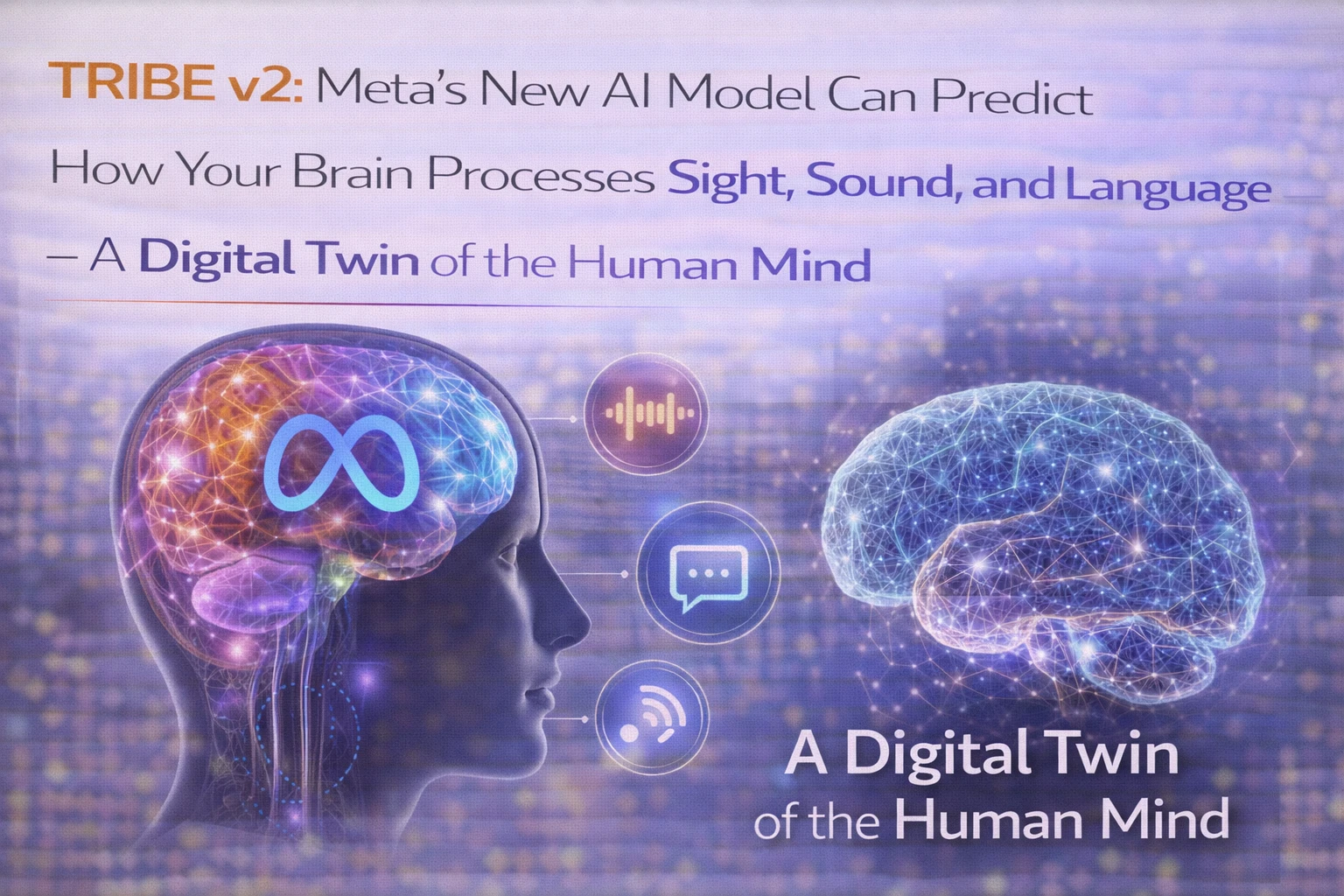
TRIBE v2 — Meta Creates a "Digital Twin" of the Human Brain
Meta's Fundamental AI Research (FAIR) team has released TRIBE v2 (TRansformer for In-silico Brain Experiments, version 2), a groundbreaking tri-modal foundation model that can predict how the human brain responds to what we see, hear, and read. Released on March 26, 2026, this is Meta's first AI model capable of creating computational "digital twins" of human neural activity.
The original TRIBE v1 won the Algonauts 2025 award but was limited — trained on low-resolution fMRI recordings from just 4 individuals. TRIBE v2 is a massive leap forward in scale, resolution, and generalization capability.
What Can TRIBE v2 Actually Do?
TRIBE v2 takes any stimulus — a movie clip, a podcast segment, or a piece of text — and predicts exactly which brain regions will activate and how strongly. Think of it as a simulation of your brain's response to content, without ever needing to put you in an fMRI machine.
Key capabilities:
- Predict brain responses for individuals never scanned — zero-shot generalization to entirely new people
- Generalize to unseen languages and novel task types without retraining
- Create virtual "digital twins" of neural processing at whole-brain resolution
- Enable thousands of virtual experiments — test how the brain might react to specific stimuli without expensive fMRI sessions
A remarkable finding: TRIBE v2's zero-shot predictions are often more accurate at estimating group-averaged brain responses than recordings from individual human subjects. The model's average prediction is closer to the group truth than any single person's brain scan.
Technical Architecture — How It Works
TRIBE v2 uses a three-stage pipeline:
Stage 1: Stimulus Encoding
| Modality | Encoder | Details |
|---|---|---|
| Video | V-JEPA2-Giant (Meta) | 64-frame segments, 4-second bins |
| Audio | Whisper-Large-v3 (OpenAI) | Audio feature extraction |
| Language | Llama 3.1 70B (Meta) | Text understanding |
Stage 2: Cross-Modal Integration
A cross-attention Transformer fuses the three modality streams into a unified neural representation, mimicking how the brain integrates sight, sound, and language simultaneously.
Stage 3: Brain Mapping
Subject-specific linear readouts map the fused representations to individual voxel-level brain predictions — essentially predicting the activity of specific tiny regions across the entire brain surface.
Training Data and Scale
| Metric | TRIBE v1 | TRIBE v2 |
|---|---|---|
| Training Subjects | 4 individuals | 25 subjects |
| Training Hours | Limited | 451.6 hours fMRI data |
| Evaluation Subjects | Small | 720+ subjects |
| Evaluation Hours | Limited | 1,117.7 hours |
| Modalities | Vision only | Vision + Audio + Language |
| Resolution | Low | High (whole-brain voxel-level) |
TRIBE v2 follows a log-linear scaling law: prediction accuracy increases steadily with more fMRI data, with no performance plateau currently visible. As global neuroimaging repositories grow, TRIBE v2 will only get better.
Real-World Applications
- Drug Development — Pharmaceutical companies can simulate how a patient's brain might respond to a new drug without expensive clinical trials
- Mental Health — Predict how individuals with depression, anxiety, or PTSD process emotional stimuli differently
- Brain-Computer Interfaces — Improve BCI systems by understanding brain processing patterns without requiring individual fMRI scans
- Content Optimization — Media companies can predict which content triggers the strongest neural engagement
- Education — Understand how different people process learning materials differently
- Neurological Disorders — Identify where neural signaling might break down in conditions like dyslexia, aphasia, or Alzheimer's
Impact on Indian Research
India has a growing neuroscience community with strong programs at IIT Bombay, IISc Bangalore, NIMHANS, NBRC (National Brain Research Centre), and AIIMS. TRIBE v2 could be transformative for Indian neuroscience:
- Cost reduction — fMRI scans cost ₹15,000-₹30,000 per session in India. Virtual experiments could save crores in research budgets
- Accessibility — Smaller institutions without fMRI machines can still conduct brain research using TRIBE v2 predictions
- Multilingual brain research — TRIBE v2 generalizes to unseen languages, enabling research on how Tamil, Hindi, and other Indian languages are processed in the brain
- Clinical applications — India's massive population with neurological disorders could benefit from cheaper, faster diagnostic tools
Limitations and Ethical Considerations
- Privacy — A model that can predict brain responses raises questions about mental privacy and neuroethics
- Accuracy ceiling — While impressive, predictions are still averages. Individual brain responses are complex and partially unpredictable
- Data bias — Training on 25 subjects may not capture the full diversity of human neural processing
- Misuse potential — Predicting brain responses to content could be used for manipulative advertising or propaganda
TRIBE v2 represents a fundamental advance in computational neuroscience. The ability to create "digital twins" of brain activity — without requiring physical brain scans — opens a new era of virtual neuroscience experiments. For India's research community, this could democratize brain research in ways that were previously impossible.





Comments (0)
Be the first to comment!