


Key Takeaways
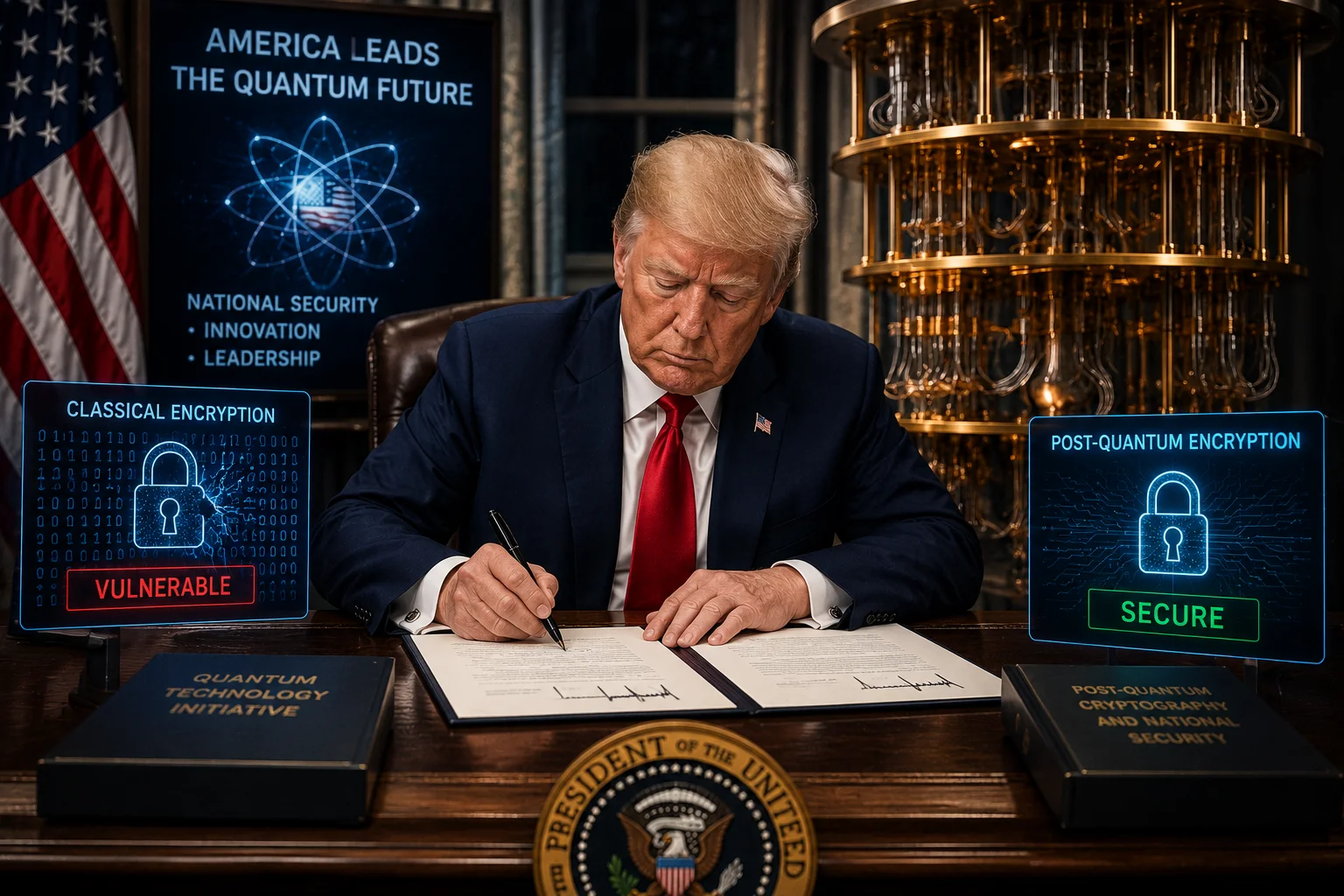
- President Trump signed two executive orders on June 23, 2026, targeting both the rapid development of quantum hardware and the immediate migration to quantum-resistant encryption.
- The orders mandate federal agencies to transition to Post-Quantum Cryptography (PQC) by 2035 to prevent 'Harvest Now, Decrypt Later' attacks.
- A new National Quantum Initiative Advisory Committee has been established to ensure the US maintains a lead over global competitors in qubit stability and error correction.
- For India, this marks a critical signal for the National Quantum Mission to fast-track PQC implementation across UPI and banking infrastructures to maintain global compatibility.
- TamilTech Verdict: This isn't just about faster PCs; it's a fundamental shift in how global data is protected, and businesses must start auditing their encryption today.
The Quantum Race Just Hit Overdrive
Imagine a computer so powerful that it could crack your banking password, your private WhatsApp chats, and even government top-secret files in a matter of seconds. For years, this was the stuff of science fiction, but as of 2026, we are standing on the precipice of what experts call 'Q-Day'—the day a quantum computer becomes powerful enough to break traditional encryption. Recognizing this massive shift, President Trump has just signed two major executive orders that aim to put the US at the forefront of this revolution while simultaneously building a digital fortress against it. This is a massive move that will ripple through the tech industry, affecting everything from how Google builds its servers to how you secure your smartphone in India.
The first order is all about speed and innovation. It’s designed to pump resources into the National Quantum Initiative, ensuring that the best minds in the country have the funding and hardware they need. The second order, however, is the one that should make every IT professional sit up and take notice. It focuses on 'Quantum-Resistant Cryptography' or Post-Quantum Cryptography (PQC). The goal is simple but terrifyingly urgent: we need to replace our current security systems before a functional quantum computer can be used by bad actors to wipe out digital privacy. This isn't just a policy change; it's a survival strategy for the digital age.
How We Got Here: From Qubits to Reality
To understand why these executive orders are a big deal in 2026, we have to look at the progress made over the last two years. Back in 2024 and 2025, quantum computers were mostly experimental toys with high error rates. But recently, companies like IBM, Google, and IonQ have achieved massive breakthroughs in logical qubits—the kind that don't make mistakes every millisecond. We are no longer talking about 'if' quantum computers will work, but 'when' they will scale. This rapid advancement has created a paradox: the very technology that could cure cancer or solve climate change also has the power to destroy the foundation of the internet—encryption.
The threat isn't just in the future; it's happening now through a strategy called 'Harvest Now, Decrypt Later.' State-sponsored hackers are currently stealing and storing massive amounts of encrypted data. They can't read it today, but they are betting that in five or ten years, they will have a quantum computer that can unlock it all. This means your current data is already at risk. The White House's move to mandate PQC migration is a direct response to this 'store-now-crack-later' threat. It’s about making sure that when the quantum monster finally wakes up, the data it has stolen is already useless because it was encrypted with quantum-proof keys.
The Details: Innovation vs. Mitigation
The first executive order focuses on the National Quantum Initiative Advisory Committee. This group will now report directly to the President, cutting through the usual bureaucratic red tape. Their mission is to ensure that quantum research isn't just happening in silos. They want to bridge the gap between university labs and commercial products. Think of it like the Manhattan Project for the 21st century. The focus is on 'Qubit Scaling'—moving from hundreds of qubits to tens of thousands. This is where the real magic happens, allowing for simulations of complex molecules that could revolutionize the EV battery industry and pharmaceutical research.
The second order is the 'Shield.' It instructs NIST (National Institute of Standards and Technology) to finalize and push out the standards for quantum-resistant algorithms. Every federal agency has been given a strict timeline to audit their systems and start the migration. But it’s not just for the government. The order encourages the private sector—banks, healthcare providers, and tech giants—to follow suit. If you are running a business in 2026 that handles sensitive customer data, these orders are your roadmap. If you don't start moving to PQC now, you are essentially leaving your vault door wide open for the future.
The India Impact: UPI, Banking, and Beyond
Now, why should we in India care about what’s happening in the White House? The answer is simple: the global financial system is interconnected. India’s digital backbone—the UPI (Unified Payments Interface)—and our massive banking sector rely on the same RSA and ECC encryption standards that the US is now moving away from. If the US shifts to new quantum-resistant standards, Indian banks like SBI, HDFC, and ICICI will have to adapt to maintain secure international transactions. We cannot afford to be the 'weak link' in the global security chain.
Furthermore, India has its own National Quantum Mission (NQM) with a budget of over ₹6,000 crore. These US executive orders will likely act as a catalyst for the Indian government to accelerate our own PQC standards. We have a massive pool of developers and mathematicians who are already working on these algorithms. For the Indian techie, this is a golden opportunity. There will be a huge demand for 'Quantum Security Auditors' and developers who can implement these new protocols. If you're looking for a career pivot in 2026, this is where the money and the impact are going to be.
Step-by-Step: How to Prepare for the Quantum Era
You might be wondering, "What can I do as a regular user or a small business owner?" While you can't build a quantum-proof server in your backyard, you can follow these steps to stay ahead of the curve. First, perform a 'Data Audit.' Identify what data you have that would still be sensitive 10 years from now. This is the data that is most at risk from 'Harvest Now, Decrypt Later' attacks. Second, keep your software updated. Major players like Apple and Google are already rolling out PQC-lite features in iMessage and Chrome. By simply staying on the latest versions, you are already getting better protection.
Third, if you are a developer, start experimenting with NIST-approved PQC algorithms like Kyber or Dilithium. There are plenty of open-source libraries available now in 2026. Don't wait for a mandate from the RBI or the government; start building 'Quantum Agility' into your apps today. This means designing your systems so that you can easily swap out encryption algorithms without rewriting the entire codebase. It’s better to be a year too early than a day too late when it comes to the security of your users.
TamilTech’s Honest Take: A Necessary Wake-Up Call
At TamilTech, we’ve been tracking quantum developments for years, and honestly, this is the most significant move we’ve seen yet. Some might argue that 2035 is a long way off for a full migration, but in the world of legacy banking and government systems, ten years is like ten minutes. The transition is going to be painful, expensive, and technically challenging. We expect to see some 'quantum-washing' where companies claim to be 'quantum-secure' just for marketing, so you need to be careful and look for actual NIST-standard implementations.
What we expect next is a surge in 'Quantum-as-a-Service' (QaaS) from companies like Microsoft Azure and AWS, making this tech accessible to smaller players. We also anticipate that the Indian government will soon issue similar guidelines for our critical infrastructure. The bottom line is this: The age of classical encryption is ending. It’s been a good run, but the quantum era is here, and it’s time to upgrade our digital locks. Stay tuned to TamilTech, and we’ll keep you updated on every qubit and code change along the way!




Comments (0)
Be the first to comment!